
All grade guides — one page, every alloy we cover
Browsing for a grade? The full library of per-grade technical guides is on one list.
Open the listMonel 400 is the nickel-copper alloy that the chemical and marine industries reach for when stainless steel has already failed: roughly two-thirds nickel, one-third copper, no chromium at all, and still the reference material for hydrofluoric acid alkylation, flowing seawater and hot caustic. It is a solid-solution alloy — there is no ageing treatment and no brittle phase to worry about — which is why it stays ductile from cryogenic temperature to about 480 °C. This guide collects the composition, the mechanical minima per product form, the physical data and the selection rules we use when quoting 400 plate, bar, tube and forgings.
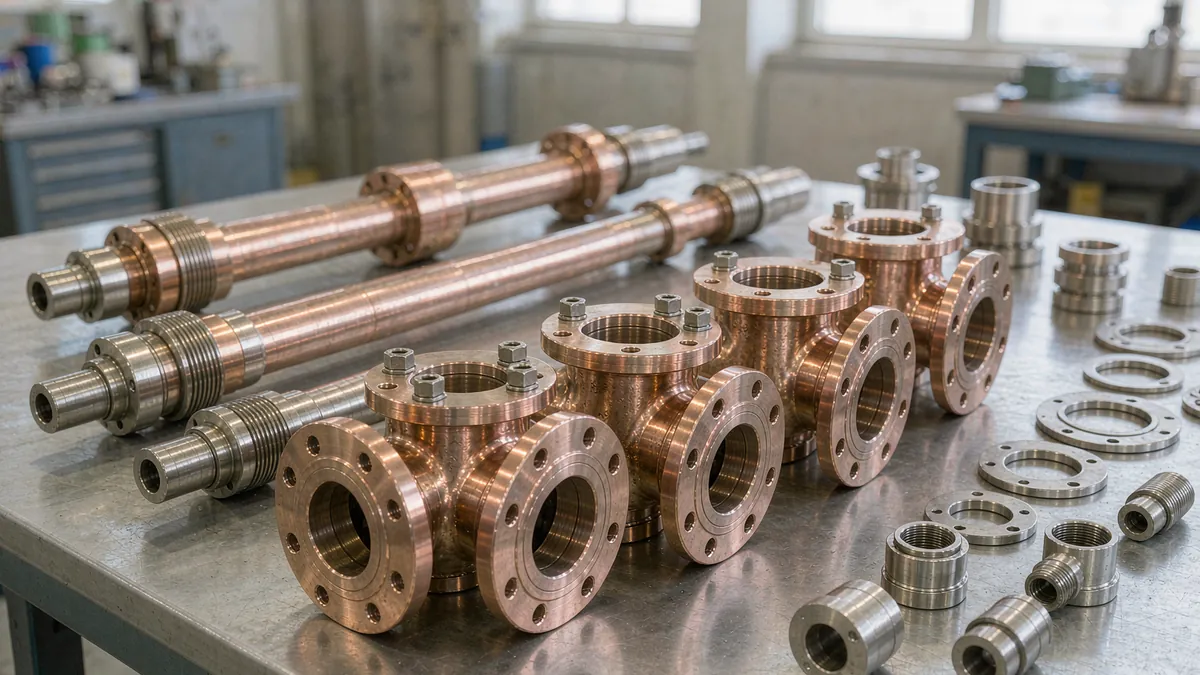
Monel 400 (UNS N04400, W.Nr 2.4360, AFNOR NiCu30Fe) is a binary nickel-copper alloy with 63 % minimum nickel (including cobalt) and 28–34 % copper, balanced by up to 2.5 % iron and 2.0 % manganese. There is no chromium and no molybdenum — which is exactly the point. Chromium brings oxidation resistance but it also makes an alloy vulnerable to attack in reducing acids; Monel 400 deliberately gives that up in exchange for outstanding performance in reducing media: hydrofluoric acid at every concentration up to boiling, sulphuric acid in the absence of air, hydrochloric acid at low concentration and ambient temperature, and caustic soda at any concentration.
Because it is a single-phase solid-solution alloy, 400 cannot be strengthened by heat treatment. Strength comes from cold work or from grain-size control, and the annealed condition is soft enough to deep-draw, expand into tubesheets and machine into complex valve bodies. The copper addition also gives the alloy something stainless steels never have: it is thermodynamically noble in seawater, so it resists biofouling and does not pit in flowing seawater the way 316L does.
Two relatives are worth knowing before you order. Monel R-405 (UNS N04405) is the same alloy with added sulphur for free machining — same corrosion resistance, screw-machine stock only. Monel K-500 (UNS N05500) adds aluminium and titanium so the alloy can be age hardened to roughly three times the yield strength; the trade-off is that K-500 loses the HF-acid capability and becomes sensitive to hydrogen.
Composition limits per ASTM B127 / B164 / B165 (identical chemistry across all three product-form standards):
| Element | Content (wt %) | Role in the alloy |
|---|---|---|
| Nickel + Cobalt (Ni+Co) | 63.0 min | The matrix. Sets the noble potential in seawater, gives immunity to chloride stress-corrosion cracking, and provides the alkali resistance. Typical heats run 65–67 %. |
| Copper (Cu) | 28.0–34.0 | The defining addition. Creates the Ni-Cu couple that resists hydrofluoric acid and reduces biofouling; also lowers the Curie temperature to near ambient. Typical 30–32 %. |
| Iron (Fe) | 2.5 max | Improves hot workability and gives a modest strength increase. Excessive iron (above spec) degrades seawater performance — one reason to check the certificate rather than the grade name. |
| Manganese (Mn) | 2.0 max | Deoxidation and sulphur control during melting. |
| Carbon (C) | 0.30 max | Kept low so that carbon does not precipitate at grain boundaries in the weld HAZ. Premium corrosion-critical heats are ordered to 0.05 % max. |
| Silicon (Si) | 0.50 max | Deoxidation; also improves fluidity in casting. |
| Sulphur (S) | 0.024 max | Residual tramp element. Deliberately raised to ~0.04 % in the free-machining R-405 variant. |
There is no chromium in Monel 400 — so do not expect it to survive oxidising conditions. Any medium that is aerated, or that contains ferric or cupric ions, will attack 400 far faster than a chromium-bearing alloy would.
Monel 400 is ordered in one of two families of condition: annealed (the default, maximum corrosion resistance and ductility) or cold worked (higher strength, lower elongation). The minima below are the ASTM acceptance values; the bracketed figures are the ranges normally seen on mill certificates.
| Form / condition | Standard | Yield 0.2 % | Tensile | Elongation | Hardness |
|---|---|---|---|---|---|
| Plate, sheet, strip — hot-rolled, annealed | B127 | ≥ 195 MPa | ≥ 485 MPa | ≥ 35 % | 110–150 HB |
| Bar and rod — hot-worked, annealed | B164 | ≥ 170 MPa | ≥ 480 MPa | ≥ 35 % | 60–80 HRB |
| Seamless pipe and tube — annealed | B165 | ≥ 193 MPa | ≥ 483 MPa | ≥ 35 % | — |
| Typical annealed mill spread | — | 170–345 MPa | 480–620 MPa | 35–50 % | — |
| Bar — cold-drawn, rounds under 12.7 mm | B164 | ≥ 585 MPa | ≥ 760 MPa | ≥ 8 % | — |
| Plate — cold-rolled, hard temper | B127 | ≥ 620 MPa | ≥ 690 MPa | ≥ 2 % | — |
Read the last two rows carefully: the hard tempers buy roughly three times the annealed yield and give away almost all of the ductility. Parts should therefore be formed and welded in the annealed condition and only then given their final cold pass. Cold working raises strength quickly — a 37 % reduction takes yield to roughly 515–585 MPa with 15–20 % elongation; spring wire at 60 % reduction reaches 655–725 MPa yield with 8–12 % elongation.
At temperature: 400 holds its strength unusually well for a solid-solution alloy. At 425 °C typical values are still about 450 MPa tensile / 170 MPa yield with 50 % elongation, and the alloy has no ductile-to-brittle transition, so it is used down to liquid-hydrogen temperature in cryogenic service.
| Property | Value | Comment |
|---|---|---|
| Density | 8.80 g/cm³ | About 11 % heavier than 304/316 — matters for weight-critical marine hardware |
| Melting range | 1,300–1,350 °C | Solidus 1,300 °C, liquidus 1,350 °C |
| Thermal conductivity (20 °C) | ≈ 21.8 W/m·K | Roughly 1.4× that of 316L — an advantage in heat-exchanger and pump-shaft duty |
| Specific heat (20 °C) | ≈ 427 J/kg·K | |
| Mean expansion (20–100 °C) | ≈ 13.9 ×10⁻⁶ /K | Close to carbon steel — helpful when 400 is tubed into steel shells |
| Electrical resistivity | ≈ 0.547 µΩ·m | Used for resistor and thermocouple-adjacent components |
| Modulus of elasticity | ≈ 179 GPa | Lower than steel (206 GPa) — allow for extra deflection in shaft design |
| Poisson's ratio | ≈ 0.32 | |
| Magnetic behaviour | Weakly ferromagnetic at room temperature | Curie point sits around 20–50 °C depending on the Ni/Cu balance; permeability stays close to 1.00x, so a magnet is not a reliable grade check |
The magnetic point trips people up regularly. Monel 400 is often described as "non-magnetic", and above about 50 °C it effectively is — but a cold workshop and a slightly nickel-rich heat will both produce a weak pull. If non-magnetic behaviour is a design requirement (instrument housings, sensor bodies), specify it as a tested property with a maximum permeability, and use K-500 or a fully austenitic grade if the margin is tight.
Monel 400 is not a general-purpose corrosion alloy; it is a specialist for reducing media. Judged on that basis it has no economical substitute.
Selection rule: Monel 400 is the answer when the medium is reducing — HF, de-aerated sulphuric or hydrochloric acid, hot caustic — or when it is clean flowing seawater at moderate velocity. If the medium is oxidising, aerated, or heavily chlorinated, 400 is the wrong alloy regardless of how good its reputation is; move to 625, C-276 or a high-chromium stainless.
One more practical limit worth quoting to customers: 400 is not specified for sour oil and gas service on the strength of its corrosion resistance alone. It appears in NACE MR0175 / ISO 15156 for specific environments and hardness limits, and every sour application has to be checked against the current edition rather than assumed.
| Industry | Typical Monel 400 components | Why 400 |
|---|---|---|
| Marine and shipbuilding | Propeller shafts and shaft liners, seawater pump shafts and impellers, rudder bearings, valve stems, hull sheathing, heat-exchanger tubing | Resists flowing seawater, cavitation and biofouling; no chloride SCC |
| Oil refining — HF alkylation | Reactor and settler internals, acid coolers, relief lines, valves, pump casings, fractionator trays | The only economic material for hydrofluoric acid service |
| Chemical processing | Caustic evaporator tubes and vessels, chlorinated-solvent equipment, sulphuric acid handling in de-aerated duty, salt and brine systems | Reducing-acid and alkali resistance without chromium |
| Desalination and power | MSF/MED evaporator tubing, brine heaters, boiler feedwater heater tubing, condenser tube plates | Seawater-side resistance with good thermal conductivity |
| Oil and gas | Crude distillation tower internals, sour-service valve trim, instrumentation tubing, umbilical components | Chloride SCC immunity where 316L cracks |
| Food, salt and general | Salt-handling equipment, brine pumps, musical instrument bodies, electronic and resistor components | Food-safe, resistant to neutral salts, stable resistivity |
| Product form | Standard | Notes |
|---|---|---|
| Plate, sheet, strip | ASTM B127 / ASME SB127 | Annealed, or cold-rolled to a hard temper on request |
| Bar, rod, wire | ASTM B164 / ASME SB164 | Hot-worked annealed or cold-drawn; R-405 free-machining available to B164 chemistry with raised S |
| Seamless pipe and tube | ASTM B165 / ASME SB165 | Annealed or stress-relieved |
| Condenser and heat-exchanger tube | ASTM B163 / ASME SB163 | Integral finning and U-bending available |
| Forgings, flanges, fittings | ASTM B564, B366 | Supplied to drawing with EN 10204 3.1 certificates |
| European designations | W.Nr 2.4360 · NiCu30Fe · DIN 17743 / 17750 / 17752 / 17754 | Useful when the customer's drawing is DIN-based |
| Sour service | NACE MR0175 / ISO 15156 | Hardness and environment limits apply — confirm per project |
| Filler metal | ERNiCu-7 (AWS A5.14), ENiCu-7 (AWS A5.11) | Same filler for 400-to-400 and 400-to-steel joints |
Anneal at 870–980 °C and cool rapidly — water quench where maximum corrosion resistance is needed. Grain growth is fast in this alloy, so stay at the low end of the range and keep the soak short if strength matters. Stress relief, when required after heavy machining or cold forming, is done at 540–570 °C; a low-temperature "stress equalising" treatment near 300 °C raises proof stress on cold-worked material without touching the other properties.
400 work-hardens at a rate between low-carbon steel and 304 stainless, so deep-drawn parts usually need an intermediate anneal at 704–871 °C. In the machine shop the alloy is gummy and work-hardens under the tool: use sharp positive-rake carbide, take deep cuts, never let the tool dwell, and keep coolant flowing. Sulphur-chlorinated cutting oils must be removed completely before any subsequent heat treatment.
GTAW, GMAW, SMAW and SAW all work well with ERNiCu-7 / ENiCu-7 filler. No preheat and no post-weld heat treatment are required for service up to about 480 °C. The critical rule is cleanliness: the weld pool must not pick up sulphur, lead, zinc or phosphorus, so grind the joint area clean, use dedicated stainless brushes, and keep the argon cover until the pool has frozen. For any joint that will see HF acid, a full penetration weld with argon backing is strongly preferred over a partial-penetration design.
We supply Monel 400 plate, bar, seamless tube, condenser tube and forgings from stock and to order, with EN 10204 3.1 certificates and PMI before packing. Typical lead time is 7–15 days for stock sizes and 30–45 days for forged or machined-to-drawing parts.
Only weakly. Monel 400 is ferromagnetic below a Curie point that sits around 20–50 °C depending on the exact nickel-copper balance, and permeability stays close to 1.00x. A faint magnet pull at room temperature is normal and is not evidence of a wrong grade — if non-magnetic behaviour matters, specify it as a tested maximum permeability.
316L pits and suffers crevice attack in seawater above about 30–40 °C and cracks under chloride stress. Monel 400 resists flowing seawater, cavitation and biofouling, and is immune to chloride SCC — that is why it is the traditional propeller-shaft material. For stagnant seawater under deposits, or for very high chloride and chlorinated duty, super duplex or 625 is the better choice.
No. Nitric acid is strongly oxidising and attacks Monel 400 rapidly. Use a chromium-bearing grade instead — 304L/310S for dilute nitric, or C-276 for mixed oxidising/reducing acid duty.
R-405 (UNS N04405) is the same nickel-copper alloy with sulphur raised to about 0.04 % so it machines freely on automatic screw machines. Corrosion resistance and physical properties are essentially unchanged, but weldability is poor and it should only be used for screw-machine parts, never as a substitute in a welded corrosion assembly.
About 480 °C in air, limited by oxidation rather than by strength. Above roughly 370 °C sulphur-bearing gases attack the alloy, and molten sulphur attacks it above about 260 °C. In sulphur-free reducing environments it can go higher, but the mechanical values at temperature must be taken from the mill data for the specific heat.
Send us your drawing or specification for a quotation — we reply within one business day.
Buy this grade as: Plate · Round bar · Seamless tube · Elbows · Reducers · Flanges · Fasteners · Welding wire

Browsing for a grade? The full library of per-grade technical guides is on one list.
Open the list
Which family fits which corrosion or temperature problem — and the selection rules that keep you out of trouble.
Read article
Traceability, honest heats, the documents to demand — and the red flags to walk away from.
Read article