
All grade guides — one page, every alloy we cover
Browsing for a grade? The full library of per-grade technical guides is on one list.
Open the listMonel K-500 is Monel 400 with a precipitation-hardening trick: 2.3–3.15 % aluminium and 0.35–0.85 % titanium are added so that a controlled age at about 595 °C precipitates sub-microscopic Ni₃(Al,Ti) particles throughout the nickel-copper matrix. The result keeps the seawater and alkali resistance of 400 while lifting yield strength from roughly 195 MPa to 620–690 MPa — enough to make propeller shafts, pump shafts, non-magnetic drill collars and subsea fasteners out of a nickel-copper alloy. This guide covers the ageing cycle, the property tables by condition, and the two places where K-500 must not be used.
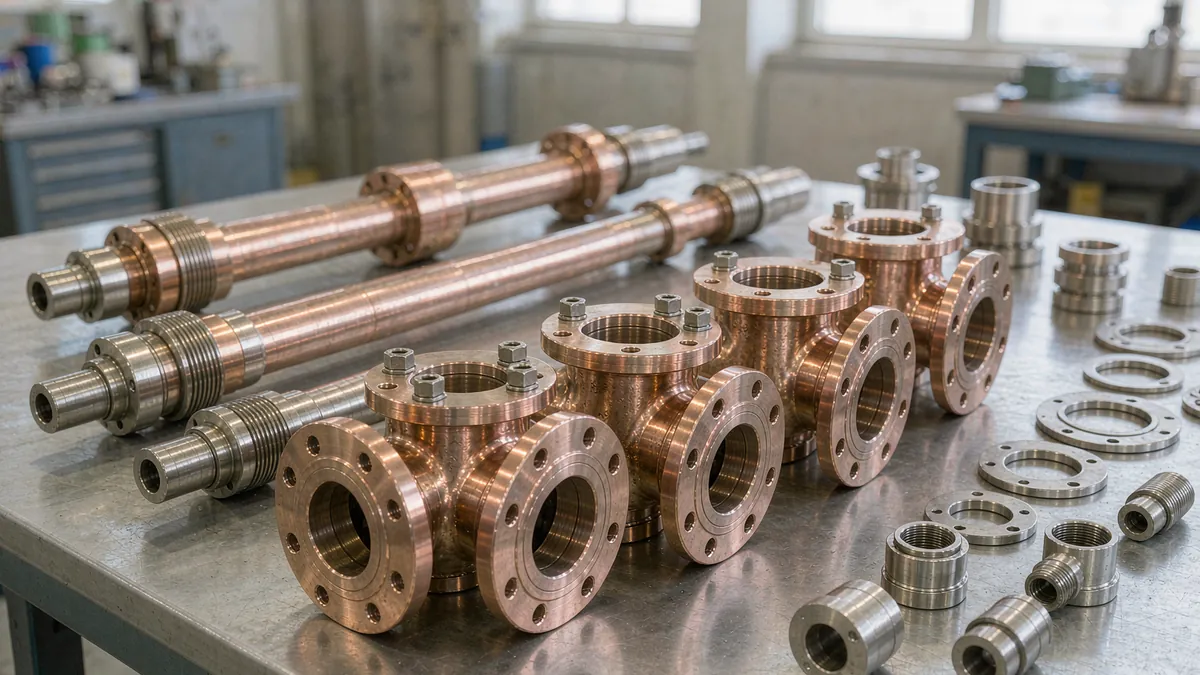
Monel K-500 (UNS N05500, W.Nr 2.4375) is the age-hardenable member of the nickel-copper family. The base is the same roughly 65/30 nickel-copper matrix as Monel 400; the difference is a deliberate addition of aluminium and titanium (2.3–3.15 % Al, 0.35–0.85 % Ti) which, after a solution anneal and a controlled ageing treatment, precipitates Ni₃(Al,Ti) gamma-prime particles throughout the matrix. That precipitation reaction is what turns a 195 MPa-yield corrosion alloy into a 690 MPa-yield structural alloy — while the corrosion behaviour in seawater, brine, caustic and most reducing acids stays essentially that of Monel 400.
The commercial consequence is easy to state: wherever a Monel 400 part is failing mechanically rather than chemically — a pump shaft that twists, a propeller shaft that is too slender, a valve stem that wears, a fastener that stretches — K-500 is the direct upgrade, at roughly 85 % of the density and three times the yield strength. It is also non-magnetic at room temperature and keeps its properties to about 480 °C, which is why it is the standard material for non-magnetic drill collars and measurement-while-drilling housings.
Two limitations have to be stated up front, because both cause field failures. K-500 is not a hydrofluoric-acid alloy — the aluminium addition degrades HF performance, so HF alkylation stays with Monel 400. And K-500 is susceptible to hydrogen embrittlement: it should not be coupled to sacrificial anodes or used under cathodic protection without engineering review, and it is not a general sour-service material.
Composition limits per ASTM B865:
| Element | Content (wt %) | Role in the alloy |
|---|---|---|
| Nickel (Ni) | 63.0–70.0 | Matrix; provides chloride-SCC immunity and the noble potential in seawater |
| Copper (Cu) | 27.0–33.0 | Seawater and reducing-acid resistance; the Ni-Cu couple is the whole point of the family |
| Aluminium (Al) | 2.30–3.15 | Principal gamma-prime former — this is the alloy's strengthening element and also the reason it cannot be used in HF acid |
| Titanium (Ti) | 0.35–0.85 | Partners aluminium in Ni₃(Al,Ti); controls the ageing response and the peak hardness |
| Iron (Fe) | 2.0 max | Processing control; kept lower than in 400 because excess iron disturbs the ageing response |
| Manganese (Mn) | 1.5 max | Deoxidation and sulphur control |
| Carbon (C) | 0.25 max | Restricted to limit grain-boundary carbides in the aged condition |
| Silicon (Si) | 0.50 max | Deoxidation |
| Sulphur (S) | 0.010 max | Tightly restricted — sulphur harms both ductility and weldability in an aged alloy |
K-500 is a narrow-window alloy: the Al and Ti ranges are only about 0.85 and 0.5 percentage points wide, and both the ageing response and the corrosion resistance depend on staying inside them. A heat at the bottom of the Al range will not reach the specified hardness; a heat at the top loses ductility. Always read the chemistry, not just the grade stamp.
K-500 properties are meaningless without the condition, so the heat treatment belongs in the purchase specification.
Two practical consequences follow. First, the part contracts slightly during ageing — typically a few hundredths of a percent — and the effect is predictable but not zero. The standard shop practice is to rough machine with an allowance, age, then finish to final tolerance. Second, never weld in the aged condition: the aged microstructure cracks in the heat-affected zone. Weld in the solution-annealed condition and re-run solution anneal plus age afterwards.
ASTM B865 minima by condition and section size, with typical mill-certificate values alongside:
| Condition / section | Yield 0.2 % | Tensile | Elongation | Hardness |
|---|---|---|---|---|
| Solution annealed (pre-ageing) | ≈ 240–380 MPa | ≈ 620–760 MPa | 45–55 % | ≤ 30 HRC |
| Annealed + aged, rounds ≤ 25.4 mm | ≥ 620 MPa | ≥ 895 MPa | ≥ 20 % | 24–35 HRC |
| Annealed + aged, rounds > 25.4 mm | ≥ 585 MPa | ≥ 895 MPa | ≥ 20 % | 24–32 HRC |
| Hot-worked + aged, all sizes | ≥ 690 MPa | ≥ 965 MPa | ≥ 20 % | 27–38 HRC |
| Cold-worked + aged, 6.4–25.4 mm | ≥ 760 MPa | ≥ 1,000 MPa | ≥ 15 % | 25–41 HRC |
| Typical aged production spread | 620–860 MPa | 965–1,170 MPa | 15–30 % | — |
For comparison, annealed Monel 400 sits at 170–345 MPa yield and 480–620 MPa tensile. The upgrade is therefore roughly a factor of three in yield — but only in the correctly aged condition, and only after the section-size adjustment above is applied. A certificate that quotes 965 MPa tensile without stating the condition and the section is not a usable certificate.
Temperature: K-500 keeps useful strength to about 480 °C. Above that the strengthening precipitates overage and coarsen, and strength falls away; the alloy is not a substitute for a gamma-prime nickel superalloy such as 718 or X-750 above 550 °C. At cryogenic temperature it remains tough and non-magnetic.
| Property | Value | Comment |
|---|---|---|
| Density | 8.44 g/cm³ | About 4 % lighter than Monel 400 — a real gain on rotating shafts |
| Melting range | 1,315–1,350 °C | Some mill data sheets quote 1,300–1,350 °C; either way the ageing temperature sits far below the solidus |
| Thermal conductivity (20 °C) | ≈ 17.2 W/m·K | Lower than 400 (21.8) because of the aluminium and titanium in solution |
| Specific heat (20 °C) | ≈ 419 J/kg·K | |
| Mean expansion (20–100 °C) | ≈ 13.7 ×10⁻⁶ /K | Very close to 400 and to carbon steel |
| Electrical resistivity | ≈ 0.615 µΩ·m | Higher than 400, as expected for a precipitation-hardened alloy |
| Modulus of elasticity | ≈ 179 GPa | Unchanged by ageing — stiffness does not improve, only strength |
| Magnetic behaviour | Non-magnetic at room temperature | Curie point lies well below ambient (reported between about −210 and −90 °C depending on heat and source) |
That last row is the reason K-500 exists in the oilfield. Non-magnetic drill collars, MWD/LWD housings and instrument barrels are made from K-500 because the permeability stays near 1.00x while the yield strength is high enough to carry the bending loads of a directional well — a combination that 400 cannot deliver and that austenitic stainless cannot match on strength.
In most environments K-500 behaves like Monel 400: excellent in flowing seawater, brine, neutral salts and caustic alkalis, and resistant to chloride stress-corrosion cracking. In marine fasteners and pump trim it consistently outperforms 316 and even duplex stainless in seawater because it does not pit and does not suffer crevice attack under marine growth to the same degree.
Where it differs from 400 is at the edges of the envelope, and this is where specification mistakes happen:
Selection rule: choose K-500 when you need Monel 400's seawater and alkali resistance plus at least 600 MPa yield — shafts, fasteners, impellers, non-magnetic collars. Do not choose it for hydrofluoric acid, for sour service, or for any component that will sit under cathodic protection. In those three cases the answer is Monel 400 (HF), or a qualified corrosion-resistant alloy with documented sour-service approval.
| Industry | Typical K-500 components | Why K-500 |
|---|---|---|
| Marine and shipbuilding | Propeller shafts, pump shafts, impellers, rudder stock, valve stems and trim, deck fasteners, mooring chain and fittings | Seawater resistance with three times the yield of 400, so shafts can be slimmer |
| Oil and gas — drilling | Non-magnetic drill collars, MWD/LWD housings, instrument barrels, stabiliser parts | Non-magnetic plus high strength; the standard material for measurement-while-drilling |
| Oil and gas — subsea | Subsea valve stems, actuator parts, bolting, choke trim (non-sour duty) | Strength and seawater resistance in one alloy — subject to the cathodic-protection caveat above |
| Chemical and petrochemical | Pump shafts and sleeves, valve stems, compressor and fan components, caustic and brine pump internals | Corrosion resistance of 400 where 400 would wear or deflect |
| Pulp and paper | Doctor blades, scraper blades, suction-roll components, refiner parts | Hardness plus resistance to white liquor and chloride |
| Aerospace and instrumentation | Springs, fasteners, sensor and instrument bodies, non-magnetic housings | Non-magnetic, stable modulus, good fatigue behaviour to about 480 °C |
| Product form | Standard | Notes |
|---|---|---|
| Bar, rod, wire, forging stock | ASTM B865 / ASME SB865 | The core K-500 product standard — covers both annealed and aged conditions |
| Aerospace bar and forgings | AMS 4676 | Requires the full solution-anneal + age cycle with certified response |
| Plate and sheet | Ordered to B865 chemistry and mechanicals | K-500 plate is mill-rolled to order rather than stocked; confirm availability early |
| Forgings, flanges, rings | To drawing, B865 / AMS 4676 | Supplied with EN 10204 3.1 certificates and hardness survey |
| European designations | W.Nr 2.4375 · DIN 17743 / 17752 / 17754 | |
| Military / legacy | QQ-N-286 | Still called up on older naval drawings |
| Filler metal | ERNiCu-7 / ENiCu-7 (for the annealed-condition joint) | Matching-composition K-500 filler is not generally used; joints are made with 400-type filler and re-aged |
Machine in the solution-annealed condition and finish after ageing. Aged K-500 is hard (24–41 HRC) and abrasive on tooling, and because the part shrinks slightly during the ageing cycle, any tolerance held before the age is lost afterwards. Allow roughly 0.1–0.3 mm of stock depending on diameter, age, then finish. Use sharp positive-rake carbide, heavy feeds to get under the work-hardened skin, and plenty of coolant.
Weld only in the solution-annealed condition, with ERNiCu-7 or ENiCu-7 filler, low heat input and interpass temperature below about 150 °C. Welding an aged part produces heat-affected-zone cracking that will not show up until the part is in service. After welding, the assembly must be re-solution-annealed and re-aged to restore the specified properties — which in practice means welding is a factory operation, not a site repair. If a repair weld is unavoidable on an installed part, treat the joint as Monel 400 properties and design accordingly.
Keep K-500 away from pickling baths, electroplating lines and any process that generates nascent hydrogen at the surface unless the cycle has been qualified. Do not mark, lubricate or heat-treat with sulphur- or lead-bearing compounds: nickel-copper alloys embrittle at grain boundaries when these elements are present at temperature.
We supply Monel K-500 bar, rod, forgings and machined-to-drawing parts in both annealed and aged condition, with EN 10204 3.1 certificates, hardness surveys and PMI before packing. Stock sizes ship in 7–15 days; forged or fully machined parts typically 30–45 days.
K-500 is Monel 400 plus 2.3–3.15 % aluminium and 0.35–0.85 % titanium, which allows it to be age hardened. Aged K-500 reaches 585–690 MPa yield against 170–345 MPa for annealed 400, with the same seawater and alkali resistance. In exchange, K-500 cannot be used in hydrofluoric acid service and is sensitive to hydrogen embrittlement.
Only in the solution-annealed condition, and the assembly must be re-solution-annealed and re-aged afterwards to restore properties. Welding an already-aged part causes heat-affected-zone cracking. Filler is ERNiCu-7 / ENiCu-7, low heat input, interpass below about 150 °C.
No. The aluminium addition that provides the strengthening also degrades HF resistance, so K-500 should not be used in hydrofluoric acid at any concentration. For HF alkylation service use Monel 400 instead.
No — it is non-magnetic at room temperature, with a Curie point well below ambient (reported between about −210 and −90 °C depending on heat and source). That is why it is used for non-magnetic drill collars and MWD housings; specify maximum permeability as a tested value if the application depends on it.
The ageing treatment causes a small, predictable contraction (a few hundredths of a percent). Standard practice is to rough machine in the annealed condition, leave 0.1–0.3 mm of stock, age, then finish to final tolerance. A part machined to final size before ageing will usually end up undersize.
Send us your drawing or specification for a quotation — we reply within one business day.
Buy this grade as: Plate · Round bar · Seamless tube · Flanges · Fasteners · Welding wire · Forged rings

Browsing for a grade? The full library of per-grade technical guides is on one list.
Open the list
Which family fits which corrosion or temperature problem — and the selection rules that keep you out of trouble.
Read article
Traceability, honest heats, the documents to demand — and the red flags to walk away from.
Read article