
All grade guides — one page, every alloy we cover
Browsing for a grade? The full library of per-grade technical guides is on one list.
Open the listIncoloy 825 is the titanium-stabilised nickel-iron-chromium alloy that made sulphuric and phosphoric acid service affordable: 38-46 % nickel for chloride stress-corrosion resistance, 2.5-3.5 % molybdenum plus 1.5-3.0 % copper for reducing acids, and enough chromium to hold a passive film in oxidising conditions. This guide collects the composition limits, the mechanical values per product form, the physical data and the selection rules we apply when quoting 825 plate, bar, tube and forgings.
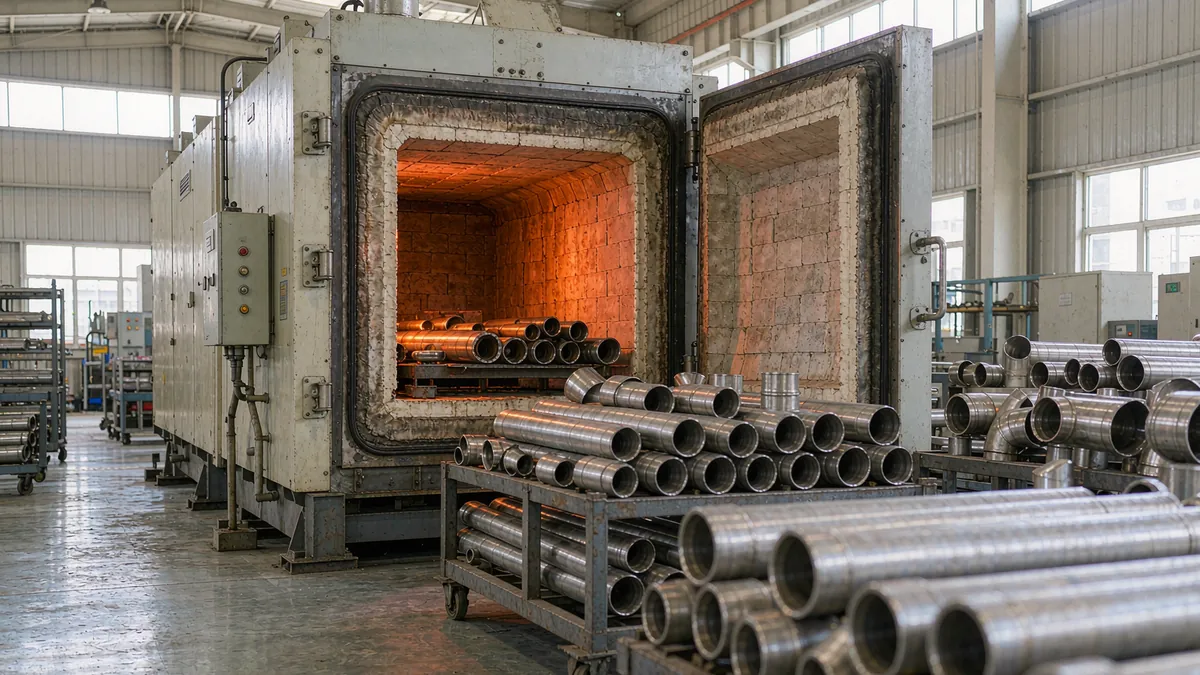
Incoloy 825 (UNS N08825, W.Nr 2.4858, also sold as Alloy 825 and NiCr21Mo) is a fully austenitic nickel-iron-chromium alloy with deliberate additions of molybdenum, copper and titanium. It sits between the stainless steels and the high-nickel Inconel grades: about 40 % nickel is enough to make it essentially immune to chloride stress-corrosion cracking, but not enough to match the pitting resistance of 625 or the reducing-acid performance of the C-family alloys.
The chemistry is doing four separate jobs, and it is worth understanding them before choosing the grade. Chromium (19.5-23.5 %) provides the passive film and resistance to oxidising media such as nitric acid and nitrates. Molybdenum (2.5-3.5 %) plus copper (1.5-3.0 %) is the combination that resists reducing acids - sulphuric and phosphoric acid in particular - where chromium alone is useless because there is nothing to maintain the passive film. Titanium (0.6-1.2 %) stabilises carbon as titanium carbides, so the alloy does not sensitise during welding or slow cooling. And the nickel level keeps the structure austenitic and ductile, which is why 825 is still tough at -196 °C.
The grade is not age hardenable. Everything above the annealed minimum comes from cold work, which matters when a specification asks for high yield strength: you either accept a cold-drawn condition with reduced elongation, or you move to a precipitation-hardened grade such as Incoloy 925.
Limits per ASTM B424 / B425 / B423 (wt %):
| Element | Content (wt %) | Why it matters |
|---|---|---|
| Nickel (Ni) | 38.0-46.0 | Austenitic matrix; the single biggest contributor to chloride SCC resistance |
| Chromium (Cr) | 19.5-23.5 | Passive film, oxidising-acid and high-temperature oxidation resistance |
| Iron (Fe) | 22.0 min (balance) | Cost control - 825 is an iron-bearing alloy, not a true superalloy |
| Molybdenum (Mo) | 2.5-3.5 | Pitting and crevice resistance; reducing-acid performance |
| Copper (Cu) | 1.5-3.0 | The decisive addition for sulphuric and phosphoric acid service |
| Titanium (Ti) | 0.6-1.2 | Carbide stabiliser - prevents intergranular attack after welding |
| Carbon (C) | 0.05 max | Kept low so that sensitisation is not a risk in the HAZ |
| Manganese (Mn) | 1.0 max | Deoxidation and hot-workability control |
| Silicon (Si) | 0.5 max | Deoxidation |
| Aluminium (Al) | 0.2 max | Deoxidation only - deliberately too low to form gamma-prime |
| Sulphur / Phosphorus | 0.03 max each | Impurity control for hot ductility and weld quality |
The titanium-to-carbon ratio is the detail buyers should check on the mill certificate. Titanium must be present in sufficient excess over carbon (the specification requires Ti/C of at least 6 after accounting for nitrogen) for the stabilisation to work; a heat that scrapes the bottom of the titanium range while sitting at the top of the carbon range will still pass the chemistry but is a poorer bet for welded acid service.
Minimum values per ASTM B425 (bar), B424 (plate/sheet) and B423/B163 (seamless pipe and tube), annealed, with typical mill-certificate values in brackets:
| Product form / condition | Yield strength (0.2 %) | Tensile strength | Elongation | Hardness |
|---|---|---|---|---|
| Bar and rod - annealed (B425 min.) | ≥ 241 MPa [270-340] | ≥ 586 MPa [650-720] | ≥ 30 % [40-50] | ≤ 200 HB [approx. 75 HRB] |
| Plate and sheet - annealed (B424 min.) | ≥ 241 MPa [300-360] | ≥ 586 MPa [640-720] | ≥ 30 % [40-50] | ≤ 200 HB |
| Seamless tube - annealed (B423/B163 min.) | ≥ 241 MPa [380-450] | ≥ 586 MPa [700-780] | ≥ 30 % [32-40] | ≤ 200 HB |
| Tube - cold drawn, high strength | 600-890 MPa | 850-1,000 MPa | 12-20 % | - |
Short-time elevated-temperature values for annealed material (typical, not guaranteed):
| Temperature | Yield strength (0.2 %) | Tensile strength |
|---|---|---|
| 20 °C | approx. 240-250 MPa | approx. 550-590 MPa |
| 200 °C | approx. 200 MPa | approx. 520 MPa |
| 400 °C | approx. 180 MPa | approx. 480 MPa |
| 550 °C | approx. 170 MPa | approx. 450 MPa |
Design rule: treat 825 as a corrosion alloy that happens to have moderate strength, not as a high-temperature alloy. For pressure-bearing service above roughly 540-550 °C the creep data become unattractive and the oxidation resistance is only good for intermittent exposure - at that point Incoloy 800H/HT or a nickel-base grade is the correct move.
| Property | Value | Remark |
|---|---|---|
| Density | 8.14 g/cm³ | At 20 °C |
| Melting range | 1,370-1,400 °C | Narrow range; low thermal conductivity means heat input must be controlled |
| Thermal conductivity | approx. 11.1 W/m·K at 20 °C; approx. 17 W/m·K at 500 °C | Roughly one third of carbon steel at room temperature |
| Specific heat capacity | approx. 440 J/kg·K at 20 °C | Use for heat-exchanger and thermal-cycle calculations |
| Mean thermal expansion (20-100 °C) | approx. 14.0 ×10⁻⁶ /K | Close to 304/316 - dissimilar joints with stainless are relatively benign |
| Thermal expansion (20-500 °C) | approx. 14.5-15.0 ×10⁻⁶ /K | Mean coefficient |
| Electrical resistivity | approx. 1.13 µΩ·m at 20 °C | Useful for eddy-current and PMI method selection |
| Modulus of elasticity | approx. 196 GPa at 20 °C | Slightly lower than carbon steel at temperature |
| Magnetic behaviour | Essentially non-magnetic (relative permeability approx. 1.005) | Curie point below -196 °C; a strong magnet response suggests contamination or wrong grade |
Two practical consequences of these numbers. The low thermal conductivity (about 11 W/m·K against roughly 50 for carbon steel) means heat stays where you put it: welding needs lower heat input and interpass control, and heat exchangers need more surface area for the same duty. The expansion coefficient being close to the 300-series stainless steels means 825-to-316L tube-to-tubesheet joints do not create the severe residual stresses you get when joining to ferritic steel.
825 was designed for one specific problem: acid streams that are simultaneously reducing, chloride-bearing and mildly oxidising. That combination defeats 316L (chloride SCC, and no resistance to reducing acid), and it does not need the full molybdenum load of a C-family alloy.
Selection rule: 825 is the right answer for reducing acids with chlorides up to about 450-500 °C, and the wrong answer for (a) hot concentrated hydrochloric acid, (b) hypochlorite or heavily chlorinated seawater, and (c) load-bearing service above about 550 °C. For those three cases step up to Hastelloy C-276/C-22, a super duplex grade, or a nickel-base high-temperature alloy respectively.
| Industry | Typical 825 components | Why 825 |
|---|---|---|
| Chemical processing | Sulphuric and phosphoric acid heat exchangers, reactors, piping, pumps, acid coolers | Cu + Mo for reducing acids; chloride SCC resistance |
| Pickling and surface treatment | Pickling tank internals, hooks, baskets, acid recovery equipment, heating coils | H2SO4/HCl mixtures at temperature, with oxidising contamination |
| Oil and gas | Sour-service wellhead and downhole components, tubing, valves, hangers (NACE MR0175) | H2S + CO2 + chlorides, where annealed strength is sufficient |
| Fertiliser / phosphoric acid plants | Evaporator tubes, slurry lines, agitators, filter components | Wet-process phosphoric acid with chlorides and fluorides |
| Nuclear fuel reprocessing | Tanks, dissolver internals, piping in nitric-acid duties | Nitric acid resistance plus intergranular corrosion resistance |
| Marine and offshore | Seawater-cooled exchangers, piping, splash-zone components | Chloride SCC immunity; limited by PREN in chlorinated seawater |
| Pollution control | FGD scrubber internals, quench and mist-eliminator components | Chloride-bearing condensates with low pH |
| Pulp,paper and hydrometallurgy | Digesters, pressure-leaching autoclave internals, liquor lines | Mixed acid and chloride streams at moderate temperature |
| Product form | Standard |
|---|---|
| Plate, sheet and strip | ASTM B424 / ASME SB424 |
| Bar, rod and billet | ASTM B425 / ASME SB425 |
| Seamless pipe | ASTM B423 / ASME SB423 |
| Seamless tube | ASTM B163 / ASME SB163 |
| Welded tube | ASTM B704 / B705 |
| Welded pipe | ASTM B705 / B775 |
| Fittings and flanges | ASTM B366 (fittings), B564 (forgings) |
| Weld consumables | AWS A5.14 ERNiCrMo-3; AWS A5.11 ENiCrMo-3 |
| Sour service qualification | NACE MR0175 / ISO 15156 |
| European / other designations | W.Nr 2.4858, NiCr21Mo, BS NA16, JIS NCF 825 |
825 is normally supplied annealed and pickled, or annealed and descaled, with EN 10204 3.1 certificates. Common stock ranges: plate 1-80 mm, round bar 6-300 mm, seamless tube 6-219 mm OD. Forging stock, rings, welded tube and wire are available to order.
Anneal at roughly 940-980 °C followed by rapid cooling (water or rapid air). This dissolves carbides and restores the optimum corrosion resistance and ductility. Stress relief, when a specification requires it after heavy cold forming or machining, is done in the 540-600 °C range - but note that stress relief in the sensitisation window must be avoided, and for critical acid service a full anneal is preferred.
825 welds like an austenitic stainless but with a nickel-alloy mindset: no preheat, low heat input, stringer beads, interpass temperature kept below 150 °C, and a slightly convex bead profile to reduce hot-cracking risk. Matching or over-alloyed nickel-base filler is the norm - ERNiCrMo-3 (625-type) is the most widely used and gives better corrosion margin than the base metal, while ERNiFeCr-1 is the closer matching composition. Post-weld heat treatment is not required for corrosion service thanks to the titanium stabilisation, which is the main fabrication advantage over 316L in acid duty. Pickle and passivate after welding to remove iron contamination and heat tint.
825 work-hardens quickly and has low thermal conductivity, so it behaves like a gummy stainless: sharp positive-rake carbide tools, heavy feeds, low speeds, plenty of coolant, and never let the tool rub. Cold forming is good - the alloy is ductile enough for deep drawing and tube bending, with a post-form anneal for severe reductions.
We supply Incoloy 825 plate, sheet, round bar, seamless tube and pipe, forgings and weld wire, cut to size in-house with saw cutting, waterjet and machining to drawing. Stock sizes typically ship in 7-15 days; forged or machined-to-drawing parts run 30-45 days. Every order ships with EN 10204 3.1 mill certificates and PMI verification, and we can arrange third-party inspection (SGS, BV, TUV) on request.
If you are comparing 825 against 625, 904L or a super duplex grade for a specific acid stream, send us the medium, concentration, temperature and chloride level - that is enough for us to tell you where 825 stops working.
Yes. Incoloy 825 is the Special Metals trade name; Alloy 825 is the generic name used by most other mills; UNS N08825 is the unified numbering system designation and W.Nr 2.4858 (NiCr21Mo) is the European equivalent. They all refer to the same chemistry, but always confirm the specification and condition on the certificate rather than the trade name.
No. 825 is a solid-solution alloy with no gamma-prime forming elements in useful quantity (aluminium is capped at 0.2 % for deoxidation only). Higher strength comes from cold work - cold-drawn tube reaches 600-890 MPa yield - at the cost of elongation. If you need strength plus 825-type corrosion resistance in the annealed condition, Incoloy 925 is the age-hardenable version of the same matrix.
For corrosion service the practical ceiling is about 540-550 °C; oxidation resistance is adequate for intermittent exposure up to roughly 815 °C but the alloy has no creep strength to speak of. Do not select 825 for a load-bearing high-temperature application - use Incoloy 800H/HT or a nickel-base grade.
For chlorides and chloride SCC, yes - it is widely used for seawater-cooled exchangers. But its PREN of about 30-31 is not enough for chlorinated seawater or high-velocity aerated seawater where pitting and crevice attack dominate. In those cases 625, AL-6XN or a super duplex grade is the safer choice. State the chlorine residual and velocity when you enquire.
ERNiCrMo-3 (625-type) is the most common choice and gives a corrosion-resistant weld with good tolerance for dilution. ERNiFeCr-1 is the closer compositional match when colour match or thermal expansion consistency matters. For shielded metal arc welding, ENiCrMo-3 electrodes are used. No post-weld heat treatment is required for corrosion service.
Send us your drawing or specification for a quotation — we reply within one business day.
Buy this grade as: Plate · Seamless tube · Elbows · Reducers · Flanges · Welding wire

Browsing for a grade? The full library of per-grade technical guides is on one list.
Open the list
Which family fits which corrosion or temperature problem — and the selection rules that keep you out of trouble.
Read article
Traceability, honest heats, the documents to demand — and the red flags to walk away from.
Read article