
All grade guides — one page, every alloy we cover
Browsing for a grade? The full library of per-grade technical guides is on one list.
Open the listIncoloy 925 is what you get when the corrosion resistance of 825 is right but its strength is not: the same nickel-iron-chromium-molybdenum-copper matrix, with titanium and aluminium raised enough to form gamma-prime and roughly triple the yield strength after ageing. It is the standard answer for sour-gas wellhead and downhole components that must survive H2S, CO2 and chlorides at 724 MPa minimum yield. This guide covers the two conditions you can buy, the heat treatment that separates them, and the limits you must respect.
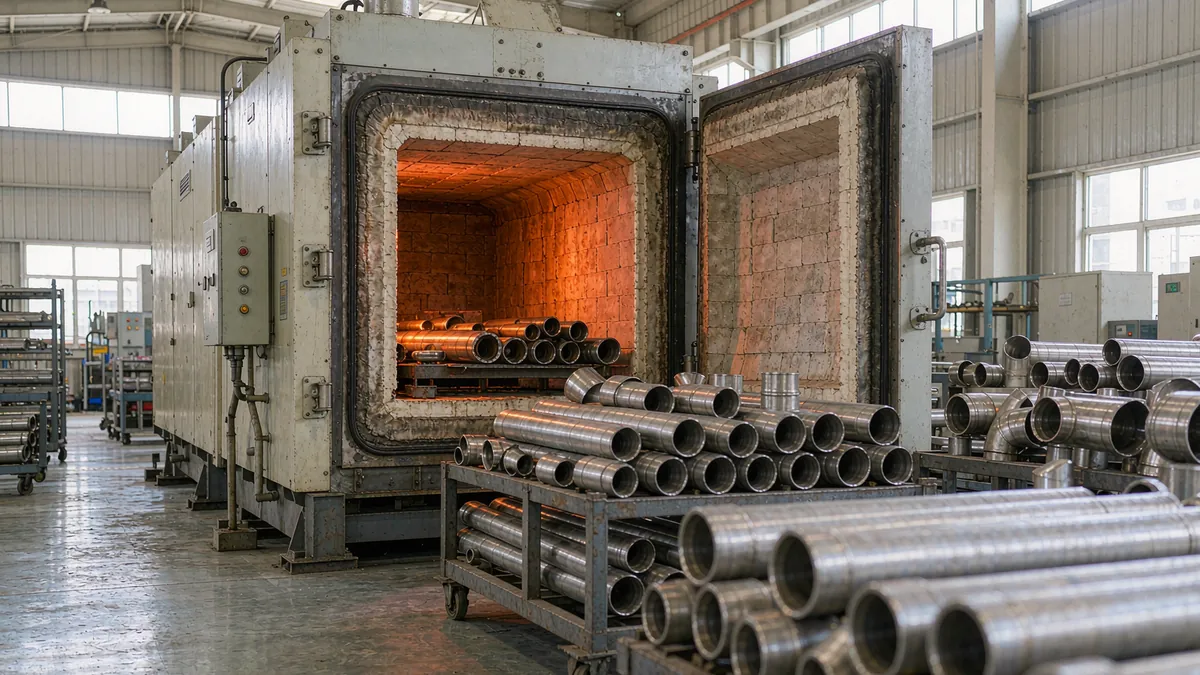
Incoloy 925 (UNS N09925, frequently written Inconel 925 in oilfield literature) is a precipitation-hardenable nickel-iron-chromium alloy built on the corrosion-resistant matrix of 825. The chromium, molybdenum and copper levels are essentially unchanged - that is what preserves the resistance to chlorides, CO2 and mildly reducing acids. What changes is titanium (1.9-2.4 % against 0.6-1.2 % in 825) and aluminium (0.1-0.5 %), which together precipitate the gamma-prime phase Ni3(Ti,Al) during ageing and lift the yield strength from around 240 MPa to 724 MPa minimum.
That single change defines the market for the grade. In a sour well the material has to resist sulphide stress cracking, chloride pitting and CO2 corrosion and carry mechanical loads through a wellhead or a packer. Annealed 825 fails the second requirement; 718 meets the strength requirement but is expensive, harder to machine, and its sour-service envelope is narrower and more heavily restricted. 925 fills the gap, and it is why it appears in almost every wellhead specification for wet, sour, high-pressure gas.
The trade-off is process discipline. 925 is only useful in the correct heat-treatment condition, welded joints need a full post-weld solution treat plus age to recover strength, and the alloy is far less forgiving in machining than 825. Most 925 ends up as machined or forged bar stock rather than welded fabrication.
Limits per ASTM B805 (wt %), with the 825 value shown for comparison:
| Element | 925 (wt %) | 825 (wt %) | Why it matters |
|---|---|---|---|
| Nickel (Ni) | 42.0-46.0 | 38.0-46.0 | Austenitic matrix, chloride SCC and sulphide cracking resistance |
| Chromium (Cr) | 19.5-22.5 | 19.5-23.5 | Passive film, CO2 and oxidising-media resistance |
| Iron (Fe) | 22.0 min (balance) | 22.0 min (balance) | Matrix; keeps cost below the nickel-base superalloys |
| Molybdenum (Mo) | 2.5-3.5 | 2.5-3.5 | Pitting and crevice resistance in chloride brines |
| Copper (Cu) | 1.5-3.0 | 1.5-3.0 | Resistance to reducing acids and to CO2-containing brines |
| Titanium (Ti) | 1.9-2.4 | 0.6-1.2 | Gamma-prime former - the strengthening element |
| Aluminium (Al) | 0.1-0.5 | 0.2 max | Gamma-prime former, works with titanium |
| Carbon (C) | 0.03 max | 0.05 max | Lower than 825 to protect ductility and SCC resistance |
| Manganese (Mn) | 1.0 max | 1.0 max | Deoxidation, hot workability |
| Silicon (Si) | 0.5 max | 0.5 max | Deoxidation |
| Sulphur / Phosphorus | 0.015 max each (common purchase limit) | 0.03 max each | Tight control - sulphide cracking resistance is sensitive to inclusions |
Read the titanium and aluminium together, not separately. The gamma-prime volume fraction - and therefore the achievable strength - depends on both, and a heat at the bottom of both ranges will struggle to reach the 724 MPa aged yield minimum without a well-controlled ageing cycle. Ask for the certified aged mechanicals on the actual heat, not just the chemistry.
925 is bought in one of two conditions, and the difference is large enough that it must be stated explicitly on every enquiry:
| Condition | Yield strength (0.2 %) | Tensile strength | Elongation | Hardness |
|---|---|---|---|---|
| Solution annealed (as supplied for machining) | 345-550 MPa typical | 690-860 MPa typical | 25-40 % typical | approx. 180-220 HB |
| Aged / STA - ASTM B805 minimum | ≥ 724 MPa | ≥ 896 MPa | ≥ 20 % | - |
| Aged / STA - typical mill values | 690-860 MPa | 965-1,170 MPa | 15-25 % | approx. 290-350 HB |
Elevated-temperature behaviour (aged condition, typical): yield strength stays around 650 MPa at 400 °C and about 520 MPa at 540 °C, so the grade holds useful strength well beyond the temperature at which 825 has to be abandoned. Impact toughness in the aged condition is typically above 80 J Charpy V-notch at room temperature - adequate, but a long way from the 200 J-plus of annealed 825, which is the price of the strength.
Specify the condition, not just the grade. "Incoloy 925 bar" without a condition statement is ambiguous: solution-annealed bar will machine beautifully and fail a 724 MPa yield requirement, while STA bar machines poorly and meets it. Most fabricators buy solution annealed, machine near-net, then age - because ageing after machining also avoids distortion.
| Property | Value | Remark |
|---|---|---|
| Density | 8.08 g/cm³ | At 20 °C; for weight and buoyancy calculations on downhole tools |
| Melting range | approx. 1,340-1,385 °C | Solution treatment sits well below the solidus |
| Thermal conductivity | approx. 11.5 W/m·K at room temperature | Low - heat concentrates at the cutting edge and in the weld |
| Specific heat capacity | approx. 420-440 J/kg·K | Published values vary slightly by source |
| Mean thermal expansion (20-100 °C) | approx. 13.0-13.9 ×10⁻⁶ /K | Sources differ; use the mill data sheet for critical fits |
| Electrical resistivity | approx. 1.08 µΩ·m at 20 °C | Relevant to NDT method selection |
| Modulus of elasticity | approx. 195-200 GPa at 20 °C | Slightly higher than 825 in the aged condition |
| Magnetic behaviour | Weakly magnetic at most - iron-based matrix | Never use a magnet as a grade check; use PMI |
The low thermal conductivity is not a footnote for this grade. Combined with an aged hardness of 290-350 HB, it means machining heat stays in the workpiece, tool life collapses if feeds are too light, and the surface can work-harden under a rubbing tool. The same property makes welding heat concentration a real risk for the gamma-prime-forming elements.
Because the chromium, molybdenum and copper levels are those of 825, the general corrosion behaviour is essentially inherited: good resistance to chlorides, to CO2-containing brines, to dilute reducing acids and to seawater at moderate velocity. The differences are in sour service and in the consequences of the alloying change.
Selection rule: choose 925 when the service is sour (H2S present), the strength requirement is in the 724-860 MPa yield band, and the temperature is within the sour-service envelope. Choose 718 when you need strength above roughly 900 MPa yield or service well above 200 °C. Choose plain 825 when annealed strength is enough - it is cheaper, welds without post-weld heat treatment, and is far easier to machine.
| Industry | Typical 925 components | Why 925 |
|---|---|---|
| Oil and gas - wellhead | Christmas tree bodies and bonnets, valve bodies and stems, tubing hangers, casing hangers, adapters and spools | Sour service plus pressure-containing strength |
| Oil and gas - downhole | Packers, mandrels, safety-valve components, completion tools, drill-string subs | High strength in H2S/CO2/chloride brines |
| Oil and gas - subsea | Subsea tree components, clamp and connector hardware, fasteners | Seawater external plus sour internal environment |
| Valves and flow control | Sour-service gate, ball and choke trim, stems, seat retainers | Strength plus galling and corrosion resistance |
| Fasteners | High-strength bolting for wellhead and manifold assemblies | Strength retention with SCC resistance |
| Chemical and petrochemical | Pumps and compressors handling wet CO2 or chloride brines | Strength where 825 would need an oversized section |
| Geothermal and injection wells | Injection mandrels, tubular connectors, monitoring housings | Chloride and H2S-bearing high-temperature brines |
One pattern worth noting: almost all of these parts are machined from bar or forged near-net shape. Welded 925 fabrication is rare because a welded joint needs a full post-weld solution treatment plus age to recover strength, which is impractical on a large wellhead body.
| Item | Reference |
|---|---|
| Bar, forgings and forging stock | ASTM B805 / ASME SB805 |
| Sour-service qualification | NACE MR0175 / ISO 15156 |
| Wellhead and tree equipment | API 6A (material and hardness requirements apply at equipment level) |
| Downhole and completion equipment | API 17D / API 11D1 where applicable |
| Material designation | UNS N09925; commonly written Inconel 925 in oilfield documentation |
| UTS / impact / hardness testing | ASTM A388 (forging UT), ASTM E8/E8M, ASTM E23, ASTM E10/E18 |
Forms we supply: hot-rolled and forged round bar 16-300 mm, cold-finished and ground bar, forging billet and upset stock, wire, and machined-to-drawing components in the solution-annealed or STA condition. Plate and seamless tube are available to order but are not standard mill stock in this grade - plan lead times accordingly.
Solution anneal in the 980-1,010 °C window and quench rapidly (water for bar and forgings) to put the gamma-prime formers into solution and produce a soft, machinable structure. Then age in the 720-760 °C window - hold times run from roughly 8 to 24 hours depending on section size and the qualified cycle - followed by air cooling, which precipitates Ni3(Ti,Al). Both steps need calibrated furnaces and chart records: under-ageing leaves strength on the table, over-ageing coarsens the precipitate and costs both strength and ductility.
Machine in the solution-annealed condition whenever possible, then age. Aged 925 at 290-350 HB with a strong work-hardening tendency demands sharp positive-geometry carbide, low surface speed, heavy feed and generous coolant - the same rules as 718, slightly easier. Do not let the tool rub: a work-hardened skin of 0.1 mm will destroy the next pass. Threads and sealing faces are usually finished after ageing to hold tolerance through the heat treat.
Weldability is the weak point. 925 is prone to strain-age cracking in the heat-affected zone if it is aged after welding without a proper solution treatment, so the sequence is: weld in the solution-annealed condition, solution treat the assembly, then age. Use low heat input, interpass below 150 °C, matching nickel-base filler where available (an over-alloyed ERNiCrMo-3 type is used for non-critical joints), and clean the joint area thoroughly - sulphur and lead contamination cause cracking in this family. Where welding cannot be avoided and post-weld heat treatment is impossible, re-examine whether 825 will do the job.
925 is a made-to-order grade for us rather than a shelf item: we quote forged and rolled bar, forging billet and machined components against your drawing, in solution-annealed or STA condition, with NACE MR0175 documentation where required. Because the heat treatment is qualification-critical, we supply the ageing cycle records with the certificate and can arrange third-party witness of the mechanical tests.
Send us the environment (H2S partial pressure, CO2, chloride level, temperature), the required strength and the applicable standard - API 6A, NACE MR0175, or your company specification - and we will confirm whether 925 is the right grade or whether the duty calls for 718 or plain 825.
Yes. UNS N09925 is sold under both names depending on the mill and the market - oilfield documentation usually says Inconel 925, European and chemical industry documents usually say Incoloy 925. The chemistry and the ASTM B805 specification are the same. Always order by UNS number plus condition.
The corrosion-resistant matrix is nearly identical; the difference is titanium and aluminium. 925 carries 1.9-2.4 % Ti and 0.1-0.5 % Al against 0.6-1.2 % Ti and 0.2 % max Al in 825, which allows gamma-prime precipitation during ageing. The result is a jump from about 240 MPa to 724 MPa minimum yield, at the cost of weldability, machinability and roughly 15-20 % higher price.
It can, but you lose the entire reason for buying the grade - solution-annealed 925 is only about 345-550 MPa yield and behaves much like an expensive 825. If the annealed condition is acceptable, buy 825 instead.
Welding in the aged condition, or ageing a weld without re-solutioning it, leaves a heat-affected zone that is susceptible to strain-age cracking and has poor ductility. The correct sequence is weld in the solution-annealed condition, solution treat the whole assembly, then age. On large wellhead bodies this is impractical, which is why the grade is normally machined or forged rather than welded.
925 when the requirement is in the 724-860 MPa yield band and the temperature is inside the sour-service envelope - it is cheaper and has better SSC resistance in chloride brines. 718 when you need above roughly 900 MPa yield, service well above 200 °C, or the higher fatigue and creep performance. Both are precipitation-hardenable and both are restricted by NACE MR0175 hardness limits.
Send us your drawing or specification for a quotation — we reply within one business day.
Buy this grade as: Plate · Round bar · Seamless tube · Flanges · Fasteners · Forged rings

Browsing for a grade? The full library of per-grade technical guides is on one list.
Open the list
Which family fits which corrosion or temperature problem — and the selection rules that keep you out of trouble.
Read article
Traceability, honest heats, the documents to demand — and the red flags to walk away from.
Read article