
All grade guides — one page, every alloy we cover
Browsing for a grade? The full library of per-grade technical guides is on one list.
Open the listIncoloy 800 is the iron-base member of the high-temperature alloy family: 30–35 % nickel and 19–23 % chromium in an iron balance, giving stainless-steel economics with far better oxidation and creep behaviour. Its creep-rated sibling 800H (UNS N08810) is the code-approved answer for pressure parts above 600 °C — steam reformers, ethylene pyrolysis coils and heat exchangers the world over. This guide explains what separates 800 from 800H and 800HT, and which numbers to put into a design.
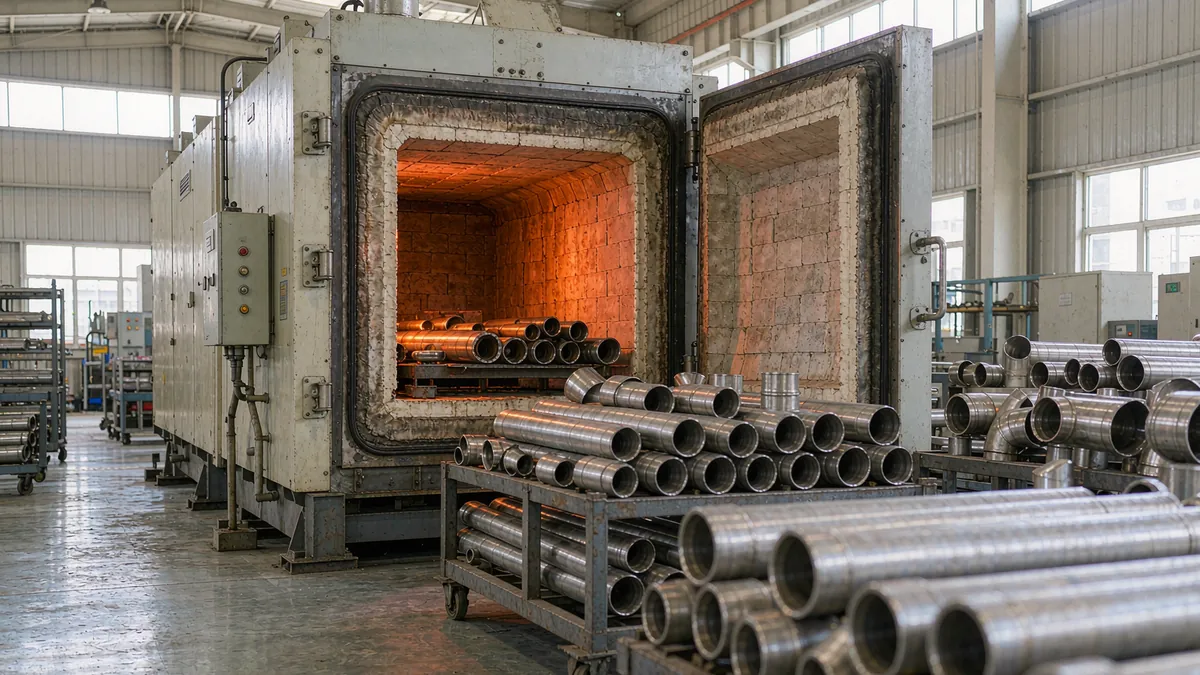
Incoloy 800 (UNS N08800, W.Nr 1.4876) is a nickel-iron-chromium alloy: 30–35 % Ni and 19–23 % Cr on an iron base. The nickel keeps the structure fully austenitic and holds creep strength where plain austenitic stainless steels start to sag; the chromium forms a tight, spalling-resistant oxide scale. The family has three designations that share one chemistry base: 800 is the standard grade, 800H (UNS N08810, W.Nr 1.4958) is the same alloy with carbon 0.05–0.10 % and a grain-size requirement (ASTM 5 or coarser, solution annealed ≥ 1,100 °C), which gives it the code-qualified creep-rupture strength for pressure parts; 800HT (N08811) tightens the Al+Ti window (0.85–1.20 % total) for even better creep strength above about 690 °C. Same metal, different acceptance rules — which is why the designation matters on the purchase order.
| Element | Content (wt %) | Why it matters |
|---|---|---|
| Nickel (Ni) | 30–35 | Austenitic stability and creep strength above 600 °C |
| Chromium (Cr) | 19–23 | Adherent oxide scale — oxidation resistance in air and steam |
| Iron (Fe) | balance | Economics — the reason 800 costs a fraction of full Ni-base grades |
| Aluminium (Al) | 0.15–0.60 | With Ti, boosts high-temperature creep strength (0.85–1.20 % total for 800HT) |
| Titanium (Ti) | 0.15–0.60 | Same role as Al; fine precipitation refines long-term structure |
| Carbon (C) | 0.05–0.10 (800H) | Solution-strengthening at temperature — the 800H creep lever |
| Manganese (Mn) | 1.5 max | Deoxidation and hot-workability |
| Silicon (Si) | 1.0 max | Deoxidation; slightly improves carburisation resistance |
Minimum values per ASTM B408 (bar) / B409 (plate, sheet, strip) with typical mill ranges in brackets:
| Condition | Yield strength (0.2 %) | Tensile strength | Elongation |
|---|---|---|---|
| 800 (N08800) — annealed | ≥ 205 MPa [240–290] | ≥ 520 MPa [520–700] | ≥ 30 % [30–45] |
| 800 (N08800) — hot-worked, as-rolled | ≥ 240 MPa [250–300] | ≥ 550 MPa [550–700] | ≥ 25 % [25–35] |
| 800H / 800HT (N08810 / N08811) — annealed | ≥ 170 MPa [200–290] | ≥ 450 MPa [450–650] | ≥ 30 % [30–45] |
Note the deliberate trade: 800H gives up about 35 MPa of room-temperature yield versus plain 800 in exchange for its coarse grain and higher carbon — both of which are what buy its code-qualified creep-rupture life above 600 °C. Do not "upgrade" a 800H order to plain 800 because the certificate looks stronger; the ASME design values will not follow.
| Property | Value |
|---|---|
| Density | 7.94 g/cm³ |
| Melting range | 1,350–1,400 °C |
| Thermal conductivity (20 °C) | ≈ 11.5 W/m·K |
| Specific heat | ≈ 460 J/kg·K |
| Thermal expansion (20–100 °C) | ≈ 14.4 ×10⁻⁶ /K |
| Elastic modulus (20 °C) | ≈ 196.5 GPa |
| Magnetic behaviour | Non-magnetic at ambient temperature (permeability ≈ 1.014; Curie point −115 °C) |
Selection rule of thumb: above 600 °C under pressure, order 800H or 800HT, never plain 800 — the room-temperature certificate looks similar but the creep design values are what the code accepts. If the duty is wet and chloride-bearing instead of hot, 825 or 625 is the right family, not 800.
| Industry | Typical 800 / 800H components |
|---|---|
| Petrochemical — reforming | Steam-reformer tubes, manifolds, pigtails and outlet systems (800H/800HT) |
| Petrochemical — ethylene | Pyrolysis-furnace tubing and radiant coils above 600 °C |
| Heat treatment | Furnace muffles, radiant tubes, fixtures, baskets, annealing covers |
| Power / nuclear | Steam-generator tubing and superheater components (the classic 800 nuclear variant) |
| General | Heat-exchanger tubing, electric-heater element sheaths, thermowells, high-temperature ducting |
800/800H weld readily by TIG, MIG and SMAW with no preheat and no post-weld heat treatment required for standard service. ERNiCr-3 (FM 82) is the everyday filler; switch to FM 617 when the weld must match the parent metal's creep strength in 800HT service. Keep interpass temperature below 150 °C and protect the pool with argon. Machining is class "C" (difficult): rigid setups, sharp tooling, slow speeds and deep cuts to get under the work-hardened layer. Hot working finishes above 870 °C followed by the correct anneal — 980 °C for plain 800, and 1,150–1,200 °C for 800H/800HT, which must develop the coarse ASTM 5-or-coarser grain the code creep values depend on.
We supply Incoloy 800, 800H and 800HT plate, bar, seamless pipe and tube (including long reformer-tube lengths), forgings and machined parts, with the heat-treatment condition and grain-size requirement matched to the designation you order. Every shipment goes out with EN 10204 3.1 certificates, and PMI verification is standard before packing. Typical lead time: 7–15 days for stock sizes, 30–45 days for forged or custom tube lengths.
Same alloy base, different acceptance rules. 800 (N08800) is the standard grade. 800H (N08810) adds carbon 0.05–0.10 %, a minimum solution-anneal around 1,100 °C and a coarse grain (ASTM 5+), which qualifies its creep strength under ASME codes. 800HT (N08811) further tightens Al+Ti to 0.85–1.20 % total, adding creep margin above ~690 °C. Room-temperature certs look similar; the design values above 600 °C are what differ.
No. The 30–35 % nickel content keeps it fully austenitic — magnetic permeability is about 1.014 and the Curie point is −115 °C, so it stays non-magnetic at every service temperature.
No, not for code-stamped pressure parts above 600 °C. Plain 800 has no code-qualified creep-rupture values; substituting it risks both the design margin and the stamping review. Order exactly the designation on the drawing.
Austenitic stainless steels work fine to roughly 550–600 °C. Above that their creep strength and scale stability fall away while 800/800H continues; the extra nickel also resists sensitisation and sigma embrittlement in long-term high-temperature service. For hot duty the lifecycle cost favours 800H; for cold chloride service pick a molybdenum grade instead.
Send us your drawing or specification for a quotation — we reply within one business day.
Buy this grade as: Plate · Round bar · Seamless tube · Elbows · Reducers · Flanges · Welding wire · Forged rings

Browsing for a grade? The full library of per-grade technical guides is on one list.
Open the list
Which family fits which corrosion or temperature problem — and the selection rules that keep you out of trouble.
Read article
Traceability, honest heats, the documents to demand — and the red flags to walk away from.
Read article