
All grade guides — one page, every alloy we cover
Browsing for a grade? The full library of per-grade technical guides is on one list.
Open the listHastelloy C-276 is the most widely specified nickel-chromium-molybdenum-tungsten corrosion alloy in the world: the go-to choice when a wet process stream contains chlorides plus an acid, where stainless steels pit and duplex grades fall short. It resists pitting and crevice attack (PREN ≈ 69), is essentially immune to chloride stress-corrosion cracking, and needs no post-weld heat treatment. This guide collects the composition, mechanical and physical data and the selection rules we apply daily when quoting C-276 plate, pipe, bar, forgings and weld overlay.
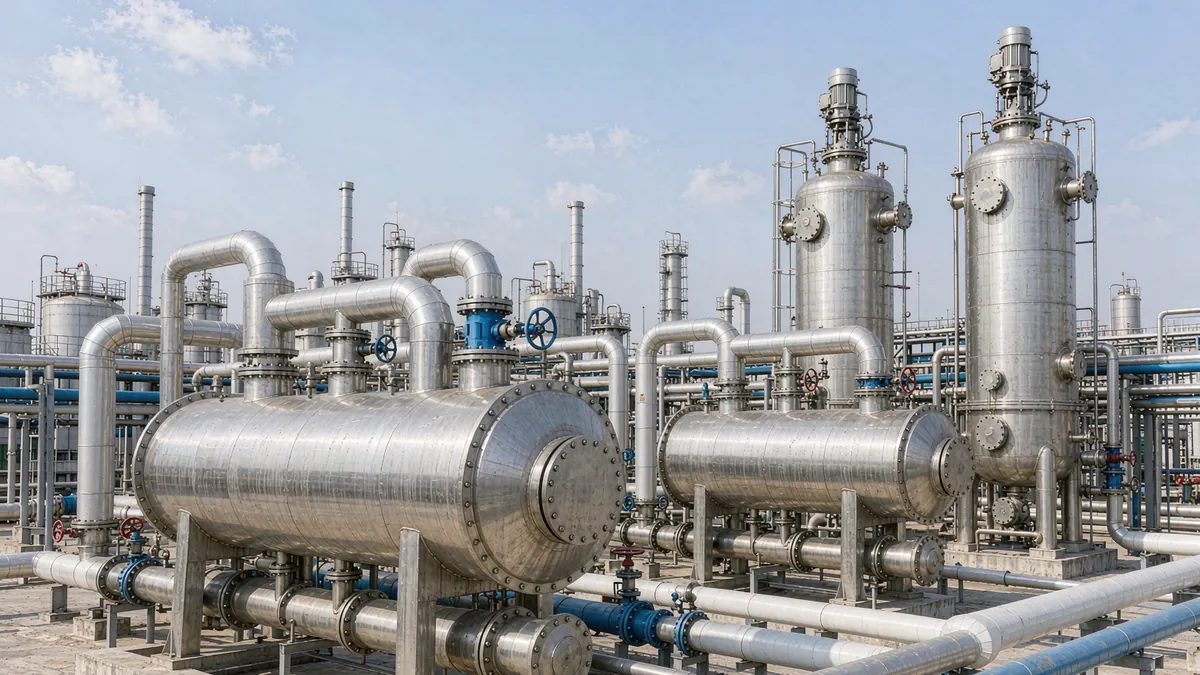
Hastelloy C-276 (UNS N10276, W.Nr 2.4819, NiMo16Cr15W) is a nickel-base alloy balanced around 15–17 % molybdenum, 14.5–16.5 % chromium and 3–4.5 % tungsten. That combination is unusual: molybdenum and tungsten protect against reducing acids, chromium protects against oxidising media, and no single element is allowed to dominate — which is exactly why C-276 works in mixed streams (wet chlorine, chlorine dioxide, ferric/ferrous chlorides, contaminated acids) where an alloy optimised for one chemistry alone would fail. Carbon is held to 0.01 % max and silicon to 0.08 % max, so the alloy can be solution annealed and welded without significant grain-boundary precipitation, and it is supplied and used in the solution-annealed condition only.
| Element | Content (wt %) | Why it matters |
|---|---|---|
| Nickel (Ni) | Balance | Matrix that anchors chloride-SCC immunity and high-temperature stability |
| Molybdenum (Mo) | 15–17 | Main resistance to reducing acids (HCl, H₂SO₄) and to localized corrosion |
| Chromium (Cr) | 14.5–16.5 | Protection against oxidising media (wet chlorine, Fe³⁺/Cu²⁺ solutions, nitric contamination) |
| Iron (Fe) | 4–7 | Controlled addition; keeps cost down without sacrificing corrosion performance |
| Tungsten (W) | 3–4.5 | Boosts reducing-acid and crevice resistance together with Mo |
| Cobalt (Co) | 2.5 max | Residual, limited |
| Carbon (C) | 0.01 max | Prevents grain-boundary carbides — the key to as-welded usability |
| Silicon (Si) | 0.08 max | Strictly limited; high Si accelerates attack in hot concentrated H₂SO₄ |
| Vanadium (V) | 0.35 max | Residual, limited |
| Manganese | 1.0 max | Deoxidation and processing control |
Note for buyers: C-276 is one of the few high-performance alloys where the impurity limits (Si, V) are as commercially important as the main elements — insist on the full heat analysis on the EN 10204 3.1 certificate.
The same minimum values apply to plate (ASTM B575), bar (B574), seamless pipe (B622), welded pipe (B619/B626) and forgings (B564) in the solution-annealed condition. Typical mill-certificate values in brackets:
| Condition | Yield strength (0.2 %) | Tensile strength | Elongation | Hardness |
|---|---|---|---|---|
| Solution annealed — ASTM minimums | ≥ 283 MPa | ≥ 690 MPa | ≥ 40 % | — |
| Solution annealed — typical | [360–410 MPa] | [760–830 MPa] | [50–60 %] | [≈ 87–95 HRB] |
| Cold-drawn bar (when specified) | [550–720 MPa] | [830–1,000 MPa] | [15–30 %] | [up to ≈ 35 HRC] |
C-276 is a solid-solution alloy and is not age-hardenable: any strength above the annealed minimum comes from cold work only. Yield falls gently with temperature — roughly 85 % of the room-temperature yield at 200 °C and about 65 % at 400 °C. Do not order cold-worked C-276 for corrosion service without agreeing the condition and a subsequent anneal in writing.
| Property | Value |
|---|---|
| Density | 8.89 g/cm³ |
| Melting range | 1,323–1,371 °C |
| Thermal conductivity | ≈ 10.2 W/m·K (at 100 °C) |
| Specific heat | ≈ 427 J/kg·K |
| Thermal expansion (20–100 °C) | ≈ 11.2 ×10⁻⁶ /K |
| Elastic modulus | ≈ 205 GPa |
| Electrical resistivity (20 °C) | ≈ 1.30 µΩ·m |
| Magnetic behaviour | Practically non-magnetic |
Selection rule of thumb: C-276 wins when the stream is both reducing and oxidising — chlorides mixed into acids, wet chlorine gas, contaminated phosphoric acid. If the medium is purely oxidising (hot HNO₃), pick C-22 or 690; if it is purely reducing (hot concentrated HCl), B-2 / B-3 resists better at lower cost.
| Industry | Typical C-276 components |
|---|---|
| Chemical processing | Reactors and heat-exchanger tubing in HCl / H₂SO₄ / mixed-acid service, pump and valve internals, distillation column internals |
| Flue gas desulphurisation | Scrubber liners, outlet dampers, quench ducts and mist eliminators exposed to chloride-rich condensate |
| Pulp & paper | Bleach plant washers and piping for chlorine dioxide and hypochlorite stages |
| Oil & gas | Sour-service valve trim, downhole tools, weld overlay on pressure vessels (NACE MR0175) |
| Pharmaceutical / fine chemicals | Agitators, thermowells and lined equipment where product purity demands low metal pick-up |
| Waste treatment | Incinerator scrubbers, nuclear-waste reprocessing evaporators |
Welding: GTAW/GMAW/SMAW with ERNiCrMo-4 / ENiCrMo-4 filler. No preheat, no post-weld heat treatment required — the 0.01 % carbon ceiling keeps the HAZ free of harmful carbides. Keep interpass below 150 °C and heat input moderate; the weld area must be clean, dry and free of iron contamination (use stainless brushes only).
Heat treatment: supply condition is solution annealed at 1,120–1,175 °C followed by rapid air cool or water quench. This is critical: slow cooling through the 600–1,100 °C range precipitates intermetallic phases and destroys the corrosion performance. Avoid stress-relief treatments at intermediate temperatures — they do more harm than good for this alloy.
Forming: excellent cold formability in the annealed condition; heavy cold deformation of thick sections should be followed by re-annealing at the full solution temperature, not a stress relief.
Buying: state the product form and the governing ASTM/ASME standard at enquiry (the standard fixes condition and test requirements); for sour service add NACE MR0175 / ISO 15156 and the applicable hardness limit; for pure HCl duty above ~20 % concentration, price B-2/B-3 as an alternative before committing to C-276.
No — it is practically non-magnetic in the annealed condition. A slight pull after heavy cold work is normal and does not indicate a wrong grade.
They share the same Ni-Cr-Mo-W family and similar pitting resistance. C-276 is the better pick in reducing acids (especially hot dilute HCl) and wet-process phosphoric acid; C-22 has higher chromium (20–22.5 %) and resists oxidising media — nitric acid, wet chlorine with high oxygen potential, and pickling mixed acids — better. In FGD condensate and most mixed streams the two are interchangeable and C-276 is usually the cheaper, more available option.
Only to a point: in HCl above roughly 20 % concentration at elevated temperature, the molybdenum-rich Hastelloy B-2 / B-3 give markedly longer life. C-276's strength is mixed streams, not the pure hot concentrated acid.
Because carbon is limited to 0.01 % max, almost no chromium carbide precipitates in the weld heat-affected zone, so the as-welded joint retains essentially full corrosion resistance — a major advantage over 300-series stainless steels.
Roughly 10–15× per kg depending on form, driven by the molybdenum and tungsten content. For wet chloride + acid service the comparison is misleading: 316L can fail within months, so the lifecycle cost of C-276 is usually far lower.
Send us your drawing or specification for a quotation — we reply within one business day.
Buy this grade as: Plate · Round bar · Seamless tube · Elbows · Reducers · Flanges · Fasteners · Welding wire · Forged rings

Browsing for a grade? The full library of per-grade technical guides is on one list.
Open the list
Which family fits which corrosion or temperature problem — and the selection rules that keep you out of trouble.
Read article
Traceability, honest heats, the documents to demand — and the red flags to walk away from.
Read article