
All grade guides — one page, every alloy we cover
Browsing for a grade? The full library of per-grade technical guides is on one list.
Open the listHastelloy C-22 (Alloy 22) is the broader-spectrum member of the C family: with 20–22.5 % chromium it outperforms C-276 in oxidising media — wet chlorine, nitric-bearing mixed acids, pickling solutions — while still carrying enough molybdenum and tungsten to hold up in reducing acids. It also offers one of the best records against localized corrosion in wet flue-gas desulphurisation and nuclear-waste environments. This guide gives the composition, mechanical and physical data and the selection rules we use when quoting C-22 plate, pipe, bar and forgings.
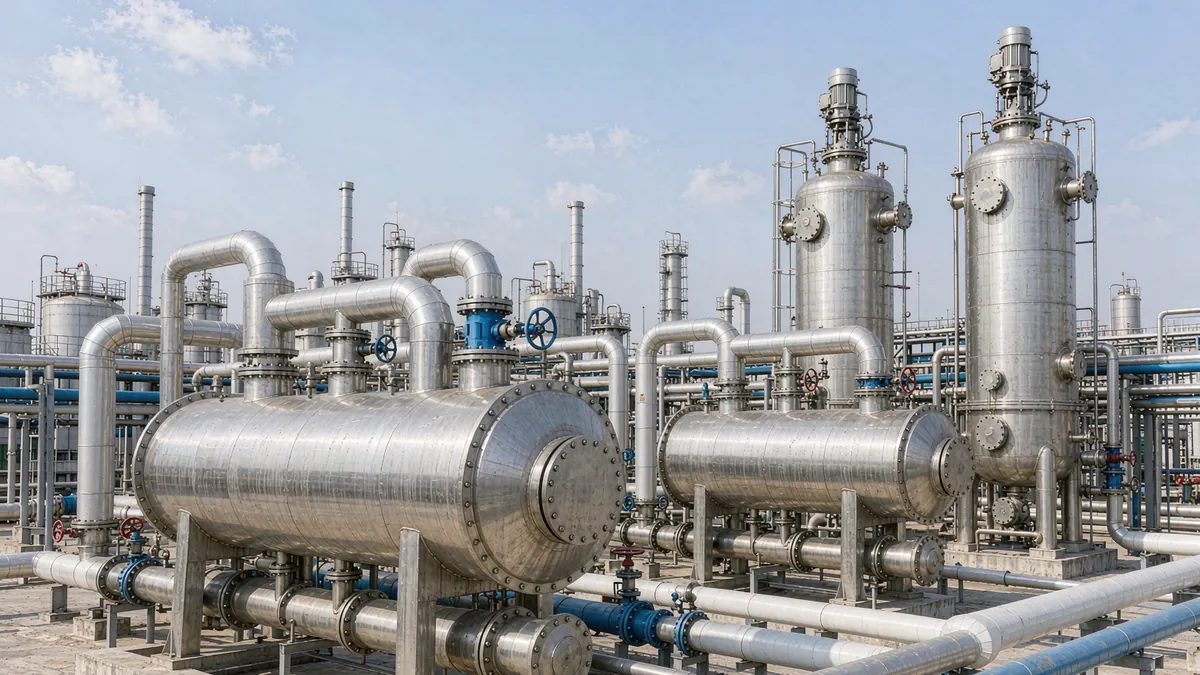
Hastelloy C-22 (UNS N06022, W.Nr 2.4602, NiCr21Mo14W) was developed as the successor to C-276 with a deliberately different balance: chromium raised to 20–22.5 % and molybdenum trimmed to 12.5–14.5 %. The higher chromium widens the passive range, so the alloy stays protective in strongly oxidising environments where C-276's lower-Cr matrix can transpassively dissolve; the retained Mo + W keep strong resistance to pitting, crevice attack and reducing acids. Like C-276 it is a single-phase, solid-solution, non-age-hardenable alloy, always supplied solution annealed, and it is the specified material for many FGD, nuclear-waste-reprocessing and mixed-acid pickling duties.
| Element | Content (wt %) | Why it matters |
|---|---|---|
| Nickel (Ni) | Balance | Matrix providing chloride-SCC immunity and phase stability |
| Chromium (Cr) | 20–22.5 | Wide passive range — the key advantage in oxidising acids and wet chlorine |
| Molybdenum (Mo) | 12.5–14.5 | Pitting / crevice resistance and strength in reducing media |
| Iron (Fe) | 2–6 | Processing control; kept low to preserve corrosion performance |
| Tungsten (W) | 2.5–3.5 | Complements Mo against localized corrosion |
| Carbon (C) | 0.015 max | Minimal grain-boundary carbide precipitation after welding |
| Vanadium (V) | 0.35 max | Residual, limited |
| Silicon (Si) | 0.08 max | Strictly limited for hot sulfuric acid resistance |
| Cobalt (Co) | 2.5 max | Residual, limited |
| Manganese | 0.5 max | Deoxidation and processing control |
The same minimum values apply to plate (ASTM B575), bar (B574), seamless pipe (B622), welded pipe (B619/B626) and forgings (B564) in the solution-annealed condition. Typical mill-certificate values in brackets:
| Condition | Yield strength (0.2 %) | Tensile strength | Elongation | Hardness |
|---|---|---|---|---|
| Solution annealed — ASTM minimums | ≥ 310 MPa | ≥ 690 MPa | ≥ 45 % | — |
| Solution annealed — typical | [330–400 MPa] | [760–850 MPa] | [50–60 %] | [≈ 89–93 HRB] |
| Cold-worked (as-drawn / as-rolled) | [550–750 MPa] | [850–1,050 MPa] | [15–30 %] | [up to ≈ 35 HRC] |
Yield falls gently with temperature: roughly 270 MPa at 100 °C and about 175 MPa at 400 °C (typical curve values). Long-term structural service is normally limited to about 400 °C — above that, the risk of long-term precipitation of intermetallic phases outweighs any strength benefit. C-22 is not age-hardenable; if your specification demands higher yield, the answer is cold work plus re-annealing discipline, or a different alloy family.
| Property | Value |
|---|---|
| Density | 8.69 g/cm³ |
| Melting range | 1,325–1,375 °C |
| Thermal conductivity (room temp) | ≈ 9.4 W/m·K (11.1 at 100 °C) |
| Specific heat (room temp) | ≈ 414 J/kg·K |
| Thermal expansion (24–100 °C) | ≈ 12.4 ×10⁻⁶ /K |
| Elastic modulus | ≈ 206 GPa |
| Electrical resistivity (20 °C) | ≈ 1.14 µΩ·m |
| Magnetic behaviour | Practically non-magnetic |
Source note: thermal values are from the Haynes C-22 data sheet (H-2019); minor variations (cp 410–420 J/kg·K, TC 9.4–11.2 W/m·K depending on the reference temperature) appear between mill publications — ask us for the values of the actual heat when the design is marginal.
Selection rule of thumb: if the stream swings between oxidising and reducing, or contains nitric acid plus chlorides, choose C-22. If the duty is consistently reducing (hot HCl, H₂SO₄ with chlorides, phosphoric acid), C-276 is usually cheaper and equally good — check both before committing.
| Industry | Typical C-22 components |
|---|---|
| Wet flue-gas desulphurisation | Scrubber internals, quench sections, dampers and stack liners in chloride-rich condensate |
| Metal pickling | Tanks, coils, heating elements and fixtures in nitric-hydrofluoric mixed-acid pickling lines |
| Chemical processing | Reactors and heat-exchanger tubing handling oxidising chlorides, wet chlorine and mixed-acid streams |
| Nuclear / waste reprocessing | Evaporators, dissolvers and waste-handling vessels in nitric-chloride media |
| Oil & gas | Sour-service components and weld overlay where chloride pitting in oxidising brines is the governing risk |
| Pulp & paper | Bleach plant equipment in chlorine dioxide stages |
Welding: GTAW/GMAW/SMAW with ERNiCrMo-10 / ENiCrMo-10 filler (never substitute C-276 filler in a C-22 vessel without a design review — the dilution lowers weld-metal chromium exactly where oxidising resistance matters). No preheat and no post-weld heat treatment required for most duties; keep interpass below 150 °C and use low heat input for the root pass. Only clean, dry, iron-free surfaces — stainless brushes and pickling where applicable.
Heat treatment: supply condition is solution annealed at 1,105–1,135 °C followed by rapid water quench (rapid air cool acceptable for thin sections). Slow cooling through the 400–980 °C range precipitates μ/σ-type phases that cut ductility and corrosion resistance, so rapid quenching is mandatory after any anneal. Intermediate stress-relief treatments are generally avoided; where residual stress must be managed, discuss the full anneal with us first.
Forming: good cold formability, though the alloy work-hardens faster than 300-series stainless — plan intermediate anneals for heavy reductions and restore full corrosion performance with a final solution anneal.
Buying: confirm the governing standard (B575/B574/B622/B619/B626) and the condition at enquiry; ask for the heat analysis including Si and V limits; and where the medium is uncertain, request our corrosion-data comparison of C-22 vs C-276 for your exact chemistry — the price difference is small but the performance gap can go either way.
No — it is practically non-magnetic in the annealed condition. Any pull on a magnet after heavy cold work comes from deformation-induced structure and does not indicate a wrong grade.
Both share the Ni-Cr-Mo-W family and nearly identical localized-corrosion resistance. Choose C-22 when the medium is oxidising or swings between oxidising and reducing: nitric-acid-containing mixtures, wet chlorine, pickling solutions. Choose C-276 for predominantly reducing streams and for better availability on many product forms. In FGD and most chemical duties the two are interchangeable — let the chemistry decide.
Yes — it resists nitric acid at all concentrations up to boiling thanks to its 20–22.5 % chromium, and unlike 304L it also tolerates oxidising chlorides in the same stream. For pure hot concentrated nitric service without chlorides, lower-cost stainless solutions may still be adequate.
Slow cooling through 400–980 °C precipitates intermetallic μ and σ phases along grain boundaries, which reduce ductility and locally deplete chromium and molybdenum — the classic failure route for a badly annealed C-22 component in mixed-acid service.
Normally no. With carbon limited to 0.015 % max, the welded joint keeps essentially full corrosion resistance as-welded. Heavy cold-formed thick sections are the exception — those should be fully re-solution-annealed and rapidly quenched.
Send us your drawing or specification for a quotation — we reply within one business day.
Buy this grade as: Plate · Seamless tube · Elbows · Reducers · Welding wire

Browsing for a grade? The full library of per-grade technical guides is on one list.
Open the list
Which family fits which corrosion or temperature problem — and the selection rules that keep you out of trouble.
Read article
Traceability, honest heats, the documents to demand — and the red flags to walk away from.
Read article