
All grade guides — one page, every alloy we cover
Browsing for a grade? The full library of per-grade technical guides is on one list.
Open the listHastelloy B-2 is the benchmark alloy for hydrochloric acid: a nickel-molybdenum alloy with 26–30 % molybdenum and deliberately almost no chromium, which makes it superb in pure reducing acids and practically useless in oxidising ones. This guide collects the composition limits, ASTM minima versus typical mill values, physical data, the oxidising-contamination rules that decide B-2 versus C-276, and the fabrication precautions — intermetallic precipitation and HAZ cracking — that every buyer of B-2 equipment should know.
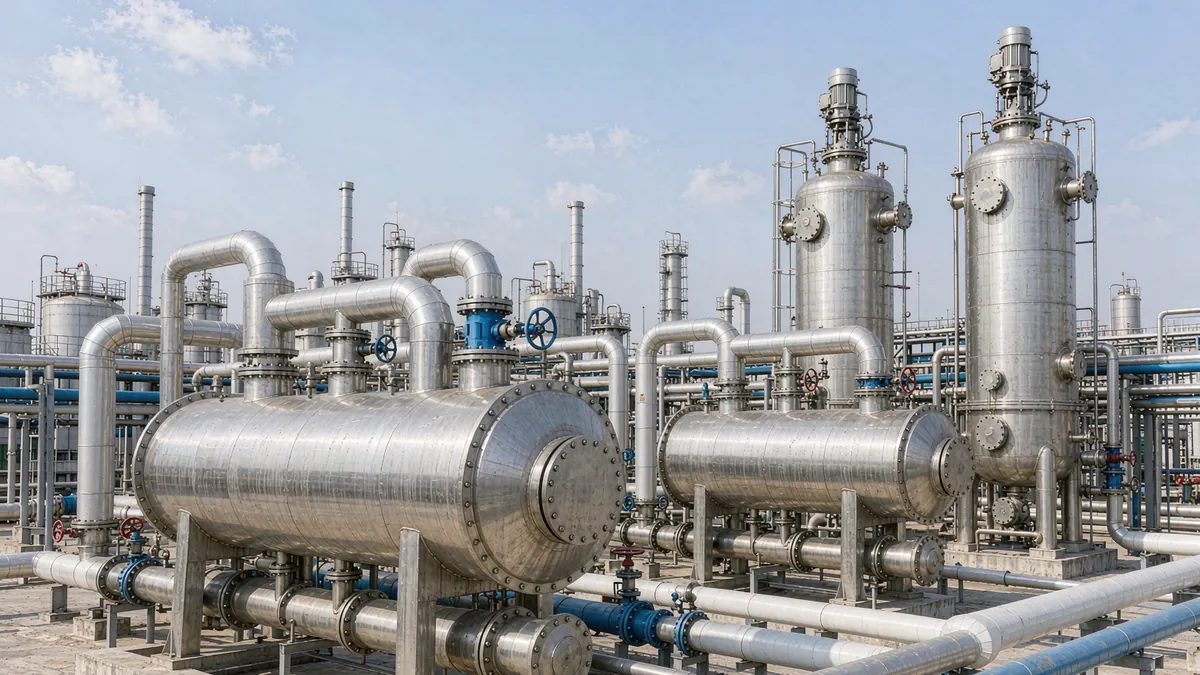
Hastelloy B-2 (UNS N10665, W.Nr 2.4617, DIN NiMo28) is a solid-solution nickel-molybdenum alloy with 26–30 % molybdenum, iron limited to 2.0 % and chromium limited to a trace — just 1.0 % maximum. That near-total absence of chromium is the whole point: chromium helps in oxidising media but actually accelerates attack in hot, concentrated hydrochloric acid. By stripping it out, B-2 achieves corrosion rates in all concentrations of HCl, from dilute to 37 % and from ambient to boiling, that no C-family alloy can match. It also performs superbly in non-aerated sulfuric, acetic and phosphoric acids. The trade-offs are equally clear: B-2 has essentially no oxidation resistance for high-temperature air service, it is vulnerable to intermetallic phase precipitation if heat treatment is mishandled, and any oxidising contaminant in the acid — ferric or cupric ions, dissolved oxygen, wet chlorine — will push you straight to C-276 or C-22.
| Element | Content (wt %) | Why it matters |
|---|---|---|
| Nickel (Ni) | Balance (~69) | Matrix of the alloy; resists chloride stress-corrosion cracking |
| Molybdenum (Mo) | 26–30 | The active ingredient — gives the outstanding resistance in reducing acids, especially HCl |
| Iron (Fe) | 2.0 max | Kept low to avoid the β-phase (Ni₄Mo) precipitation problem of the older B alloy |
| Chromium (Cr) | 1.0 max | Deliberately minimal — even small Cr additions degrade hot HCl performance |
| Carbon (C) | 0.02 max | Limits carbide precipitation in the weld HAZ |
| Cobalt (Co) | 1.0 max | Residual control |
| Manganese / Silicon | 1.0 / 0.10 max | Deoxidation; silicon kept very low to protect weld-metal ductility |
B-2 is the successor to the original Hastelloy B: the same Ni-Mo concept with iron and carbon tightly capped to suppress the β-phase (Ni₄Mo) that caused weld-zone embrittlement in the older grade.
B-2 is supplied in the solution-annealed condition. Minimum values per ASTM B335 / B574 (annealed bar) with typical mill-certificate values in brackets:
| Condition | Yield strength (0.2 %) | Tensile strength | Elongation |
|---|---|---|---|
| Solution annealed (most common) | ≥ 310 MPa [350–450] | ≥ 690 MPa [760–900] | ≥ 43 % [40–55] |
Two design notes: first, strength falls off steadily with temperature — expect roughly two-thirds of the room-temperature yield by 400 °C, which is about the practical upper limit for B-2 pressure equipment. Second, B-2 is not a high-temperature grade: with under 1 % chromium it has no meaningful oxidation resistance, so the 400 °C ceiling is set by the process medium, not creep.
| Property | Value |
|---|---|
| Density | 9.2 g/cm³ |
| Melting range | 1,330–1,380 °C |
| Thermal conductivity (20 °C) | ≈ 11.1 W/m·K |
| Specific heat (20 °C) | ≈ 377–420 J/kg·K (sources vary; confirm on mill data sheet) |
| Thermal expansion (20–100 °C) | ≈ 10.3 ×10⁻⁶ /K |
| Modulus of elasticity | ≈ 217 GPa |
| Electrical resistivity | ≈ 1.37 µΩ·m |
| Magnetic behaviour | Essentially non-magnetic (relative permeability < 1.01) |
At 9.2 g/cm³ B-2 is one of the densest alloys we quote — noticeably heavier than C-276 (8.89) and about 14 % heavier than 316L. Weight-based quotations should always be checked against the density difference before comparing offers.
Selection rule of thumb: pure reducing acid — all concentrations of HCl, non-aerated H₂SO₄ — means B-2. The moment the acid carries oxidising contaminants (Fe³⁺/Cu²⁺ pickup, aeration, wet chlorine) or the duty mixes oxidising and reducing stages, step up to Hastelloy C-276 / C-22, which trade a little reducing-acid performance for chromium-based oxidising resistance.
| Industry | Typical B-2 components |
|---|---|
| Chemical processing | HCl handling systems — reactors, transfer piping, heat exchangers, storage vessel internals |
| Acetic / phosphoric acid plants | Evaporators, heater coils, pump and valve bodies in reducing organic and mineral acids |
| Pharmaceutical & fine chemicals | Reactor vessels and agitators exposed to reducing acid intermediates |
| Pulp & paper | Equipment in reducing-acid sections of the chemical recovery cycle |
| Specialty equipment | Dry HCl gas service components; acid regeneration and pickling-system parts where the medium is strictly reducing |
Welding: B-2 welds well with GTAW/GMAW/SMAW using matching ERNiMo-7 / ENiMo-7 filler. Never bridge a B-2 joint with a chromium-containing filler (e.g. ERNiCrMo family) — the diluted weld metal loses hot HCl resistance. Keep interpass temperature low, and for highly restrained joints or thick sections plan a post-weld solution anneal rather than a simple stress relief.
Heat treatment: solution annealing is around 1,065–1,100 °C followed by a rapid quench — slow cooling through the intermediate-temperature range promotes the intermetallic precipitation described above. Hot-worked parts should be re-annealed before service; heavy cold work likewise warrants a full anneal, not just a stress relief.
Procurement: always specify "solution annealed" on the PO and check the 3.1 certificate for Mo (26–30 %) and Cr (≤1.0 %) — a certificate showing 2–3 % chromium suggests a B-3 or C-family substitution. Because B-2 is often used in tightly specified reducing-acid trains, it is frequently made to order rather than stocked; confirm lead time early in the RFQ.
We supply Hastelloy B-2 plate, bar, seamless pipe, forgings and machined parts with EN 10204 3.1 mill certificates and PMI verification before packing. For reducing-acid projects we also quote the successor grade B-3 (N10675) where its improved thermal-stability HAZ behaviour justifies the switch — tell us the medium, temperature and restraint conditions and we will recommend one grade, not both.
B-3 (UNS N10675) is the modernised successor with a modified Mo/Fe balance that greatly improves thermal stability — it resists the intermetallic precipitation and HAZ cracking that B-2 can suffer in restrained welds and slow-cooled fabrications. Corrosion performance in HCl is essentially equivalent; choose B-2 for direct replacement, B-3 for new-build fabrications with heavy welding.
No. Seawater, FGD liquors and hypochlorite all carry oxidising species that rapidly attack B-2's low-chromium surface. Those duties belong to C-276, C-22 or 625. B-2 is strictly a reducing-acid alloy.
For normal, non-restrained welds in thin sections, no — matching ERNiMo-7 welds perform well as-welded. But heavily restrained joints, thick sections and any fabrication that will see long service near 550–900 °C should get a solution anneal (≈1,065–1,100 °C, rapid quench) to eliminate the risk of HAZ embrittlement.
Molybdenum is a very heavy element, and B-2 carries 26–30 % of it — the highest Mo level of any common corrosion alloy. That gives the 9.2 g/cm³ density and, by the way, also explains why B-2 is priced per kg alongside C-276 despite having no chromium.
Send us your drawing or specification for a quotation — we reply within one business day.
Buy this grade as: Plate · Round bar · Seamless tube · Elbows · Reducers · Flanges · Fasteners · Welding wire

Browsing for a grade? The full library of per-grade technical guides is on one list.
Open the list
Which family fits which corrosion or temperature problem — and the selection rules that keep you out of trouble.
Read article
Traceability, honest heats, the documents to demand — and the red flags to walk away from.
Read article