
All grade guides — one page, every alloy we cover
Browsing for a grade? The full library of per-grade technical guides is on one list.
Open the listAL-6XN is the American 6 % Mo super-austenitic stainless steel: a nitrogen-strengthened alloy with about 24 % nickel, 21 % chromium and 6.5 % molybdenum that fills the gap between 316L and nickel-base alloys. It resists pitting and crevice corrosion in seawater with a PREN of roughly 46, keeps chloride stress-corrosion cracking off the risk list, and carries ASME allowable stresses about 40 % above 316L — usually at a fraction of the cost of a C-family alloy. This guide collects the numbers and selection rules we use when quoting AL-6XN plate, tubing, pipe and fittings.
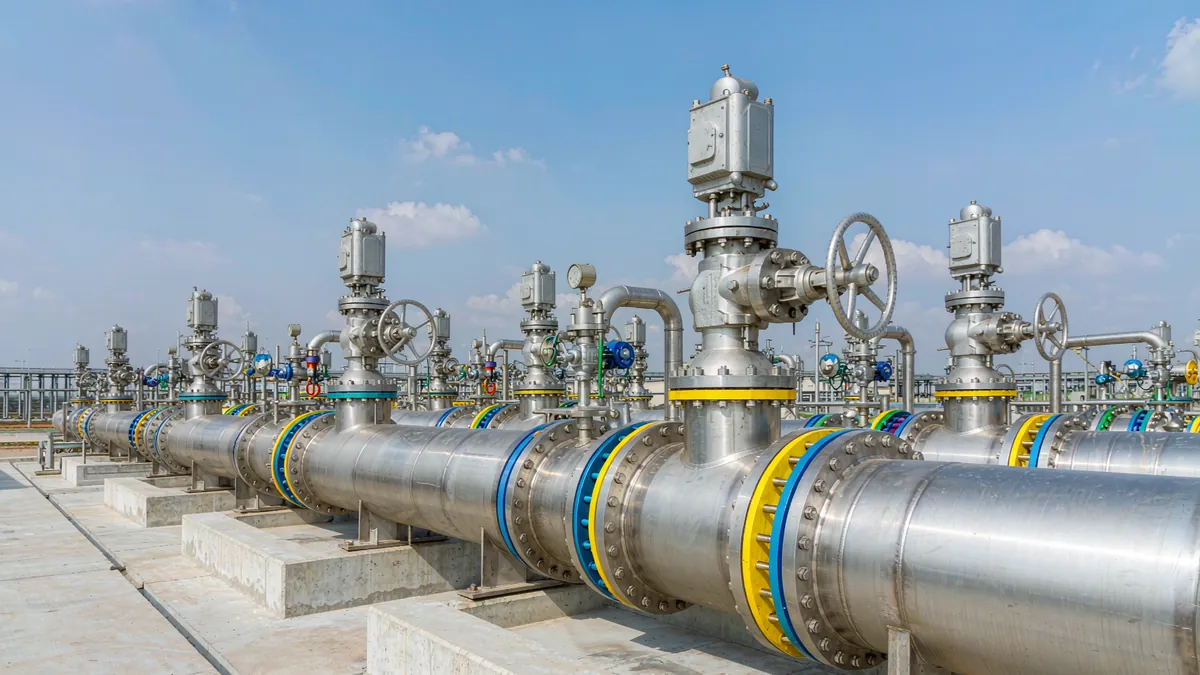
AL-6XN (UNS N08367, W.Nr 1.4478, JIS SUS 836L) is a super-austenitic stainless steel developed by Allegheny Ludlum, positioned as the American counterpart of 254 SMO (EN 1.4547). Its composition — 20–22 % Cr, 23.5–25.5 % Ni, 6–7 % Mo and 0.18–0.25 % nitrogen — is built around one idea: push pitting and crevice resistance far beyond 316L while keeping a fully austenitic, easy-welding structure. The nitrogen does double duty, raising both pitting resistance and yield strength without a single phase-change heat treatment. In practice, AL-6XN buys most of the seawater performance of a nickel alloy at roughly 254 SMO-type pricing, and its ASME design allowables run about 40 % higher than 316L — meaning thinner walls, less weight and lower installed cost.
| Element | Content (wt %) | Why it matters |
|---|---|---|
| Chromium (Cr) | 20.0–22.0 | General corrosion and oxidation barrier; base of the passive film |
| Nickel (Ni) | 23.5–25.5 | Stabilises the austenite; key to chloride-SCC immunity at these levels |
| Molybdenum (Mo) | 6.0–7.0 | Pitting and crevice resistance; the "6" in AL-6XN |
| Nitrogen (N) | 0.18–0.25 | Pitting resistance (×16 weight in PREN) and solid-solution strengthening |
| Carbon (C) | 0.030 max | Low enough to avoid sensitisation of weld HAZ in standard practice |
| Copper (Cu) | 0.75 max | Minor boost in acid resistance (residual level) |
| Manganese / Silicon | 2.0 / 1.0 max | Deoxidation and processing control |
| Iron (Fe) | Balance | Matrix — this is a stainless steel, not a nickel alloy, so the price stays sensible |
For comparison, 316L carries only 2–3 % Mo and no deliberate nitrogen; 254 SMO (S31254) sits at 6 % Mo / 0.18–0.22 % N with slightly higher copper. AL-6XN and 254 SMO are routinely interchangeable for the same duties — check which UNS your end user's spec names before quoting.
Minimum values in the solution-annealed condition (the only supply condition for pressure equipment), with typical mill-certificate values in brackets:
| Condition / product | Yield strength (0.2 %) | Tensile strength | Elongation | Hardness |
|---|---|---|---|---|
| Plate / sheet — annealed (ASTM B688) | ≥ 310 MPa [340–450] | ≥ 690 MPa [720–800] | ≥ 40 % [45–50] | ≈ 185–220 HB |
| Welded tube — annealed (ASTM B676) | ≥ 310 MPa | ≥ 690 MPa | ≥ 40 % | — |
| Seamless pipe & tube (ASTM B677) | ≥ 310 MPa | ≥ 690 MPa | ≥ 40 % | — |
| Typical annealed bar/plate (representative) | ≈ 380 MPa | ≈ 760 MPa | ≈ 45 % | ≈ 185 HB / 90 HRB |
Notes for designers: the nitrogen content gives AL-6XN higher yield than any 300-series grade — this is why ASME code allowables run ≈ 40 % above 316L and roughly double cupro-nickel at many temperatures. Tensile strength degrades gently with temperature; at 300 °C expect roughly 85–90 % of the room-temperature yield. Cold work raises strength quickly but is not used for pressure-rated product — stay with the annealed condition.
| Property | Value |
|---|---|
| Density | 8.06 g/cm³ (0.291 lb/in³) |
| Melting range | 1,320–1,400 °C |
| Thermal conductivity (20–100 °C) | ≈ 13.7 W/m·K |
| Specific heat | ≈ 450–460 J/kg·K |
| Thermal expansion (20–100 °C) | ≈ 15.3 ×10⁻⁶ /K |
| Modulus of elasticity | ≈ 197 GPa |
| Electrical resistivity | ≈ 0.89 µΩ·m |
| Magnetic behaviour | Essentially non-magnetic (relative permeability ≈ 1.003); weak response after heavy cold work is normal |
The expansion coefficient is close to carbon steel's (≈ 12) relative to most austenitics, which helps in mixed-material designs such as tube-and-shellplate combinations; still, qualify expansion joints for the differential.
Selection rule of thumb: for chloride duty up to ~60 °C, AL-6XN (or 254 SMO) replaces 316L and beats duplex 2205 on crevice resistance. Above ~70 °C seawater, or in hot concentrated HCl/H₂SO₄, step up to Hastelloy C-276 / C-22 or 625. Do not stretch a 6 % Mo alloy to save a nickel alloy — the premium is small versus a shutdown.
| Industry | Typical AL-6XN components |
|---|---|
| Desalination & seawater | RO high-pressure tubing, condensers, pump shafts and casings, brine lines |
| Oil & gas / offshore | Platform piping, seawater coolers, firewater systems, sour-service valve and fitting trim |
| Chemical processing | Reactor vessels, heat-exchanger tubing, chloride-bearing transfer lines |
| Power / environmental | FGD scrubber internals, damper and quench systems, ash-handling wet parts |
| Pulp & paper | Bleach washers and filters, chlorine-dioxide and hypochlorite stages |
| Pharma / food | High-purity tanks and piping where chlorides in CIP fluids attack 316L |
AL-6XN behaves like a well-behaved austenitic in the shop: standard GTAW/GMAW/SMAW processes, no preheat, no post-weld solution anneal needed for corrosion service in most codes. The one deliberate choice is the filler: use overmatching ERNiCrMo-3 (Alloy 625 type) rather than matching-composition wire, so the weld metal inherits the parent plate's pitting resistance. Keep interpass below 150 °C, avoid heat input above roughly 1.5 kJ/mm in the root area, and pickle/passivate the weld zone. For heavy cold-formed parts used in aggressive media, a solution anneal at about 1,105–1,175 °C with rapid quench restores full performance.
Purchasing notes: specify the UNS (N08367) and the product standard, not just "AL-6XN" — the name is a trademark and a few suppliers ship lower-moly substitutes. Confirm whether your end user accepts 254 SMO (S31254) as an alternative; both sit at the same duty point and whichever is stocked cheaper usually wins the order. Watch melt-source quality for N-content certification — the nitrogen is what makes the yield strength, and an out-of-spec heat shows up at hydrotest.
Functionally they are near-twins: both are 6 % Mo super-austenitics with PREN in the mid-40s and the same duty envelope. AL-6XN (N08367) is the American origin; 254 SMO (S31254 / 1.4547) is the European one. Composition bands differ slightly (Cu up to 0.75 vs 1.0 %, N ranges) — always quote the exact UNS the project spec calls out, and note that cross-substitution needs the end user's approval.
No. Matching 300-series filler dilutes molybdenum in the weld metal and creates a pitting-corrosion path right down the seam. Use overmatching ERNiCrMo-3 (625-type) filler — it is cheap insurance and standard industry practice.
Typically 2.5–3.5× per kg for plate and tube, depending on quantity and form. The usual counter-argument is lifecycle: one heat-exchanger retube in 316L costs more than the AL-6XN premium, and ASME allowables ~40 % higher than 316L often shrink wall thickness enough to close part of the gap on pressure parts.
No — it is fully austenitic with relative permeability around 1.003. A faint pull after heavy cold work is normal and does not indicate the wrong grade; PMI (positive material identification) is the correct acceptance test, not a magnet.
Send us your drawing or specification for a quotation — we reply within one business day.
Buy this grade as: Plate · Round bar · Seamless tube · Elbows · Reducers · Flanges · Fasteners · Welding wire

Browsing for a grade? The full library of per-grade technical guides is on one list.
Open the list
Which family fits which corrosion or temperature problem — and the selection rules that keep you out of trouble.
Read article
Traceability, honest heats, the documents to demand — and the red flags to walk away from.
Read article