
All grade guides — one page, every alloy we cover
Browsing for a grade? The full library of per-grade technical guides is on one list.
Open the listCustom 455 is the ultra-high-strength end of the martensitic PH stainless family: a single four-hour ageing treatment lifts yield strength to around 1,515 MPa minimum (typical 1,690 MPa) while the part distorts by roughly 0.001 in/in — close to nothing. Designed by Carpenter Technology around a titanium-copper-niobium precipitation system, it trades a point of chromium for a big step in strength, and it is the grade behind aerospace fasteners, surgical instruments and springs that 17-4 cannot stretch far enough.
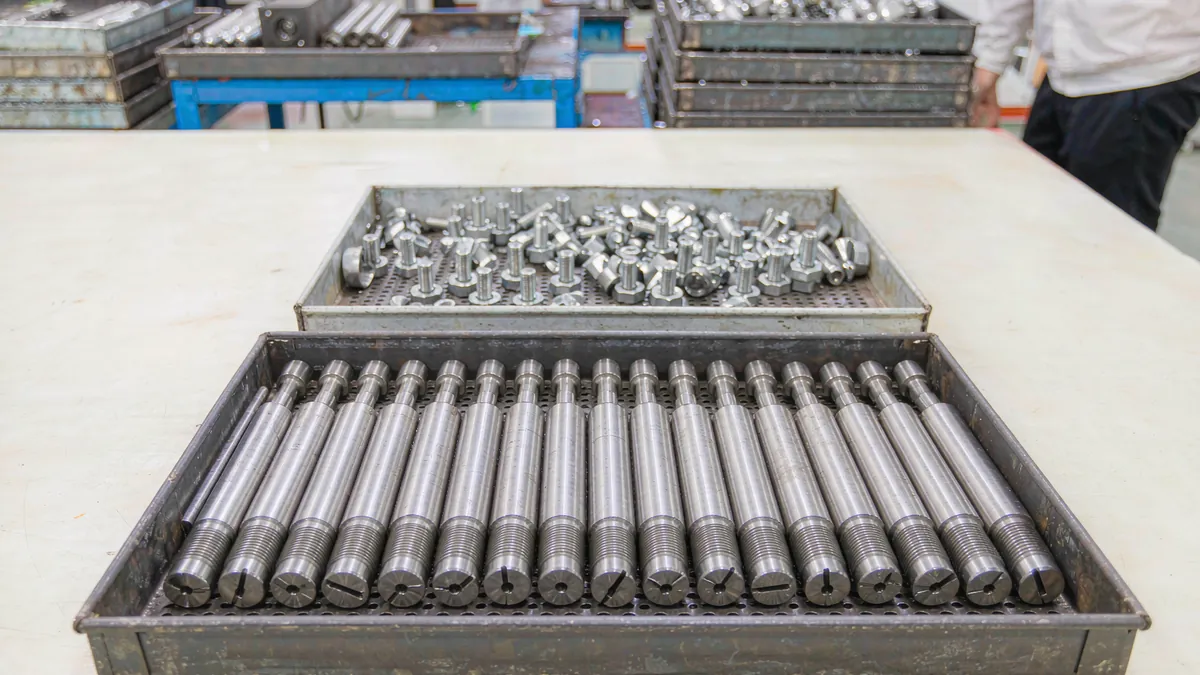
Custom 455 (UNS S45500, ASTM Type XM-16, Carpenter trademark) is a martensitic age-hardenable stainless steel that reaches about 1,700 MPa tensile in the H900 condition — roughly 400 MPa above 17-4 PH at its peak — while staying simple to process. It leaves solution treatment soft (≈30–35 HRC), machines and cold-forms readily, and then a single ageing step at 480–540 °C for 4 hours sets the final properties. Because the treatment is single-stage and low-temperature, dimensional change is minimal (~0.001 in/in contraction), so precision parts can be finish-machined before ageing. The trade-off for all that strength is a chromium content deliberately held at 11–12.5 %, which puts corrosion resistance below 17-4 and firmly in the atmospheric/mild-media category.
| Element | Content (wt %) | Why it matters |
|---|---|---|
| Chromium (Cr) | 11.0–12.5 | Deliberately low: keeps the fully martensitic structure; corrosion is atmospheric-class only |
| Nickel (Ni) | 7.5–9.5 | Toughens the martensite and supports the precipitation system |
| Titanium (Ti) | 0.80–1.40 | The main strengthening element — Ni₃Ti precipitates do most of the work on ageing |
| Copper (Cu) | 1.50–2.50 | Secondary precipitate phase; adds strength without losing ductility |
| Niobium + Tantalum (Nb+Ta) | 0.10–0.50 | Tertiary precipitation strengthening and grain refinement |
| Molybdenum (Mo) | 0.50 max | Residual-level only — 455 is not a pitting-resistant alloy |
| Carbon (C) | 0.05 max | Low-carbon martensite keeps ageing response predictable and toughness acceptable |
| Manganese / Silicon | 0.50 max each | Deoxidation control |
| Iron (Fe) | Balance | — |
The strength of a Custom 455 heat lives or dies on its titanium. If Ti sits at the bottom of the 0.80–1.40 % window, fewer Ni₃Ti precipitates form and aged yield can miss spec. When auditing mill certificates, check Cu, Ti and Nb together — all three drive the ageing reaction, and XRF can verify them in seconds.
Minimum values per ASTM A564 Type XM-16 (bar/forgings, longitudinal; cross-checked against two published tables), with typical Carpenter-class mill values in brackets:
| Condition | Tensile strength | Yield strength (0.2 %) | Elongation | Hardness |
|---|---|---|---|---|
| Condition A — solution treated (machining state) | ≈ 1,000 MPa (typical) | ≈ 793 MPa (typical) | ≥ 10–14 % | ≈ 30–35 HRC |
| H900 — 482 °C / 4 h, air cool | ≥ 1,620 [1,724] MPa | ≥ 1,515 [1,689] MPa | ≥ 8 [10] % | ≥ 47 HRC [49] |
| H950 — 510 °C / 4 h, air cool | ≥ 1,515 [1,620] MPa | ≥ 1,415 [1,551] MPa | ≥ 10 [12] % | ≈ 44 HRC [48] |
| H1000 — 538 °C / 4 h, air cool | ≥ 1,415 [1,448] MPa | ≥ 1,275 [1,379] MPa | ≥ 10 [14] % | ≈ 40 HRC [45] |
| H1050 — 566 °C / 4 h (typical values only) | ≈ 1,310 MPa | ≈ 1,207 MPa | ≈ 15 % | ≈ 40 HRC |
Two design readings that matter more than the raw numbers:
Every mechanical decision on this alloy comes down to one number: the ageing temperature. H900 buys ~200 MPa of yield over H1000 and gives it back in notch sensitivity and toughness. Choose H900 for pure tensile fasteners; choose H1000 for anything threaded, notched or dynamically loaded.
| Property | Value |
|---|---|
| Density | 7.75 g/cm³ (published 7.7–7.8) |
| Melting range | ≈ 1,400–1,450 °C |
| Thermal conductivity (≈100 °C) | ≈ 17–18 W/m·K |
| Specific heat | ≈ 460 J/kg·K |
| Thermal expansion (22–93 °C) | ≈ 10.6 ×10⁻⁶ /K, rising to ≈ 12.0 (22–480 °C) and ≈ 12.5 (22–620 °C) |
| Elastic modulus (room temp) | ≈ 199–200 GPa (shear ≈ 76 GPa, Poisson ≈ 0.30) |
| Electrical resistivity | ≈ 0.80–0.90 µΩ·m (sources differ) |
| Magnetic behaviour | Magnetic in all conditions |
With 11–12.5 % chromium and at most 0.5 % molybdenum, the pitting resistance equivalent is roughly PREN ≈ 13 — below even 17-4 PH (≈16) and far below 304 (≈19). Some supplier sheets call 455 "comparable to 304"; treat that as optimistic marketing. The honest picture:
Selection rule: Custom 455 is the answer when 17-4/15-5 strength is not enough and the medium is atmospheric or mild — not a corrosion upgrade. If the spec says seawater, sour gas or acid, no ageing condition will rescue it; move to a Ni-bearing alloy instead.
| Industry | Typical Custom 455 components |
|---|---|
| Aerospace | High-strength fasteners, structural pins and fittings, actuation springs, landing-gear detail parts at 1,650 MPa class |
| Medical / surgical instruments | Forceps, dental burrs, orthodontic tools, minimally-invasive instrument tips — soft-to-hard processing plus minimal ageing distortion is the draw |
| Valves & fluid control | Valve stems and trim, pump shafts, spring elements where 17-4 yield runs out |
| Instrumentation | Corrosion-resistant instrumentation springs and flexures |
| Power / turbine | Turbine hardware, wear parts below ~300 °C |
| Fasteners / springs | Socket-head cap screws, spring washers, retaining rings at 1,500–1,700 MPa tensile class |
Supply conditions: solution-treated (Condition A) for customers who machine and age in-house, or aged to H900/H950/H1000/H1050 on request. Ageing after delivery is a straightforward 4-hour furnace cycle — confirm your heat-treater holds ±6 °C at temperature.
Machining route. The classic sequence is: buy in Condition A (~30–35 HRC), rough and finish-machine to final size, then age. The single 4-hour ageing cycle at 480–540 °C shrinks the part by only about 0.001 in/in and never needs a re-solution treatment — that is the economic core of the alloy, and it is why dental and surgical manufacturers run 455 through fine CNC work before hardening rather than grinding after it.
Procurement checklist: UNS S45500 + condition (H900/H950/H1000) + product standard + test direction. "Custom 455 H900" without the standard leaves the mill free to certify against the weakest applicable table — and transverse elongation is roughly half the longitudinal value.
When you need roughly 1,650 MPa-class strength that 17-4 cannot reach (17-4 H900 tops out at 1,310 MPa yield), or when minimal heat-treat distortion lets you finish-machine before ageing. If 17-4 strength is enough, buy 17-4 — it has better corrosion resistance and costs less.
H1000 is usually the smarter choice. Notch sensitivity drops noticeably as the ageing temperature rises (notched/smooth ratio ≈1.09 at H900 vs ≈1.32 at H1050), and threads are notches. H900 is for pure tensile duty; H1000 keeps 1,275 MPa yield with meaningfully better toughness.
No. With 11–12.5 % Cr and ≤0.5 % Mo (PREN ≈ 13), it pits readily in chloride media. It is designed for atmospheric and mild environments. For seawater fasteners, look at duplex 2205/2507 or Ni-base grades instead.
Technically yes at 47–49 HRC, but it is tool-destroying work. The whole point of 455 is to machine in Condition A (30–35 HRC) and age afterwards — the ~0.001 in/in distortion is small enough that finish-machined dimensions survive.
Ni₃Ti precipitates do most of the strengthening during ageing. A heat with Ti at the bottom of the 0.80–1.40 % window can miss the aged yield minimum even though the certificate is chemically "in spec". That is why PMI on Ti — alongside Cu and Nb — is worth doing on receipt of critical heats.
Send us your drawing or specification for a quotation — we reply within one business day.
Buy this grade as: Plate · Round bar · Fasteners · Forged rings

Browsing for a grade? The full library of per-grade technical guides is on one list.
Open the list
Which family fits which corrosion or temperature problem — and the selection rules that keep you out of trouble.
Read article
Traceability, honest heats, the documents to demand — and the red flags to walk away from.
Read article