
All grade guides — one page, every alloy we cover
Browsing for a grade? The full library of per-grade technical guides is on one list.
Open the listAlloy 20 exists for one job and does it better than almost anything else at its price: holding dilute-to-moderate sulfuric acid at ambient-to-warm temperature. A 33 % nickel austenitic with deliberate copper and a niobium stabilization, it sits between 904L and the true nickel-base alloys — cheaper than 825 or C-276, far more durable than 316L in H2SO4, and weldable without any post-weld heat treatment. This guide gives the numbers we quote from, plus the limits that decide whether Alloy 20 is the right answer or the wrong one.
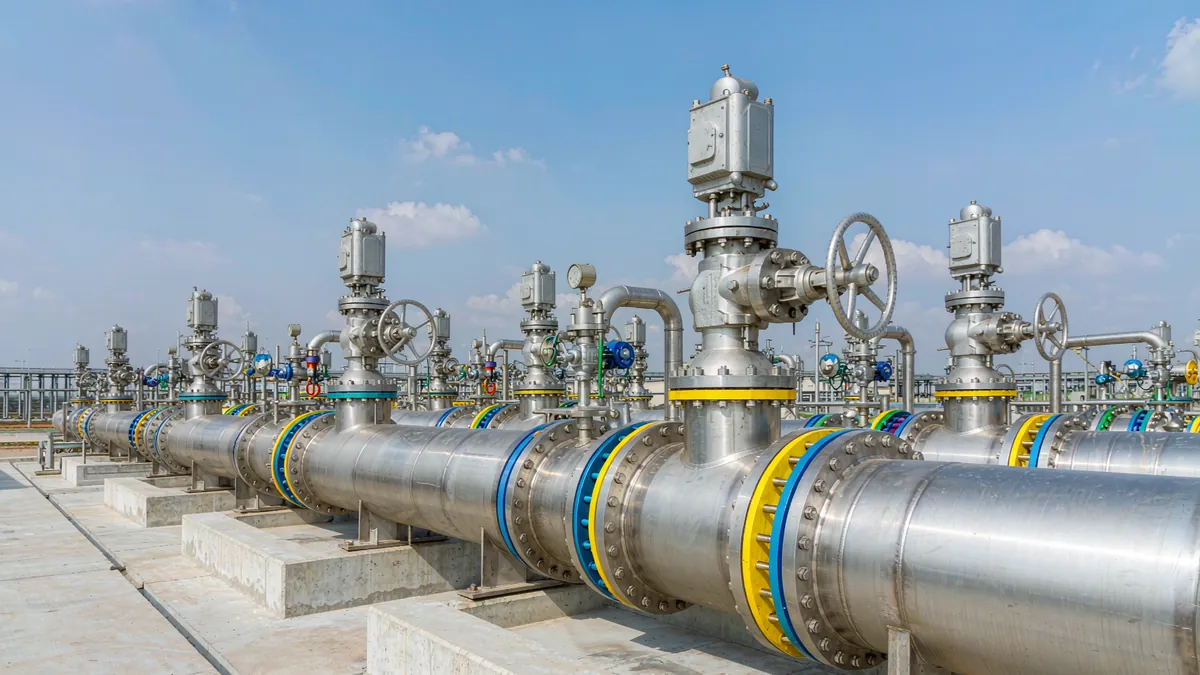
Alloy 20 (UNS N08020, W.Nr 2.4660, NiCr20CuMo, trade names Carpenter 20Cb-3 / Incoloy 020) is a fully austenitic iron-nickel-chromium alloy with roughly 33 % nickel, 20 % chromium, 3.5 % copper and 2.5 % molybdenum, stabilized with niobium at eight times the carbon content. It was developed for the sulfuric-acid duty that 316L could not survive, and that remains its defining application. Five elements do five separate jobs: nickel (32–38 %) keeps the structure austenitic and makes it essentially immune to chloride stress-corrosion cracking; chromium (19–21 %) builds the passive film and carries oxidizing duty; copper (3–4 %) is what actually buys the resistance to reducing acids, above all H2SO4; molybdenum (2–3 %) adds pitting and crevice resistance and some strength; niobium ties up carbon as NbC so the weld heat-affected zone does not sensitize. Because there is no age-hardening and no post-weld heat treatment, Alloy 20 is fabricated like a stainless steel — which is precisely why chemical plant fabricators keep it in the shop.
Compared with its neighbours in the price ladder, Alloy 20 is normally chosen over 904L when the medium is sulfuric acid rather than chloride, over Incoloy 825 when the temperature is moderate and the budget matters, and over Hastelloy C-276 whenever the acid is not hot and concentrated. Cast equivalent is ACI CN-7M; the matching welding consumable is ER320LR / E320LR, deliberately low in carbon and silicon.
| Element | Content (wt %) | Why it matters |
|---|---|---|
| Nickel (Ni) | 32.0–38.0 | Austenite stability; resistance to chloride stress-corrosion cracking |
| Chromium (Cr) | 19.0–21.0 | Passive film, oxidizing-acid resistance, general corrosion barrier |
| Copper (Cu) | 3.0–4.0 | The sulfuric- and phosphoric-acid element — this is why Alloy 20 exists |
| Molybdenum (Mo) | 2.0–3.0 | Pitting / crevice resistance, strength in reducing media |
| Niobium + Tantalum (Nb+Ta) | 8 × C min, 1.00 max | Stabilization: forms NbC instead of Cr carbides, so the weld HAZ stays corrosion resistant |
| Carbon (C) | 0.07 max | Capped low to limit carbide precipitation |
| Manganese (Mn) | 2.00 max | Deoxidation, sulphur control |
| Silicon (Si) | 1.00 max | Deoxidation; kept low for weldability |
| Phosphorus / Sulphur | 0.045 / 0.035 max | Residuals; low sulphur assists hot workability |
| Iron (Fe) | Balance (≈ 35, 29.85 min) | Matrix — Alloy 20 is iron-based, not a nickel-base superalloy |
Two lines on a mill certificate tell you whether you have been offered the real grade. First, Cu must be 3.00–4.00 %: a certificate without copper is not Alloy 20, whatever the trade name on the paperwork. Second, Nb+Ta must be at least 8 × actual carbon (so roughly 0.32–0.56 % at typical carbon levels). At the 0.07 % carbon maximum that gives a 0.56 % Nb+Ta floor. Both values should be reported as heat analysis, not as a generic composition range.
Alloy 20 is supplied solution-annealed. The specification minima are identical across the ASTM product standards, so the table below is a single set of floors with the typical mill-certificate band alongside:
| Product form / standard | 0.2 % yield | Tensile strength | Elongation | Hardness |
|---|---|---|---|---|
| Plate, sheet, strip — ASTM B463 (annealed) | ≥ 241 MPa [276–310] | ≥ 551 MPa [600–690] | ≥ 30 % [40–48] | ≈ 160–190 HB typical |
| Bar and wire — ASTM B473 (annealed) | ≥ 241 MPa [276–310] | ≥ 551 MPa [620–690] | ≥ 30 % [40–45] | ≤ 95 HRB |
| Seamless pipe and tube — ASTM B729 (annealed) | ≥ 241 MPa [270–300] | ≥ 551 MPa [590–680] | ≥ 30 % [38–45] | — |
| Forgings and flanges — ASTM B462 (annealed) | ≥ 241 MPa | ≥ 551 MPa | ≥ 30 % (RA ≥ 50 %) | 160–210 HB typical |
| Cold-drawn bar / wire (cold worked) | agreed on order | 690–860 MPa | 10–25 % | — |
Design notes. Alloy 20 work-hardens quickly — a 50 % cold reduction takes yield past 600 MPa — which is good for shaft and fastener stock and awkward for deep drawing; schedule interstage anneals. Strength retention with temperature is moderate: published factors put tensile strength at roughly 95 % of room-temperature value at 200 °C, 85 % at 300 °C and 70 % at 400 °C, with yield falling a little faster. That is respectable for a 33 % Ni austenitic but it is not a high-temperature alloy — see the limits section below.
| Property | Typical value |
|---|---|
| Density | 8.08 g/cm³ (some datasheets quote 8.05 — allow ±0.5 % on weight estimates) |
| Melting range | ≈ 1,370–1,445 °C (published ranges differ: 1,357–1,446 °C across sources; use ≈ 1,400 °C for design) |
| Thermal conductivity (20 °C) | ≈ 11.8–12.6 W/m·K |
| Specific heat (20 °C) | ≈ 450–500 J/kg·K |
| Mean expansion coefficient (20–100 °C) | ≈ 14.7–14.9 ×10⁻⁶ /K |
| Modulus of elasticity (20 °C) | ≈ 193 GPa |
| Electrical resistivity (20 °C) | ≈ 0.98–1.08 µΩ·m |
| Relative magnetic permeability | ≈ 1.004 — essentially non-magnetic |
The expansion coefficient is the number that matters in piping design: at ~14.8 ×10⁻⁶ /K Alloy 20 expands about 20 % more than carbon steel and slightly less than 304/316, so dissimilar-metal joints to carbon-steel pipe generate meaningful thermal load and need proper expansion provisions. Its thermal conductivity is roughly half that of carbon steel, which is normal for a high-nickel austenitic and should be allowed for in heat-exchanger and jacket design.
Selection rule: Alloy 20 is the sulfuric-acid grade, not a general corrosion grade. Reach for it when the stream is H2SO4-dominated at moderate concentration and moderate temperature, and when you want stainless-steel fabrication practice. If the same stream also carries hot chlorides, or runs above ~425 °C, the correct step-up is Incoloy 825 for a modest premium, or Hastelloy C-276 where the acid is hot and concentrated.
Most sourcing mistakes with this grade come from treating it as a universal upgrade over stainless. It is not. Four situations call for something else:
| Service condition | Why Alloy 20 fails or underperforms | Better choice |
|---|---|---|
| Nitric acid, chromic acid, hot oxidizing chloride solutions | Copper is cathodic to the passive film in strongly oxidizing acids and can accelerate attack; intergranular corrosion is a real risk in HNO3 | 304L / 310S for nitric; C-22 where oxidizing + chloride |
| Hot concentrated HCl, hot concentrated H2SO4 | Not enough Mo/Ni to survive reducing-acid attack at temperature | Hastelloy B-2 (HCl), C-276 / C-22 (mixed) |
| Seawater, brine, chlorinated cooling water | PREN ≈ 26–31: pitting and crevice corrosion initiate readily; Cu addition does not help | 254SMO / AL-6XN (PREN ≈ 43–46) or 625 |
| Continuous service above ~425–450 °C | ASME II-D tabulates N08020 allowables only to moderate temperature; above that carbide/σ-phase reactions cost ductility and the alloy loses its economic advantage | Incoloy 825 to ~540 °C, 625 above |
Hard limits worth writing into a purchase specification: no nitric acid service, no seawater or chloride-brine cooling duty, and no continuous duty above roughly 425–450 °C. If your process crosses one of those lines, the cheap-looking Alloy 20 quote becomes the expensive decision.
| Industry | Typical Alloy 20 components | Why this grade |
|---|---|---|
| Chemical processing | Sulfuric-acid heat exchangers, reactor vessels, storage tanks, transfer lines, bubble caps and trays, pump casings and impellers | H2SO4 resistance at 20–40 % plus weldability without PWHT |
| Pickling & surface treatment | Pickling tanks, hooks, baskets, heating coils, fume ducting for H2SO4 pickling lines | Survives hot dilute sulphuric plus chloride contamination from the bath |
| Fertilizer / phosphoric acid | Phosphoric-acid reactors, slurry lines, filter parts, gypsum-handling wear parts | Fluoride/chloride-bearing wet-process acid |
| Pharmaceutical & fine chemicals | Reactors, centrifuge baskets, dryer internals, solvent-recovery columns | Clean, non-contaminating, easily passivated and cleaned |
| Petrochemical | Alkylation and acid-treating unit piping, spent-acid lines, tanker coils | Mixed acid streams with chloride traces |
| Pulp, paper & mining | Digester fittings, chlorine-dioxide stage piping, autoclave internals in acidic slurries | Combined acid + chloride + abrasion duty |
| Environmental | Scrubber internals, quench nozzles, acid effluent neutralisation tanks | Dilute acid condensates that destroy 316L |
| Product form | ASTM / ASME specification |
|---|---|
| Plate, sheet, strip | ASTM B463 / ASME SB463 |
| Bar, rod, wire | ASTM B473 / ASME SB473 |
| Billets for reforging | ASTM B472 |
| Seamless pipe and tube | ASTM B729 / ASME SB729 |
| Welded pipe | ASTM B464 / ASME SB464 |
| Welded tube | ASTM B468 / ASME SB468 |
| Fittings (seamless and welded) | ASTM B366 / ASME SB366 |
| Forged flanges, fittings, valves, pressure parts | ASTM B462 / ASME SB462 |
| Castings | ACI CN-7M (ASTM A351/A743 family) |
| Welding consumables | ER320LR / E320LR (AWS A5.14 / A5.11) |
| European designation | W.Nr 2.4660, NiCr20CuMo |
All forms are supplied solution-annealed and water-quenched, with EN 10204 3.1 mill certificates as standard and 3.2 on request. For sour service, ask us to confirm whether your specific equipment falls inside the NACE MR0175 / ISO 15156 scope for UNS N08020 before the heat is melted — retro-fitting a hardness or heat-treatment requirement after rolling is expensive.
| Check | What to look for on the documents |
|---|---|
| Grade identity | UNS N08020 (not just "Alloy 20"), W.Nr 2.4660; cast number traceable to the heat |
| Copper | Cu 3.00–4.00 % in the heat analysis — the single most common substitution error |
| Stabilization | Nb+Ta ≥ 8 × C, and ≤ 1.00 % |
| Condition | "Solution annealed and water quenched" stated explicitly, with the annealing temperature range |
| Mechanicals | 551 / 241 / 30 % minimum reported per heat; hardness for bar and forgings |
| Corrosion test | ASTM A262 Practice B or C intergranular test on request, especially for welded plate |
| Certificates | EN 10204 3.1; PMI (XRF) verification of Cu, Mo and Nb before packing |
| Tolerances | Plate thickness to ASTM A480/A480M, edge condition, and UT for pressure-boundary plate |
We supply Alloy 20 in plate, sheet, bar, seamless and welded tube, fittings, flanges and forgings, cut and machined to drawing where required. Typical lead times are 7–15 days for stock sizes and 30–45 days for mill-rolled plate or forged and machined parts. Every shipment carries an EN 10204 3.1 certificate, and we PMI-verify copper and niobium before packing because those two elements are where counterfeits and grade mix-ups show up. Send us the medium, concentration, temperature and the product form and we will tell you honestly whether Alloy 20 is the right grade — or whether you should be buying 825 or C-276 instead.
For H2SO4-dominated streams at 20–40 % concentration and moderate temperature, Alloy 20 is normally the better and cheaper choice because of its 3–4 % copper. 904L wins when the stream carries significant chlorides or needs higher molybdenum for pitting resistance, and it has better availability in Europe. Above roughly 60 °C in 40 % acid, neither is comfortable — move to 825 or C-276.
Metallurgically it is an austenitic iron-nickel-chromium alloy with about 35 % iron; commercially and in the ASTM system it is handled as a nickel alloy under the UNS N-series (N08020) and the nickel-alloy product specifications B463/B473/B729. Fabricators treat it like a stainless steel, which is the practical point.
No. With 2–3 % Mo and no nitrogen its PREN is only about 26–31, so pitting and crevice corrosion start quickly in seawater or chloride brine. For seawater heat exchangers use 254SMO, AL-6XN or 625 instead.
No. It is niobium-stabilized, so the as-welded heat-affected zone stays resistant to intergranular corrosion and no PWHT is required — which is a large part of its appeal for shop fabrication. Do not apply a 650–870 °C stress relief; it would precipitate sigma phase and reduce both toughness and corrosion resistance.
825 has more nickel (38–46 %), more molybdenum (2.5–3.5 %) and titanium stabilization, so it covers a wider mixed-acid envelope and works to higher temperature (about 540 °C). Alloy 20 is the more economical dedicated sulfuric-acid grade. If your duty is straightforward 20–40 % H2SO4 at moderate temperature, Alloy 20 does the job for less; if the stream is mixed or hot, price 825.
Because Alloy 20 is frequently substituted with 904L, 825 or even 316L in the market, and all of them look identical on the shop floor. Only the certificate and a PMI check of copper (3–4 %) and niobium (≥ 8 × C) prove you received N08020.
Send us your drawing or specification for a quotation — we reply within one business day.
Buy this grade as: Plate · Round bar · Seamless tube · Flanges

Browsing for a grade? The full library of per-grade technical guides is on one list.
Open the list
Which family fits which corrosion or temperature problem — and the selection rules that keep you out of trouble.
Read article
Traceability, honest heats, the documents to demand — and the red flags to walk away from.
Read article