
All grade guides — one page, every alloy we cover
Browsing for a grade? The full library of per-grade technical guides is on one list.
Open the list254SMO (UNS S31254, EN 1.4547, W.Nr 1.4547 — also sold as F44 or simply "6Mo") is the reference super-austenitic stainless steel: 20 % chromium, 18 % nickel, 6 % molybdenum, 0.2 % nitrogen and a purposeful 0.7 % copper addition, giving a pitting resistance equivalent number of about 43. It stays fully austenitic — no ferrite, no duplex 475 °C embrittlement limit — and it costs a fraction of a nickel alloy while doing most of the jobs people buy nickel alloys for. This guide collects the numbers, the test data behind the sales claims, and the selection rules we apply when quoting 254SMO plate, sheet, pipe, bar and flanges.
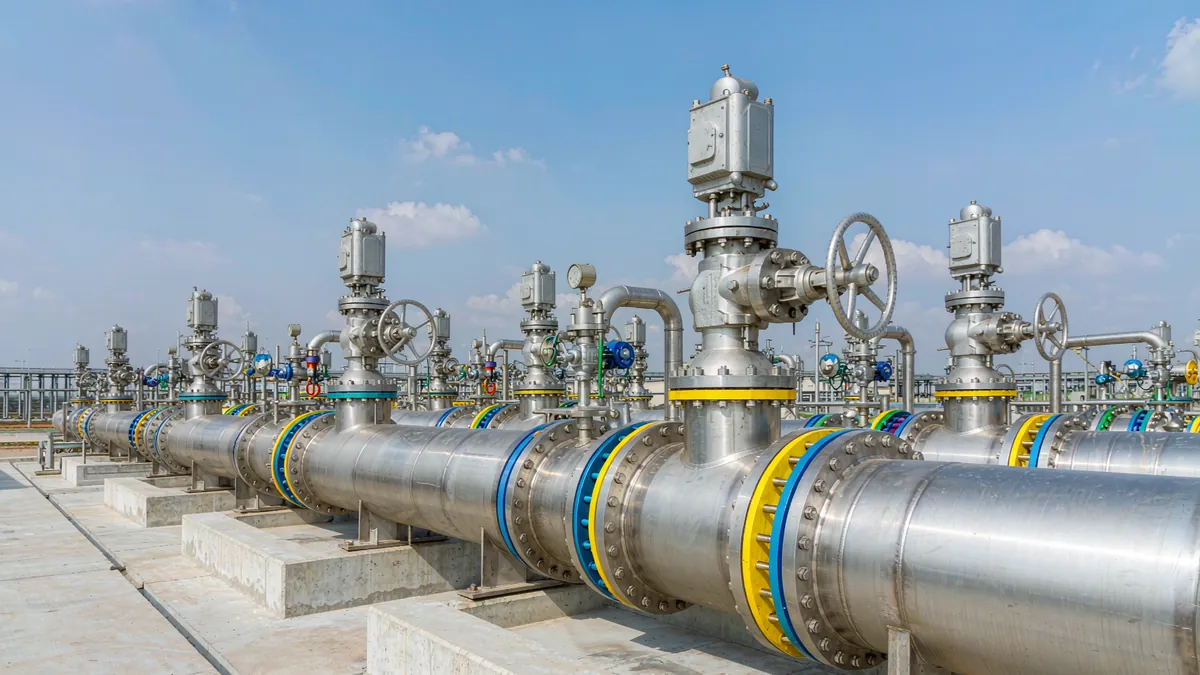
254SMO is a super-austenitic (6 % Mo) stainless steel with a fully austenitic microstructure at all temperatures. It was developed to fill the gap between 316L / 317L and the nickel-base alloys: it carries roughly twice the molybdenum of 316L, four times the nitrogen, and enough nickel (17.5–18.5 %) to remain austenitic even after heavy cold work. The result is a grade with pitting resistance equivalent number (PREN) around 43 — comparable to super duplex 2507 — but with the metallurgical simplicity of an austenitic steel: no ferrite balance to control, no 475 °C embrittlement, no hardness ceiling for sour service, and toughness that stays high down to −196 °C.
Mechanically it is roughly 1.5× the yield strength of 316L thanks to the nitrogen addition, and it work-hardens quickly, which matters for forming and machining. It is not a high-temperature alloy: above roughly 400 °C the risk of sigma-phase precipitation starts to matter in corrosion service. Where 254SMO stops, AL-6XN (higher Ni and Mo), Sanicro 28, Alloy 31 or the Ni-Cr-Mo family (C-276 / C-22) take over.
Commercially, 254SMO is the single most common upgrade we ship for seawater cooling, desalination and flue-gas desulphurisation — the three duties where 316L fails by pitting or crevice corrosion within a few years.
Values below are the ASTM A240 / EN 1.4547 limits (wt %). Note that the European specification opens the molybdenum window to 6.0–7.0 % and nitrogen to 0.25 %, while ASTM closes it at 6.0–6.5 % Mo and 0.18–0.22 % N — a dual-certified heat must satisfy both.
| Element | Content (wt %) | Why it is there |
|---|---|---|
| Chromium (Cr) | 19.5–20.5 | Builds the passive film; the base of both general-corrosion and pitting resistance |
| Nickel (Ni) | 17.5–18.5 | Holds the structure fully austenitic; the main defence against chloride stress-corrosion cracking |
| Molybdenum (Mo) | 6.0–6.5 | The single biggest contributor to pitting and crevice resistance — 3× the molybdenum level of 316L |
| Nitrogen (N) | 0.18–0.22 | Solid-solution strengthener (yield up ~50 % vs 316L) and a strong pitting-resistance contributor despite its low weight |
| Copper (Cu) | 0.50–1.00 | Improves resistance to sulphuric acid and to marine biofouling environments; also aids cold formability |
| Carbon (C) | 0.020 max | Ultra-low to avoid chromium-carbide precipitation (sensitisation) in the weld HAZ |
| Manganese (Mn) | 1.00 max | Deoxidation; also helps nitrogen solubility during melting |
| Silicon (Si) | 0.70–0.80 max | Deoxidation only — kept low because it promotes sigma and intermetallic phases |
| Phosphorus (P) / Sulphur (S) | 0.030 / 0.010 max | Residuals kept tight: P embrittles, S destroys hot ductility and weld soundness |
| Iron (Fe) | balance | Matrix |
PREN calculation (Cr + 3.3 Mo + 16 N): with 20 % Cr, 6.25 % Mo and 0.20 % N the arithmetic gives ≈ 43.8, which is why the mill data sheets quote a PREN of 42–44. For comparison: 316L ≈ 25, 904L ≈ 35, super duplex 2507 ≈ 42, AL-6XN ≈ 47, Alloy 625 ≈ 50.
One practical warning on chemistry: because nitrogen is the cheapest source of pitting resistance in this grade, a heat sitting at the bottom of the nitrogen window (0.18 %) with molybdenum at 6.0 % lands near PREN 41, while one at 0.22 % N and 6.5 % Mo reaches 45. Always read the actual heat analysis on the mill certificate rather than the specification window — it is a legitimate reason to prefer one mill over another.
254SMO is supplied in the solution-annealed condition and cannot be strengthened by heat treatment — only by cold work. Minimum values differ slightly between the ASTM product specifications, which is a common source of confusion in incoming inspection:
| Product form / condition | 0.2 % yield | Tensile strength | Elongation | Hardness |
|---|---|---|---|---|
| Sheet & strip, annealed (ASTM A240) | ≥ 310 MPa | ≥ 690 MPa | ≥ 35 % | ≤ 223 HB |
| Plate, annealed (ASTM A240) | ≥ 310 MPa | ≥ 655 MPa | ≥ 35 % | ≤ 223 HB |
| Bar, annealed (ASTM A276 / A479) | ≥ 310 MPa | ≥ 655 MPa | ≥ 35 % | ≤ 260 HB |
| EN 1.4547, solution annealed (EN 10088-2 / -3) | ≥ 300 MPa | ≥ 650 MPa | ≥ 35 % | ≤ 250 HB |
| Cold-rolled sheet 1.5 mm — typical mill values | 360–390 MPa | 720–760 MPa | 40–45 % | ≈ 180 HB |
| Cold-drawn bar, 20 % reduction — typical | 550–650 MPa | 800–900 MPa | 25–35 % | — |
Design notes that actually change wall thickness:
| Property | Value | Comment |
|---|---|---|
| Density | 8.00 g/cm³ | Use 8.0 for mass calculations; identical to 904L, marginally below 316L (8.0) |
| Melting range | ≈ 1,320–1,390 °C | Some mill data sheets quote 1,360–1,405 °C; the difference does not affect welding practice |
| Thermal conductivity, 20 °C | ≈ 14 W/m·K | Only ~60 % of carbon steel — heat stays in the weld, distortion is the main welding problem |
| Thermal conductivity, 200 °C | ≈ 16 W/m·K | Rises slowly with temperature |
| Specific heat capacity | ≈ 500 J/kg·K | 20–100 °C |
| Mean thermal expansion, 20–100 °C | ≈ 16.5 ×10⁻⁶ /K | Expansion is close to 316L but 1.6× carbon steel — design expansion loops accordingly |
| Mean thermal expansion, 20–400 °C | ≈ 17.0 ×10⁻⁶ /K | — |
| Modulus of elasticity, 20 °C | 195 GPa | Slightly below carbon steel (210 GPa); lower stiffness means more deflection for the same section |
| Electrical resistivity, 20 °C | ≈ 0.85 µΩ·m | About 50× carbon steel — relevant for resistance welding and electrical earthing |
| Magnetic behaviour | Non-magnetic when solution annealed (µ < 1.005) | Heavy cold work (bending, drawing, thread rolling) generates a little strain-induced martensite and a measurable magnet response — normal, not a grade error |
The combination of low conductivity and high expansion is the reason 254SMO weldments distort more than carbon steel ones. It is not a defect of the alloy; it simply has to be planned for with balanced welding sequences, strongbacks and adequate tacking.
Pitting and crevice corrosion. In ASTM G48 ferric-chloride testing, 254SMO typically shows a critical pitting temperature (CPT) around 85–95 °C and a critical crevice temperature (CCT) around 60–70 °C. 316L fails both tests below 25 °C. That gap is the whole commercial case for the grade: it means uncoated 254SMO survives chlorinated seawater at 40–50 °C where 316L pits through in months.
Chloride stress-corrosion cracking. With 18 % nickel and a fully austenitic structure, 254SMO resists SCC in boiling MgCl₂ U-bend tests to well above the temperatures 304 and 316L tolerate, and it does not show the SCC threshold behaviour of the duplex grades. For hot chloride environments where duplex would be limited by its ferrite phase, 254SMO is usually the simpler answer.
Acids. Good in oxidising acids (nitric, chromic) and in dilute sulphuric and phosphoric acid at moderate temperature; the copper addition helps in sulphuric acid and in seawater. It is not a hydrochloric-acid alloy — hot HCl, even dilute, requires the Ni-Mo family (B-2 / B-3) or C-276.
Seawater. The classic application. 254SMO is used uncoated for seawater-cooled heat exchangers, pump casings, valve bodies, piping and desalination equipment, and tolerates stagnant conditions far better than 316L because crevices under gaskets and deposits stay passive. Practical limits to respect: avoid permanent stagnation combined with high temperature (above ~50 °C and no flow, chlorination still matters), and keep flow velocity within the erosion-corrosion envelope for the piping design.
| Grade | PREN | Mo | Structure | Typical ceiling in chlorinated seawater |
|---|---|---|---|---|
| 316L | ≈ 25 | 2–3 % | Austenitic | < 30 °C, low chloride, no crevices |
| 904L | ≈ 35 | 4–5 % + Cu | Austenitic | ~ 35–40 °C; acid duty rather than seawater duty |
| 254SMO | ≈ 43 | 6–6.5 % + N | Fully austenitic | 50–60 °C continuous, higher with chlorination control |
| 2507 super duplex | ≈ 42 | 3–5 % + N | Ferrite + austenite | Similar, but limited to ~250 °C by embrittlement and harder to weld |
| AL-6XN | ≈ 47 | 6–7 % + N | Fully austenitic | Slightly better than 254SMO; higher Ni improves SCC and caustic |
| Alloy 625 | ≈ 50 | 8–10 % + Nb | Nickel-base | Highest, at 3–4× the price |
Selection rule: choose 254SMO when the medium is chloride-bearing water at 30–60 °C, when the structure must be fully austenitic (no duplex ferrite limits, cryogenic toughness, sour service without a hardness ceiling), and when PREN 43 is enough. Step up to AL-6XN when you also need higher nickel for SCC or caustic, and to C-276 / C-22 only when the acid is hot and reducing. Do not use 254SMO for hot concentrated HCl, or above ~400 °C in corrosive service.
| Industry | Typical 254SMO components | Why the grade is specified |
|---|---|---|
| Desalination (MSF / MED / RO) | Brine heater tube sheets, evaporator shells, brine piping, RO high-pressure headers, energy-recovery valve bodies | Hot aerated brine at 60–110 °C with chlorides above 50,000 mg/L — 316L and even 904L pit within a campaign |
| Offshore oil & gas / marine | Seawater lift and cooling lines, fire-water systems, deluge nozzles, hull penetrations, ballast piping, subsea clamp hardware | Chloride SCC immunity, no ferrite for sour service, tough at −40 °C and below |
| Pulp & paper | Bleach-plant washers and drum filters, chlorine-dioxide mixer housings, white-water piping, digester flash tanks | Chlorine dioxide and chloride mixtures at 60–90 °C; 316L is not an option |
| Power generation / FGD | Absorber internals, mist eliminator washing headers, dampers, flue-gas reheat tubing, gypsum dewatering | Chloride-rich, low-pH condensates with sulphite — the classic 254SMO duty |
| Chemical & pharmaceutical | Reactors, centrifuge baskets, crystalliser internals, tank linings, nitric/phosphoric acid transfer lines | Oxidising acids with chlorides; low carbon avoids sensitisation after welding |
| Water treatment & environmental | Brine concentrators, MBR housings, chlorine dosing lines, sludge incinerator scrubbers | Hypochlorite and chloride at ambient to 50 °C |
| Shipbuilding | Exhaust gas cleaning (scrubber) systems, seawater piping, propellers shafts sleeves | Approved by the major class societies for seawater systems; weldable on site |
Beyond these, 254SMO is frequently used as a weld overlay or cladding on carbon-steel vessels and as expansion bellows and flexible hoses where the combination of fatigue life and chloride resistance is the deciding factor.
| Product form | Specification | Remarks |
|---|---|---|
| Plate, sheet, strip | ASTM A240 / ASME SA-240 (UNS S31254); EN 10088-2 (1.4547) | Most common supply; 2B, 2D, No.1 and pickled finishes |
| Bar, rod, wire rod | ASTM A276, ASTM A479 / ASME SA-479 | A479 for pressure-retaining bolting and bar stock |
| Seamless pipe | ASTM A312 / ASME SA-312; ASTM A213 for tube | Schedules 5S to 80S typical |
| Welded pipe and tube | ASTM A249, A269, A358 | Filler must be over-alloyed (see welding notes) |
| Flanges and forged fittings | ASTM A182 F44; ASTM A403 WP-S31254 | F44 is the grade identifier on the flange stamp |
| Castings | ASTM A351 CK3MCuN (cast equivalent) | Valve bodies, pump casings; mechanical values differ from wrought |
| Weld consumables | AWS A5.14 ERNiCrMo-3; AWS A5.11 ENiCrMo-3; matching 20/18/6CuN coated electrodes where available | 625-type filler is the standard overmatched choice |
| European / industry | EN 1.4547 (X1CrNiMoN20-18-7); NORSOK MDS R11–R18; NACE MR0175 / ISO 15156 | NORSOK and NACE qualification often required offshore |
Note on the grade name: 254SMO is a trademark (Outokumpu), and the same UNS S31254 chemistry is sold as F44, 6Mo, 1.4547 or 20-18-6. For purchasing, the UNS number on the certificate is what matters — not the trade name. See also the separately published AL-6XN guide, which is the higher-nickel US cousin of this grade and is not interchangeable without a design review.
Solution anneal at 1,150–1,200 °C and quench rapidly (water or forced air, depending on section). This is the only heat treatment that should ever be applied. Stress-relief anneals below 550 °C are possible but only partially effective; for critical corrosion duty, a full solution anneal is the correct answer after heavy forming or field repair.
We supply 254SMO (UNS S31254 / EN 1.4547) plate from 3 to 60 mm, sheet and coil from 0.5 mm, round bar from 6 mm, seamless and welded pipe and tube, plus A182 F44 flanges and machined parts to drawing. Every shipment carries an EN 10204 3.1 mill certificate with the actual heat analysis, and PMI verification is done in-house before packing so the Mo and N values are confirmed rather than assumed. Standard stock sizes ship in 7–15 days; mill-rolled or forged items in 30–45 days. Send us the medium, the temperature and the chloride level and we will tell you honestly whether 254SMO is the right grade — or whether you should be looking at AL-6XN, 904L or a nickel alloy instead.
In the solution-annealed condition it is non-magnetic (permeability below 1.005). After heavy cold work such as bending, drawing or thread rolling, a small amount of strain-induced martensite raises the magnet response slightly — that is normal and does not indicate the wrong grade or a corrosion problem.
Both are 6 % Mo super-austenitic stainless steels, but AL-6XN (UNS N08367) carries 23.5–25.5 % nickel against 17.5–18.5 % for 254SMO, and up to 7 % Mo. That gives AL-6XN a slightly higher PREN (≈ 47 vs ≈ 43), better chloride SCC and caustic resistance, and better weld-metal tolerance — at 40–50 % higher cost. 254SMO is the standard choice; AL-6XN is the upgrade when nickel content itself is the requirement.
Only in chloride/seawater duty. For sulphuric and phosphoric acid, 904L is often the better and cheaper choice because its 1–2 % copper is specifically there for reducing-acid service. Where the mechanism is pitting or crevice corrosion in chlorides, 254SMO's PREN of 43 against 35 makes it clearly superior.
Short-term mechanical strength is retained to about 550 °C, but for corrosion service the practical limit is around 400 °C. Above roughly 600 °C, sigma phase and other intermetallics precipitate, reducing toughness and corrosion resistance. For continuous high-temperature duty, use a nickel-base grade such as 625 or 601 instead.
ERNiCrMo-3 (AWS A5.14, Alloy 625 type) for TIG/MIG and ENiCrMo-3 for covered electrodes. The filler is deliberately over-alloyed because the weld metal loses some molybdenum and nitrogen during solidification; a matching-composition filler without excess alloy gives a weld that pits before the parent metal.
Yes — being fully austenitic it has no ferrite phase and therefore none of the hardness or temperature limits that constrain duplex steels under NACE MR0175 / ISO 15156. It is widely used for sour seawater and sour gas piping, but the specific partial pressure and pH conditions still have to be checked against the standard for the application.
Send us your drawing or specification for a quotation — we reply within one business day.
Buy this grade as: Plate · Seamless tube · Elbows · Reducers · Welding wire

Browsing for a grade? The full library of per-grade technical guides is on one list.
Open the list
Which family fits which corrosion or temperature problem — and the selection rules that keep you out of trouble.
Read article
Traceability, honest heats, the documents to demand — and the red flags to walk away from.
Read article