
All grade guides — one page, every alloy we cover
Browsing for a grade? The full library of per-grade technical guides is on one list.
Open the listZeron 100 (UNS S32760, W.Nr 1.4501, forging grade F55) is the tungsten- and copper-bearing branch of the 25Cr super duplex family. On paper it is a near-twin of 2507: same 550 MPa yield, same PREN band around 42, same 300 °C ceiling. In practice the 0.5–1.0 % tungsten and 0.5–1.0 % copper change where it wins — warmer, sourer, more acidic chloride service, and welds that tolerate a little more heat input. This guide explains the difference with numbers rather than marketing, and gives the purchasing checks that actually separate the two grades on a certificate.
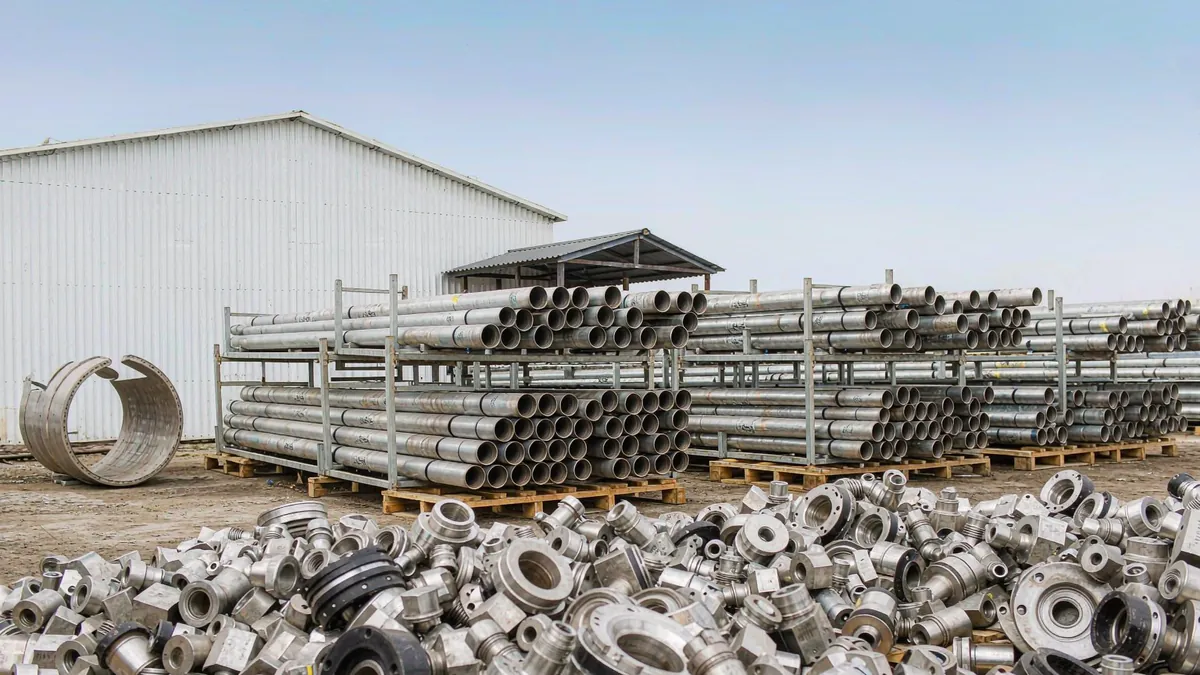
Zeron 100 is a super duplex stainless steel with nominally 25 % Cr, 7 % Ni, 3.5 % Mo, 0.25 % N, plus 0.5–1.0 % tungsten and 0.5–1.0 % copper. It is standardised as UNS S32760, EN 1.4501 (X2CrNiMoCuWN25-7-4), and as forging grade F55 under ASTM A182. The microstructure is the usual roughly 50/50 austenite-ferrite duplex, solution annealed and water quenched. Tungsten adds pitting and crevice resistance at temperature and is credited in the PREN formula at half weight; copper improves resistance to sulphuric acid and other reducing acids and helps in sour service. The result is a grade that behaves like 2507 in clean seawater but has more margin in warm, sour or acidic chloride duty — and is correspondingly less available and more expensive.
Zeron 100 is a trade name (originally Langley Alloys, now part of the Rolled Alloys group); the generic designation is UNS S32760 or 25Cr super duplex with W. When you specify it, specify S32760 and the property requirements, not only the brand name.
ASTM A240 limits for UNS S32760:
| Element | Content (wt %) | Why it matters |
|---|---|---|
| Chromium (Cr) | 24.0–26.0 | Passive film; base of pitting and general corrosion resistance |
| Nickel (Ni) | 6.0–8.0 | Holds the austenite fraction near 50 % — critical for toughness and weld phase balance |
| Molybdenum (Mo) | 3.0–4.0 | Pitting and crevice resistance in chlorides; slightly narrower window than 2507 |
| Tungsten (W) | 0.5–1.0 | The differentiator: improves pitting/crevice resistance at elevated temperature; counted as 0.5 W in PREN |
| Copper (Cu) | 0.5–1.0 | Resistance to sulphuric and other reducing acids; assists in sour service |
| Nitrogen (N) | 0.20–0.30 | Austenite former, strength, PREN contributor (16 × N) |
| Carbon (C) | 0.030 max | Ultra-low to avoid carbide precipitation in the HAZ |
| Manganese (Mn) | 1.00 max | Deoxidation and nitrogen retention |
| Silicon (Si) | 0.80 max | Deoxidation; excess promotes sigma phase |
| Phosphorus / Sulphur | 0.030 / 0.010 max | Tramp control; the tight sulphur limit matters for weld cracking and pitting |
| Iron (Fe) | Balance | — |
PREN with tungsten: Cr + 3.3 (Mo + 0.5 W) + 16 N. At a typical heat (25.0 Cr, 3.5 Mo, 0.75 W, 0.25 N) this gives 25.0 + 3.3 × 3.875 + 16 × 0.25 = ≈ 41.8. At the specification minimums it drops to about 38, so as with 2507 the PREN must be stated as a requirement (≥ 40) rather than inferred from the element table. Note also that the Mo window (3.0–4.0) is narrower than 2507's (3.0–5.0): the tungsten is doing part of the job, which is why a certificate with 3.0 Mo and 0.5 W is legal but sits at the bottom of the performance band.
Code minima with typical mill-certificate ranges in brackets. The grade is supplied solution annealed; it is not strengthened by ageing:
| Product form / standard | Yield strength 0.2 % | Tensile strength | Elongation | Hardness |
|---|---|---|---|---|
| Plate & sheet — ASTM A240 | ≥ 550 MPa [600–700] | ≥ 750 MPa [800–900] | ≥ 25 % [25–32] | ≤ 310 HBW [250–290] |
| Bar & rod — ASTM A276 / A479 | ≥ 550 MPa [610–730] | ≥ 750 MPa [800–920] | ≥ 25 % [25–30] | ≤ 310 HBW |
| Seamless tube — ASTM A790 / A789 | ≥ 550 MPa [600–720] | ≥ 750 MPa [800–900] | ≥ 25 % [25–35] | ≤ 310 HBW |
| Forgings, flanges — A182 F55 / A815 | ≥ 550 MPa [580–700] | ≥ 750 MPa [780–880] | ≥ 25 % [25–30] | ≤ 310 HBW |
Additional requirements that usually appear on the order rather than in the standard:
| Property | Value |
|---|---|
| Density | 7.81 g/cm³ (published range 7.80–7.84) |
| Melting range | ≈ 1,350–1,400 °C (some datasheets quote 1,400–1,450 — confirm with the mill) |
| Modulus of elasticity (20 °C) | 199–200 GPa |
| Thermal conductivity (20 °C) | ≈ 14.2 W/m·K |
| Specific heat (20 °C) | ≈ 475–480 J/kg·K |
| Electrical resistivity (20 °C) | ≈ 0.80–0.86 µΩ·m |
| Mean expansion 20–100 °C | ≈ 13.0 ×10⁻⁶ /K (some sources 11.1–12.8; verify per heat) |
| Ferrite content (annealed) | 35–55 % |
| Magnetic behaviour | Strongly ferromagnetic (relative permeability of the order of 30) |
The physical data are close enough to 2507 that they do not drive a selection decision between the two. Where they do matter is in mixed-metal assemblies: Zeron 100 welded to carbon steel or to 316L brings a thermal expansion mismatch of roughly 3–4 ×10⁻⁶ /K against the austenitic, so restraint and joint design deserve attention in cyclic service. The high conductivity (about twice austenitic stainless) is an advantage in seawater coolers and a complication in welding, because heat leaves the pool quickly and lack of fusion becomes the defect to watch.
| Environment | Zeron 100 behaviour | Comment |
|---|---|---|
| Seawater, ambient and warm | Excellent to ≈ 50 °C | The W addition buys margin over 2205 in warm, flowing or creviced seawater |
| Chloride SCC | Excellent | Duplex microstructure suppresses transgranular chloride SCC — the reason it replaces 316 in coastal and marine work |
| Sour service (H₂S) | Good within the MR0175 envelope | Cu and W help; hardness ≤ 32 HRC and the pH₂S/temperature limits still govern |
| Dilute and moderate sulphuric acid | Good, better than 2507 | Copper is the reason; still not a substitute for Alloy 20 or 904L at high concentration |
| Hydrochloric acid | Not recommended | Same limitation as all duplex grades — use C-276 or 625 |
| Phosphoric acid (wet process) | Good | Common in fertiliser plants, often with chloride and fluoride impurities — validate with plant data |
| Oxidising chloride (hypochlorite, ClO₂) | Conditional | The weak point of every duplex; test before committing |
| Caustic and amine service | Good to moderate conditions | Watch SCC at high concentration and temperature |
Published pitting data put the critical pitting temperature (ASTM G48 method C) at roughly 80–90 °C and the critical crevice temperature (method D) at roughly 55–70 °C, essentially the same band as 2507. The difference the tungsten makes is not a step change in CPT — it is behaviour at temperature and in crevices, and in sour or acidic brines where the copper contributes. Be sceptical of claims that Zeron 100 is a whole corrosion class above 2507; the honest statement is that it has more margin in the specific environments where W and Cu act.
Selection rule: 2507 and Zeron 100 are interchangeable in clean, warm seawater. Choose Zeron 100 when the medium also contains H₂S, dilute sulphuric or phosphoric acid, or when the weld procedure cannot be held to tight heat input and you want the extra tolerance. Choose 2507 when availability and price dominate and the environment is straightforward. Neither is a solution for hot concentrated HCl.
| Temperature band | What happens | What to do |
|---|---|---|
| −50 to +50 °C | Full toughness (45 J minimum at −46 °C) and full corrosion performance | Standard supply; specify impact testing for offshore |
| 50–250 °C | Normal design range for pressure equipment | Use code allowable stresses |
| 250–315 °C | Practical ceiling; 475 °C embrittlement begins around 300 °C | ASME VIII Div. 1 lists duplex to 315 °C only — above that, change material family |
| 600–900 °C | Sigma and chi phase precipitation, rapid at 800–850 °C | Never stress-relieve in this window; it is not recoverable without a full re-anneal |
| > 900 °C | Oxidation, grain growth | Not a service condition |
Solution annealing is carried out at 1,040–1,120 °C followed by water quenching or forced rapid cooling. Any thermal operation between 600 and 950 °C — stress relief, hot straightening, slow cooling after forming — is a defect, not a process step. If a customer's specification calls for PWHT on a Zeron 100 vessel, that is a technical conversation to have before the purchase order, not after.
| Industry | Typical Zeron 100 components |
|---|---|
| Offshore oil & gas | Seawater lift and firewater pumps, valve bodies and trim, subsea manifolds, HIP and forged hubs, riser components, sour-service piping |
| Desalination | Brine pumps, high-pressure RO pipework, energy-recovery housings, evaporator internals |
| Chemical & fertiliser | Phosphoric and sulphuric acid handling, reactor internals, heat exchangers, acid coolers |
| Marine & shipbuilding | Propellers and shafting, rudder stocks, sea-water systems, cargo pumps on chemical tankers |
| Power & environmental | FGD absorber internals and recirculation piping, flue-gas desulphurisation pumps, wastewater systems |
| Pulp & paper | Digesters, blow lines, bleach-plant piping, black-liquor handling |
| Hydropower & mining | Erosion-corrosion resistant liners, slurry pump components, penstock sections |
Because Zeron 100 is usually chosen for the hardest part of a system, it tends to appear as castings and forgings — pump casings, impellers, valve bodies, hubs — rather than as plate. That makes foundry and forge-shop capability, and the heat treatment that follows, more important than the mill certificate alone. Ask for the quench record and the ferrite measurement on the finished part.
| Property | 2205 (S32205) | 2507 (S32750) | Zeron 100 (S32760) |
|---|---|---|---|
| Cr / Ni / Mo | 22 / 5.5 / 3.0 | 25 / 7 / 4.0 | 25 / 7 / 3.5 + 0.75 W |
| Nitrogen | 0.14–0.20 | 0.24–0.32 | 0.20–0.30 |
| Copper | — | 0.50 max (residual) | 0.50–1.00 (deliberate) |
| PREN | 34–36 | 40–43 | ≥ 40 (typ. 42–43) |
| Min. yield / tensile | 450 / 620 MPa | 550 / 795 MPa | 550 / 750 MPa |
| CPT (G48 C) | 50–60 °C | 80–90 °C | 80–90 °C |
| Sour service | Limited | MR0175 within envelope | MR0175, wider practical margin |
| Sulphuric acid | Poor to fair | Fair | Fair to good (Cu) |
| Availability | Very wide | Wide | Narrower, mill-dependent |
| Relative price | 1.5–2.0× 316L | 2.2–3.0× 316L | 2.4–3.2× 316L |
The commercially useful conclusion: if a project already specifies S32750, substituting S32760 is a technical upgrade but usually a schedule risk, because fewer mills roll it and fewer distributors stock it. If a project specifies S32760 for sour or acidic duty, substituting 2507 needs a corrosion review, not just a price comparison.
| Parameter | Recommendation | Why |
|---|---|---|
| Filler metal | ER2594 / E2594 (25 9 4 N L); proprietary matching consumables also exist | Maintains PREN and phase balance; ER2209 under-matches and must not be used |
| Preheat | None | No hardening mechanism to worry about; preheat only shifts phase balance |
| Heat input | 0.5–1.5 kJ/mm, hard cap 2.0 | Zeron 100 tolerates slightly more than 2507, but the sigma-phase risk is the same |
| Interpass temperature | ≤ 150 °C | Avoids intermetallic precipitation in multipass joints |
| Root purge | Argon, or Ar + 2–5 % N₂ | Nitrogen backing restores austenite in the root and preserves pitting resistance |
| Post-weld heat treatment | None; if unavoidable, full solution anneal 1,040–1,120 °C + water quench | Stress relief in the 600–900 °C window destroys the grade |
| Post-weld cleaning | Pickle and passivate | Heat tint is a crevice corrosion initiation site |
| Ferrite in weld | 35–55 % | Outside the band, toughness and corrosion resistance both suffer |
Machining: like 2507, Zeron 100 work-hardens under a dull edge. Rigid set-up, low surface speed (30–50 m/min with carbide), high feed, flood coolant, and no dwelling in the cut. Threads and deep bores are where most scrap is generated — plan the sequence so the critical surfaces are cut while the material is still soft.
Forming: cold forming is practical at moderate strain; above roughly 10–15 % deformation, re-anneal before service. Hot forming must finish above 950 °C and be followed by a full solution anneal and water quench. Do not air-cool.
The substitution trap: a supplier quoting "super duplex" at a good price may be offering S32750 or even S31803 as an "equivalent". They are not equivalent once tungsten and copper are part of the design basis. Put the UNS number and the W/Cu ranges on the order, and verify them by PMI on receipt.
We supply S32760 as plate, bar, seamless tube, and as forged and rolled rings, flanges and machined components to drawing. For super duplex rings the critical control is the quench after solution annealing — we record it, and we can release the chart with the certificate. Every shipment carries EN 10204 3.1 documentation and PMI; ASTM G48 and Charpy testing can be arranged with third-party witnessing at the buyer's cost. Lead times are typically 15–25 working days for stock plate and bar and 35–50 days for forged rings, depending on size and quantity. If your project is comparing S32750 and S32760, send us the medium, temperature and H₂S partial pressure and we will tell you honestly which one the service actually needs.
No. 2507 is UNS S32750 (no deliberate tungsten or copper); Zeron 100 is UNS S32760 with 0.5–1.0 % W and 0.5–1.0 % Cu. Strength and PREN are similar, but S32760 has more margin in warm, sour and acidic chloride service. They are not interchangeable on a certificate.
Yes, strongly — the ferrite phase makes it ferromagnetic, with a relative permeability of the order of 30. A magnet test cannot distinguish it from 2507, 2205 or carbon steel; use PMI.
It is listed in NACE MR0175 / ISO 15156 within a defined envelope of pH₂S, temperature and hardness (≤ 32 HRC). Copper and tungsten give it useful margin, but the envelope — not the grade name — determines acceptability for a specific well.
ER2594 (25 9 4 N L) for TIG/MIG and E2594 for covered electrodes. Proprietary matching consumables exist for Zeron 100. ER2209 must not be used because the weld would have a lower PREN than the base metal.
Fewer mills roll S32760 and fewer distributors stock it, so availability is narrower and lead times longer, especially for heavy plate and large forgings. For a straightforward warm-seawater application, 2507 is usually the pragmatic choice; for sour or acidic duty, the wait is justified.
Send us your drawing or specification for a quotation — we reply within one business day.
Buy this grade as: Plate · Round bar · Seamless tube · Flanges

Browsing for a grade? The full library of per-grade technical guides is on one list.
Open the list
Which family fits which corrosion or temperature problem — and the selection rules that keep you out of trouble.
Read article
Traceability, honest heats, the documents to demand — and the red flags to walk away from.
Read article