
All grade guides — one page, every alloy we cover
Browsing for a grade? The full library of per-grade technical guides is on one list.
Open the listPH 13-8 Mo is what you specify when 17-4 PH is strong enough but not tough enough, or when a 1,400 MPa part has to survive a chloride environment without stress-corrosion cracking. It is a martensitic precipitation-hardening stainless steel — 13 % chromium, 8 % nickel, 2 % molybdenum and about 1 % aluminium — normally vacuum melted, aged in a single low-temperature step, and available from 1,000 to 1,415 MPa yield out of the same heat treatment furnace. This guide covers the AMS values by condition, the SCC trade-off that decides between H950 and H1025, and the purchasing checks that keep a 17-4 bar from arriving with a 13-8 certificate.
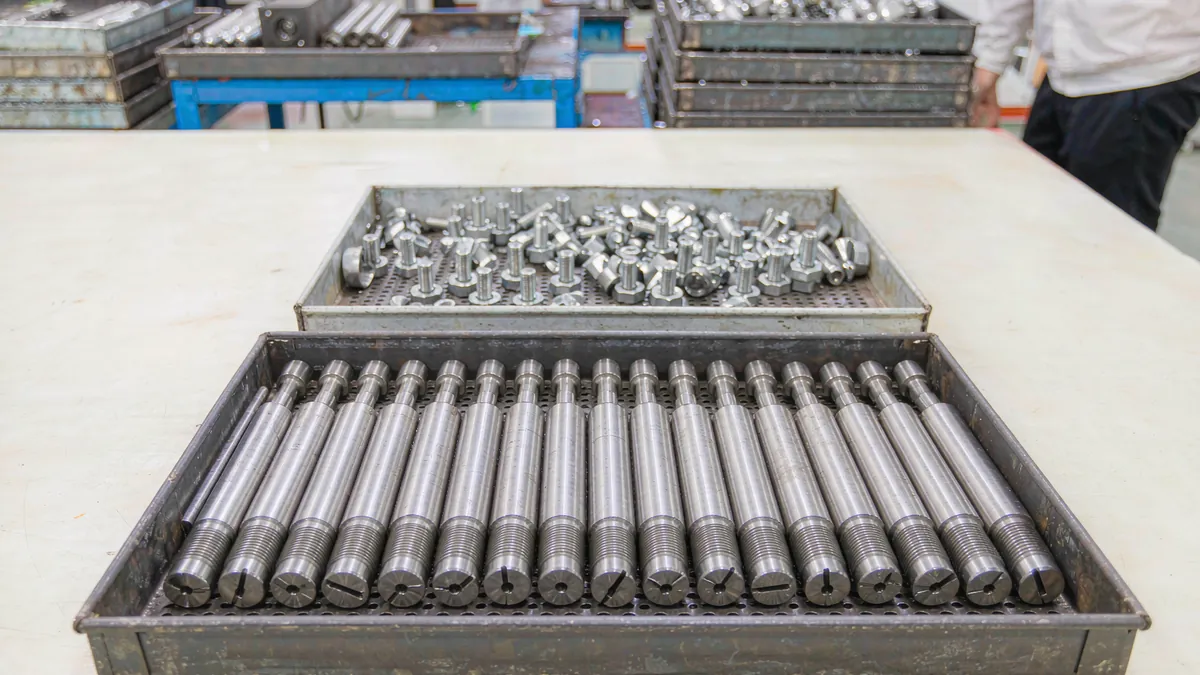
PH 13-8 Mo (UNS S13800, W.Nr 1.4534, X3CrNiMoAl13-8-2, ASTM A564 type XM-13, AMS 5629 for bar and forgings) is a martensitic precipitation-hardening stainless steel hardened by aluminium rather than copper. The matrix is a low-carbon 13 % Cr martensite; the strengthening comes from fine NiAl precipitates formed during a single 4-hour age between 510 and 620 °C. Nothing else in the common PH family combines this strength level with this toughness and this resistance to stress-corrosion cracking.
The grade was developed for airframe and nuclear hardware where a 17-4 PH part was either too brittle in thick section or cracked in service under sustained tensile stress in a marine atmosphere. Compared with 17-4 PH it adds 2 % molybdenum and 1 % aluminium, drops silicon and manganese to 0.10 % max, and is normally vacuum induction melted and vacuum arc remelted (VIM-VAR) to keep inclusion content low. That is also why it costs two to three times as much per kilogram.
Where it sits: 17-4 PH (1,170 MPa, PREN ≈ 16) → 15-5 PH (same strength, better transverse toughness) → 13-8 Mo (1,415 MPa, PREN ≈ 20, best SCC resistance) → Custom 465 (1,620 MPa, higher again). Each step buys strength or toughness and pays in price, lead time and welding difficulty.
Heat analysis per AMS 5629 / ASTM A564 type XM-13 (wt %):
| Element | Content (wt %) | What it does |
|---|---|---|
| Chromium (Cr) | 12.25-13.25 | Passive film. Deliberately close to 12 % — enough for atmospheric and mild chemical service, not enough for aggressive chloride |
| Nickel (Ni) | 7.50-8.50 | Keeps the matrix austenitic at solution temperature so it transforms to martensite on cooling; part of the NiAl precipitate |
| Molybdenum (Mo) | 2.00-2.50 | Pitting resistance (the main corrosion advantage over 17-4 PH) and tempering resistance |
| Aluminium (Al) | 0.90-1.35 | The hardening element: forms the NiAl precipitates. This is the number to control, not just to report |
| Carbon (C) | 0.05 max | Low carbon keeps the martensite tough and avoids chromium carbides |
| Manganese (Mn) | 0.10 max | Deliberately low — residual Mn degrades toughness and cleanliness |
| Silicon (Si) | 0.10 max | Also deliberately low; silicon embrittles these martensites |
| Phosphorus / Sulphur (P / S) | 0.010 / 0.008 max | Tight residuals — this is an aerospace-cleanliness specification, not a commercial stainless one |
| Nitrogen (N) | 0.010 max | Nitrogen ties up aluminium as nitrides and removes it from the hardening reaction |
| Iron (Fe) | Balance | Matrix |
Two composition notes worth a minute of a buyer's time.
The aluminium window is narrower than many catalogue pages suggest. Distributor tables sometimes print Al 0.75-1.50 % and Mn 0.20 max, which are the older or EN-era windows. AMS 5629 and A564 XM-13 both specify Al 0.90-1.35 % and Mn 0.10 max. Since aluminium is the hardening element, an out-of-window Al reading shows up directly as a missed strength level — which is exactly what a certificate review should catch before the bar is cut.
Melting practice is part of the specification. Aerospace and nuclear purchase orders call for VIM-VAR or at minimum VIM; general industrial bar may be air melted. The chemistry looks the same on paper, but toughness, fatigue life and inclusion content do not. If the drawing says AMS 5629, the certificate must state the melt practice.
Minimum values per AMS 5629 / ASTM A564 XM-13, with typical mill values in brackets:
| Condition | 0.2 % yield | Tensile strength | Elongation (2 in / 50 mm) | Hardness |
|---|---|---|---|---|
| A — solution annealed (as supplied for machining) | 550-750 MPa typical | 950-1,100 MPa typical | 18-22 % typical | 28-32 HRC typical |
| H950 — 510 °C / 4 h | ≥ 1,415 MPa [1,450-1,520] | ≥ 1,520 MPa [1,550-1,650] | ≥ 10 % [11-13] | ≥ 45 HRC |
| H1000 — 538-540 °C / 4 h | ≥ 1,310 MPa [1,340-1,410] | ≥ 1,410 MPa [1,430-1,500] | ≥ 10 % [12-15] | ≥ 43 HRC |
| H1025 — 552 °C / 4 h | ≥ 1,205 MPa [1,240-1,310] | ≥ 1,275 MPa [1,300-1,380] | ≥ 11 % [13-16] | ≥ 41 HRC |
| H1050 — 566 °C / 4 h | ≥ 1,138 MPa [1,170-1,240] | ≥ 1,207 MPa [1,230-1,300] | ≥ 12 % [14-17] | ≥ 40 HRC |
| H1100 — 593 °C / 4 h | ≥ 931 MPa [960-1,100] | ≥ 1,034 MPa [1,060-1,200] | ≥ 14 % [15-18] | ≥ 34 HRC |
| H1150 — 620 °C / 4 h | ≥ 621 MPa* [700-1,000] | ≥ 931 MPa [960-1,070] | ≥ 14 % [16-18] | ≥ 30 HRC |
*The H1150 yield minimum is the number that varies most between sources: AMS-derived tables give 90 ksi (621 MPa), while several mill datasheets quote 1,000 MPa. If you buy H1150 for a pressure part, put the value you need on the purchase order instead of relying on a catalogue. H1150 is the maximum-toughness, maximum-SCC-resistance condition and is normally chosen for nuclear and severe-service hardware, not for strength.
Condition A is not a service condition — it is a machining condition. At 28-32 HRC the alloy cuts cleanly; at H950 it is 45 HRC and machining costs triple. The standard production route is therefore: machine in A, then age to the final condition (with finish machining allowance for the small dimensional change during ageing).
Two other properties justify the price in airframe work. Thick-section response is excellent — 13-8 Mo through-hardens to roughly 150 mm, where 17-4 PH loses toughness and strength in the centre of a large forging. And low-temperature toughness is good: Charpy values at −196 °C remain usable in the H1000-H1150 conditions, which is why the grade appears in cryogenic and launch-vehicle hardware. If your application needs that, specify the impact test — it is not part of AMS 5629 by default.
| Property | Value |
|---|---|
| Density | 7.76 g/cm³ (some sources 7.76-7.80) |
| Melting range | ≈ 1,404-1,440 °C |
| Thermal conductivity, 20 °C | ≈ 12.8-14 W/m·K (sources 12.8-15) |
| Specific heat capacity | ≈ 460 J/kg·K |
| Thermal expansion, 20-100 °C | ≈ 10.4 ×10⁻⁶ /K |
| Young's modulus | ≈ 197-200 GPa |
| Electrical resistivity | ≈ 0.80-0.98 µΩ·m depending on condition and source |
| Magnetic behaviour | Ferromagnetic (martensitic) — strongly magnetic in all conditions |
| Structure | Low-carbon martensite with fine NiAl precipitates after ageing |
Practical notes. The thermal expansion of 10.4 ×10⁻⁶/K is close to that of carbon steel and about 15 % lower than 304 — useful when a 13-8 part is bolted to a steel or titanium structure and the joint has to stay tight over a temperature cycle. The low thermal conductivity means heat stays where you put it: welding heat concentrates, and grinding burns are a real risk on a 45 HRC surface. Being ferromagnetic, the grade is unsuitable for anything that must be magnetically transparent, and it will be pulled by magnetic chucks and lifting magnets.
With 13 % Cr, 2.25 % Mo and no nitrogen, the pitting resistance equivalent is modest:
PREN = 13.0 + 3.3 × 2.25 ≈ 20 (17-4 PH, with no molybdenum, computes to about 16; 316L is 25-26).
That number tells the honest story. 13-8 Mo is better than 17-4 PH against pitting — the molybdenum does real work in chloride-containing process water and marine atmosphere — but it is not a seawater-immersible alloy, and it is nowhere near a duplex or a 6Mo grade. Where 13-8 Mo genuinely wins is stress-corrosion cracking, not pitting.
| Environment | Behaviour of 13-8 Mo | Recommendation |
|---|---|---|
| Marine and industrial atmosphere | Good; far better than 410/420, better than 17-4 in chloride-bearing humidity | Standard choice for airframe hardware; passivate per ASTM A967 |
| Sustained tensile stress in chlorides | Best of the common PH family; H950 is the weakest condition, H1000-H1050 markedly better | Design to H1000 or H1025 where stress corrosion is a credible failure mode |
| Seawater immersion | Not recommended — pitting and crevice attack at PREN ≈ 20 | Use 2205/2507, 6Mo, or a nickel alloy; coat and isolate if 13-8 must be immersed |
| Mild acids, process water, fuels | Good, comparable to 304 in many streams | Suitable; check concentration and temperature against published isocorrosion data |
| Hot concentrated chlorides | Poor — pitting plus SCC risk | Do not use; step to a super duplex or nickel alloy |
| Sour service (H₂S) | Not automatically qualified under NACE MR0175 | Requires explicit evaluation to ISO 15156-3 and purchaser approval |
Strength and SCC resistance pull in opposite directions. H950 gives 1,415 MPa but the lowest stress-corrosion threshold in the family; H1025 gives about 1,205 MPa with a much wider margin in chloride service. For a part that sees sustained tensile stress — a pressurised fitting, a preloaded bolt, a landing-gear component — the correct engineering answer is usually to drop one or two ageing steps and design for 1,200-1,300 MPa.
Two secondary corrosion issues deserve attention. Hydrogen embrittlement: at 45 HRC this steel is sensitive to hydrogen picked up during pickling, electroplating or cathodic protection; if the part is cadmium or zinc plated, specify a post-plate bake per ASTM B850 and avoid high-current density pre-treatment. Galvanic coupling: 13-8 Mo is cathodic to aluminium and to cadmium plating, so an unprotected couple in a wet environment will sacrifice the aluminium — isolate with a coating or a compatible washer.
The whole property range of 13-8 Mo comes from one ageing temperature. The route is short and, once understood, very repeatable:
| Step | Parameters | Purpose and notes |
|---|---|---|
| Solution anneal | 927 °C (1,700 °F), 15-30 min per 25 mm, air or oil quench | Dissolves the precipitates and produces austenite that transforms to martensite on cooling. Oil or polymer quench for sections over about 50 mm |
| Cryogenic treatment (optional) | −73 °C (−100 °F), 2 h, then warm in air | Completes the martensite transformation, reduces retained austenite, improves dimensional stability and slightly raises strength. Standard for precision aerospace parts |
| Age | 510-620 °C, 4 h, air cool | Forms the NiAl precipitates. One step, no double ageing. Temperature sets the strength level; ±10 °C matters |
| Condition | Age temperature | Result |
|---|---|---|
| H950 | 510 °C | Maximum strength (≥1,415 MPa yield), lowest toughness and SCC margin |
| H1000 | 538-540 °C | The usual aerospace compromise: 1,310 MPa with good toughness |
| H1025 | 552 °C | 1,205 MPa; preferred where SCC is a design case |
| H1050 | 566 °C | 1,138 MPa; high-toughness structural parts |
| H1100 | 593 °C | 931 MPa; maximum ductility in the high-strength range |
| H1150 | 620 °C | ≈931 MPa tensile, ≥30 HRC; maximum toughness and SCC resistance, nuclear and severe service |
Three rules that prevent most heat-treatment failures. Do not exceed the ageing temperature in service — overageing is irreversible without a full re-solution anneal, so a part intended for H950 that sees 550 °C in service quietly becomes something closer to H1050. Do not re-age a part twice hoping to "top up" hardness; the precipitate size coarsens and strength falls. Control the furnace: AMS 2759/3 governs the pyrometry and uniformity requirements, and a survey-certified furnace is not optional for aerospace work.
Forging is done at 1,177-1,204 °C and must be followed by the full solution anneal plus ageing — never age a forged part directly from the forge heat.
| Industry | Typical 13-8 Mo components | Why this grade |
|---|---|---|
| Aerospace structures | Landing-gear actuators, flap tracks, wing fittings, engine mounts, control-surface hinges | 1,300-1,400 MPa with fracture toughness and thick-section uniformity; SCC resistance in a marine atmosphere |
| Aerospace fasteners | High-strength bolts, pins, bushings, tie rods | Strength plus notch toughness; H1000-H1050 for preloaded joints |
| Defence | Missile casings, launcher hardware, ordnance components, valve bodies | Toughness at low temperature and predictable ageing response |
| Nuclear | Reactor internals, control-rod drive components, pump shafts, valve stems | H1150 condition for toughness and SCC margin; qualified to nuclear material specs |
| Oil & gas | High-pressure fittings, valve bodies and trim, subsea bolting, downhole tools | Strength in compact sections; not for sour service without explicit qualification |
| Medical | Surgical instruments, implant trials, dental components | ASTM F899 chemistry; corrosion resistance plus hardness |
| Industrial | Waterjet intensifier parts, injection-mould tooling, gears, shafts, die components | Wear resistance at 40-45 HRC with better corrosion than 420 |
| Motorsport | Driveshafts, suspension uprights, fasteners | Strength-to-weight with fatigue resistance |
The common thread is a part that is highly stressed, safety-critical, and exposed to weather or chloride — and where a 17-4 PH failure would be a fatigue or SCC failure rather than a simple corrosion failure.
| Grade | UNS | Best-condition yield | PREN | Toughness | SCC resistance | Indicative cost vs 17-4 |
|---|---|---|---|---|---|---|
| PH 13-8 Mo | S13800 | 1,415 MPa (H950) | ≈ 20 | High, including thick sections | Best of the common PH grades | 2.5-3.0× |
| 17-4 PH | S17400 | 1,170 MPa (H900) | ≈ 16 | Moderate; falls off in large sections | Good | 1.0 |
| 15-5 PH | S15500 | 1,170 MPa (H900) | ≈ 16 | Better transverse toughness than 17-4 | Good | 1.1-1.2× |
| Custom 465 | S46500 | 1,620 MPa (H900) | ≈ 21 | High | Very good | 3.0-4.0× |
| A286 | S66286 | 590 MPa (aged) | ≈ 19 | High | Good, and good to 700 °C | 1.5-2.0× |
Cost multiples are indicative and driven by melt practice and surcharges, not by any fixed ratio.
When 13-8 Mo is the right answer: the part is above about 1,200 MPa, the section is thick enough that 17-4 toughness becomes a concern, and there is a chloride or humidity exposure with sustained stress. When it is not: a 17-4 part that has worked for years at 1,000 MPa in a dry environment — moving to 13-8 triples the material cost and adds a VIM-VAR lead time for no functional gain. And if the problem is genuinely pitting or immersion corrosion, neither grade is the answer; go to a duplex, a 6Mo austenitic or a nickel alloy.
If the failure you are solving is "17-4 cracked", the first question is whether it cracked from corrosion or from hydrogen. 17-4 in the H900 condition is notch-sensitive and susceptible to hydrogen from plating; 13-8 Mo in H1000-H1050 fixes the SCC part of the problem but not the plating part. Specify the bake after plating either way.
| Document | Scope |
|---|---|
| AMS 5629 | Bar, wire and forgings — the primary aerospace material specification, including melt practice and mechanical properties by condition |
| AMS 5630 | Sheet, strip and plate |
| ASTM A564 type XM-13 | Hot-rolled and cold-finished bars, wire and forgings for general industry |
| ASTM A705 | Forgings, generally for pressure and general service |
| AMS 2759/3 | Heat treatment of PH corrosion-resistant steels — governs furnace class and pyrometry |
| EN 1.4534 / X3CrNiMoAl13-8-2 | European designation; note the EN aluminium window is wider than AMS |
| DIN 65038, EN 3357 / 3358 / 3470 / 3486 | Aerospace series specifications used in European programmes |
| ASTM F899 | Wrought stainless for surgical instruments |
| ASTM A967 / A380 | Passivation and cleaning of stainless parts |
Forms we supply: round bar 12-250 mm, flat and square bar, wire for fasteners, forged blocks, rings and near-net shapes to drawing, and plate on request. Standard condition is A (solution annealed) for machining, or aged to H950 / H1000 / H1025 / H1075 / H1150 before shipment if you prefer to receive finished properties. VIM-VAR is available on request for aerospace and nuclear purchase orders, with EN 10204 3.1 certification as standard.
Machining. Do it in condition A. At 28-32 HRC the alloy machines like a tough alloy steel with sharp carbide, positive rake and constant feed; at H950 (45 HRC) tool life drops sharply and CBN or ceramic inserts become economic. Never dwell — 13-8 work-hardens and the martensite is abrasive. Keep coolant flowing; a dry pass on a 45 HRC surface will temper the skin and leave a soft, low-strength layer that fails fatigue checks.
Welding. 13-8 Mo is weldable by TIG, MIG, plasma and electron beam, with these rules:
Forming. Cold forming is limited by the 1,400 MPa strength in the aged condition; form in A and age afterwards, allowing for the small shrinkage that occurs during ageing (roughly 0.04-0.06 % linear — measure it on a first-off rather than trusting a handbook). Hot forming is done at 1,177-1,204 °C followed by full heat treatment.
| # | Requirement to write on the PO | Why |
|---|---|---|
| 1 | UNS S13800, AMS 5629 (or ASTM A564 XM-13) and the required condition, e.g. "aged H1000" | "13-8" alone is not a grade designation; the condition changes every property |
| 2 | Melt practice: VIM-VAR for aerospace/nuclear, VIM minimum for critical industrial | Chemistry alone does not deliver toughness or fatigue life |
| 3 | Aluminium 0.90-1.35 %, reported on the certificate | Aluminium is the hardening element; out-of-window Al means out-of-window strength |
| 4 | Hardness and tensile test per heat, tested after the specified age | Ageing temperature errors are the most common non-conformance |
| 5 | EN 10204 3.1 certificate; ultrasonic inspection for forging stock on request | Traceability plus internal soundness for highly stressed parts |
| 6 | If plating: post-plate bake per ASTM B850 | Hydrogen embrittlement at 45 HRC is a delayed, brittle failure |
17-4 PH contains no molybdenum and no aluminium; 15-5 PH contains no molybdenum. A handheld XRF or an OES check reading Mo ≈ 2 % and Al ≈ 1 % proves the grade in under a minute — and a certificate that says 13-8 with a bar that shows no aluminium is a substitution you want to catch before machining, not after.
Lead time is the practical constraint with this grade: expect 6-8 weeks for mill bar in common sizes and longer for VIM-VAR or forged shapes. If a distributor offers immediate delivery in a wide size range, confirm the heat number, the melt practice and the condition before committing a machining programme to it.
We supply UNS S13800 round bar, flat bar, wire, forged blocks and rings to AMS 5629 or ASTM A564 XM-13, in condition A or aged to your specified condition (H950 through H1150), with EN 10204 3.1 certificates. VIM-VAR stock is sourced on request for aerospace and nuclear purchase orders, and every lot is PMI-verified for molybdenum and aluminium before packing.
Typical lead time is 6-8 weeks for mill bar and 8-12 weeks for forged or heat-treated components. If you are converting a 17-4 PH part, send us the drawing, the working stress and the environment — we will tell you honestly whether 13-8 Mo is the right upgrade, whether 15-5 PH would do at half the price, or whether the failure you are solving is actually a corrosion problem that no PH grade will fix.
Three cases: thick sections (13-8 through-hardens to roughly 150 mm where 17-4 loses centre toughness), sustained tensile stress in a chloride or marine environment (13-8 has the best SCC resistance of the family), and strength above about 1,250 MPa with usable toughness. For a dry, thin-section part at 1,000 MPa, 17-4 PH or 15-5 PH will do the job at a third of the price.
Yes, strongly. It is martensitic in every delivered condition, so it is ferromagnetic and cannot be used where magnetic transparency is required. This also means magnetic particle inspection is straightforward, and the part will be attracted by chucks and lifting magnets.
Condition A is the solution-annealed state — about 28-32 HRC, 550-750 MPa yield — soft enough to machine economically. Most buyers machine in A and then age to H950/H1000/H1025, because machining at 45 HRC costs several times more per part and burns tool life.
Yes, preferably in condition A followed by solution treatment and ageing. ER630 (17-4 composition) filler is common. If the assembly cannot be re-heat-treated after welding, do not specify H950 — use H1025 or H1150, which temper the HAZ as they age the weld and avoid the cracking risk that untempered martensite creates.
The ageing temperature sets the ceiling in practice: H950 at 510 °C, H1000 at 540 °C. Sustained service near or above that temperature overages the alloy and strength falls away. We do not recommend 13-8 Mo above roughly 350-400 °C for continuous duty — for hot service use A286, 17-4 in a high-temperature condition, or a nickel alloy.
Not immersed. PREN is about 20, well below 316L, so pitting and crevice attack are expected in permanent immersion. It performs well in marine atmosphere and splash-zone hardware where stress corrosion, not pitting, is the governing failure mode — and even then, coat and isolate it from aluminium and cadmium.
Check molybdenum and aluminium. 13-8 Mo contains 2.0-2.5 % Mo and 0.90-1.35 % Al; 17-4 PH contains neither. A handheld XRF or laboratory OES reading proves it in seconds, and the mill certificate should report Al explicitly. Confirm the melt practice too if the order was placed to AMS 5629.
Send us your drawing or specification for a quotation — we reply within one business day.
Buy this grade as: Plate · Round bar · Seamless tube · Flanges

Browsing for a grade? The full library of per-grade technical guides is on one list.
Open the list
Which family fits which corrosion or temperature problem — and the selection rules that keep you out of trouble.
Read article
Traceability, honest heats, the documents to demand — and the red flags to walk away from.
Read article