
All grade guides — one page, every alloy we cover
Browsing for a grade? The full library of per-grade technical guides is on one list.
Open the list17-4 PH is the most widely used precipitation-hardening stainless steel in the world, and for good reason: one low-temperature ageing treatment takes it from a machinable 30 HRC condition to 1,310 MPa tensile at H900, its corrosion resistance sits close to 304, and it is available off the shelf in bar, plate and forging stock from hundreds of mills. It is also the grade most often bought on a shop-floor assumption rather than a specification — which is why the certificate condition, the ageing temperature and the copper content are the three things worth checking on every delivery. This guide collects the ASTM A564 numbers by condition, the physical data, the corrosion limits that decide whether 17-4 is the right answer at all, and the purchasing checks we run before shipping.
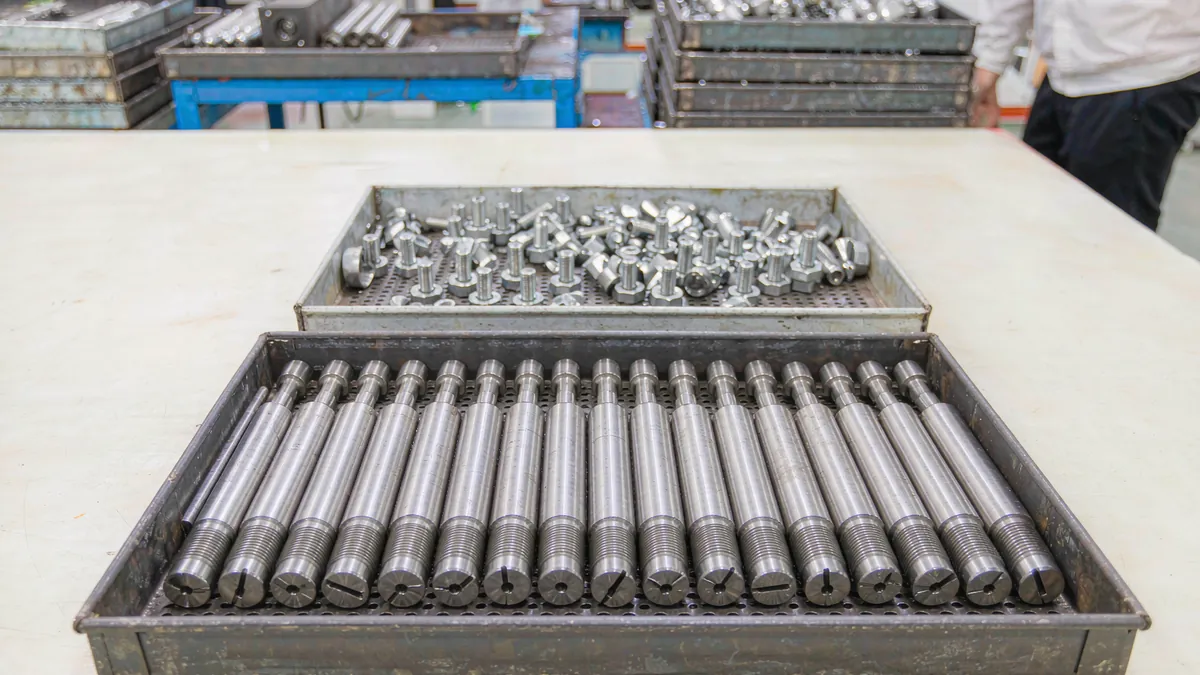
17-4 PH (UNS S17400, W.Nr 1.4542, X5CrNiCuNb16-4, ASTM A564 Type 630, JIS SUS630, Chinese 05Cr17Ni4Cu4Nb) is a martensitic precipitation-hardening stainless steel: 15.0–17.5 % chromium, 3.0–5.0 % nickel, 3.0–5.0 % copper and 0.15–0.45 % niobium plus tantalum, balanced with iron. It is delivered in Condition A — solution annealed at about 1,040 °C and quenched to below 32 °C, which leaves a low-carbon martensite at roughly 28–35 HRC and, importantly, still machinable. A single ageing treatment between 480 and 620 °C then precipitates copper-rich particles a few nanometres across, and the yield strength climbs from about 700 MPa to as much as 1,180 MPa.
The practical attraction is the sequence, not just the strength. Because the part is machined in Condition A and hardened afterwards at a temperature low enough that distortion stays in the 0.05–0.2 % range, 17-4 is the default choice for valve stems, pump shafts, gears, fasteners, instrument bodies and airframe fittings where a hardened, corrosion-resistant, dimensionally stable part is needed at a fraction of the cost of a nickel alloy. Nothing in the 400-series can match its combination of strength and corrosion resistance; nothing in the austenitic family can match its strength at all.
Its limits are just as clear, and they are what separate a good application from a field failure: the chromium level gives a PREN of only about 16, so it is a mild-environment alloy — atmospheric, fresh water, mild acids, food and paper process streams — and not a seawater or chloride-soak material. It loses toughness above roughly 300 °C and embrittles if held in the 400–500 °C band. And the higher the ageing strength, the lower the resistance to stress-corrosion cracking, which is why sour-service and marine hardware is specified in H1150 rather than the H900 everybody asks for first.
Heat analysis per ASTM A564 / A693 Type 630 (wt %):
| Element | Content (wt %) | What it does — and what goes wrong if it drifts |
|---|---|---|
| Chromium (Cr) | 15.00–17.50 | The passive film. Sets the corrosion ceiling: with no molybdenum and no nitrogen, PREN works out at roughly 16, so this is a 304-class alloy, not a 316-class one |
| Nickel (Ni) | 3.00–5.00 | Keeps the matrix austenitic at solution temperature so that it transforms to martensite on cooling. Too low and delta ferrite appears; too high and the martensite start temperature drops and retained austenite remains |
| Copper (Cu) | 3.00–5.00 | The hardening element. Ageing precipitates copper-rich zones 5–20 nm across. This is the single number that a 420 or 431 substitution cannot fake on a PMI gun |
| Niobium + Tantalum (Nb+Ta) | 0.15–0.45 | Forms niobium carbides that pin grain boundaries during the solution treatment, and combines with carbon so that chromium carbides do not form. Also the second element a counterfeit grade will be missing |
| Carbon (C) | 0.07 max | Low carbon keeps the martensite tough and limits sensitisation. Higher carbon raises as-quenched hardness and brittleness — useful in a knife steel, wrong here |
| Manganese (Mn) | 1.00 max | Deoxidation and residual control. Deliberately generous compared with aerospace PH grades, which is one reason 17-4 is cheap |
| Silicon (Si) | 1.00 max | Melt deoxidation |
| Phosphorus (P) | 0.040 max | Residual; segregated phosphorus degrades toughness in heavy sections |
| Sulphur (S) | 0.030 max | Residual. The free-machining variant 17-4 PH is a different product — do not accept it silently for a pressure part |
| Iron (Fe) | Balance | Matrix |
Why the niobium matters more than its 0.3 % suggests. Without niobium, a 17 % Cr / 4 % Ni martensite would form chromium carbides along prior-austenite grain boundaries during cooling, and those boundaries become crack paths and sensitised zones. Niobium takes the carbon first. That is also why a supplier who offers "17-4 equivalent without Nb" is offering a different, inferior alloy.
Certificate check: C ≤ 0.07, Cr 15.0–17.5, Ni 3.0–5.0, Cu 3.0–5.0, Nb+Ta 0.15–0.45. If the Cu or Nb line is missing from the certificate, the heat is probably not 17-4 — and a 420 or 431 bar will pass every mechanical test you throw at it while corroding in the first month of service.
Minimum values per ASTM A564 (bars, billets and forgings, longitudinal, section ≤ 75 mm unless noted), with the typical mill-certificate range in brackets:
| Condition | Ageing treatment | 0.2 % yield | Tensile strength | Elongation | Reduction of area | Hardness |
|---|---|---|---|---|---|---|
| A — solution annealed (as supplied) | 1,040 °C, quench below 32 °C | not specified | not specified | not specified | not specified | ≤ 363 HB / ≤ 38 HRC |
| H900 | 482 °C / 1 h, air | ≥ 1,170 MPa [1,180–1,260] | ≥ 1,310 MPa [1,320–1,420] | ≥ 10 % [12–17] | ≥ 40 % [45–55] | 40–47 HRC |
| H925 | 496 °C / 4 h, air | ≥ 1,070 MPa [1,080–1,160] | ≥ 1,170 MPa [1,190–1,280] | ≥ 10 % [13–17] | ≥ 44 % [48–57] | 38–45 HRC |
| H1025 | 552 °C / 4 h, air | ≥ 1,000 MPa [1,010–1,090] | ≥ 1,070 MPa [1,080–1,160] | ≥ 12 % [14–18] | ≥ 45 % [50–58] | 33–39 HRC |
| H1075 | 579 °C / 4 h, air | ≥ 860 MPa [870–950] | ≥ 1,000 MPa [1,010–1,080] | ≥ 13 % [15–19] | ≥ 45 % [50–58] | 31–38 HRC |
| H1100 | 593 °C / 4 h, air | ≥ 795 MPa [810–890] | ≥ 965 MPa [980–1,050] | ≥ 14 % [16–20] | ≥ 45 % [50–60] | 30–37 HRC |
| H1150 | 621 °C / 4 h, air | ≥ 725 MPa [740–820] | ≥ 930 MPa [940–1,010] | ≥ 16 % [18–22] | ≥ 50 % [55–62] | 28–37 HRC |
| H1150M (double overage) | 760 °C / 2 h + 621 °C / 4 h | ≥ 520 MPa [540–620] | ≥ 795 MPa [810–880] | ≥ 18 % [20–25] | ≥ 55 % [60–68] | 24–33 HRC |
Section size is not a detail. A564 applies a reduced set of values above 75 mm diameter for H900 and H925: the reduction-of-area minimum drops to 35 % and the hardness requirement drops by about 5 HRC, because thick sections cannot be quenched fast enough to avoid some delta ferrite and retained austenite. If you are buying a 250 mm forged bar and quoting H900 at 1,170 MPa yield, put the requirement on the order with the section size stated, and expect the mill to propose H1025 or H1075 instead — that conversation is normal, not a red flag.
H900 vs H925 — one hour or four. The standard writes H900 as 1 hour at 482 °C; several mills use 4 hours at the same temperature, which costs about 25–30 MPa of tensile strength and buys noticeably better toughness, especially in the transition region. If your drawing says H900 and your heat treater runs 4 hours, the part will still meet the minimum — but if the design depended on the last 30 MPa, say so explicitly.
Selection ladder inside one grade: H900 for wear parts and fasteners where 1,310 MPa is the point; H1025 as the general engineering compromise (1,070 MPa with 45 % reduction of area); H1075/H1100 where fatigue under alternating load matters; H1150 or H1150M for anything with a sustained tensile stress in a wet, chlorinated or sour environment. Going up the strength ladder always costs toughness and SCC resistance.
| Property | Condition A | H900 | H1150 |
|---|---|---|---|
| Density | 7.78 g/cm³ | 7.80 g/cm³ | 7.82 g/cm³ |
| Melting range | 1,404–1,440 °C (2,560–2,625 °F) | ||
| Thermal conductivity | ≈ 17.5 W/m·K at 20 °C | 17.9 W/m·K at 149 °C | 19.5 W/m·K at 260 °C; 22.6 W/m·K at 482 °C |
| Specific heat | 460 J/kg·K | 460 J/kg·K | 460 J/kg·K |
| Mean expansion, 20–100 °C | 10.8 ×10⁻⁶ /K | 10.8 ×10⁻⁶ /K | 11.9 ×10⁻⁶ /K |
| Mean expansion, 20–316 °C | 11.2 ×10⁻⁶ /K | 11.3 ×10⁻⁶ /K | 12.8 ×10⁻⁶ /K |
| Mean expansion, 20–427 °C | 11.3 ×10⁻⁶ /K | 11.7 ×10⁻⁶ /K | 13.0 ×10⁻⁶ /K |
| Young's modulus | 196 GPa (28.5 × 10⁶ psi) | ||
| Poisson's ratio | ≈ 0.27 | ||
| Electrical resistivity | ≈ 0.98 µΩ·m | ≈ 0.77 µΩ·m | ≈ 0.80–0.86 µΩ·m |
| Magnetic behaviour | Ferromagnetic in every condition — strongly attracted by a magnet | ||
Sources differ slightly on density (7.75 to 7.82 g/cm³ depending on condition and whether the table is metric-converted), and our own grade data sheet lists 7.75 g/cm³ for the annealed condition. For weight calculations use 7.78 g/cm³ for Condition A and 7.80 g/cm³ for H900; the 0.3 % difference only matters on a large forging.
The expansion coefficient is the number designers underestimate. At 10.8 ×10⁻⁶/K, 17-4 expands about 10 % less than 304 and roughly the same as carbon steel. That makes it a good match for a steel shaft or a cast-iron housing in a bearing fit, and a poor match for an aluminium structure — a 500 mm 17-4 shaft grows 5.4 mm over a 200 °C excursion, not the 7.4 mm an aluminium housing would.
Ageing shrinks the part: about 0.045 % from Condition A to H900, 0.053 % to H1025 and 0.22 % to H1150. On a 300 mm dimension that is 0.14 mm at H900 and 0.66 mm at H1150. Finish-machine to a known allowance, or machine after ageing if the tolerance is tighter than ±0.05 mm.
With 15–17.5 % Cr, no molybdenum and no deliberate nitrogen, 17-4 PH computes to a PREN of about 16 (Cr + 3.3 Mo + 16 N). For scale: 304L is around 18, 316L around 25, 2205 around 35, 2507 around 42. That single number explains almost every corrosion question about this grade.
17-4 PH is normally rated for continuous service up to about 300 °C (572 °F) and is not recommended for cryogenic service. Between roughly 400 and 500 °C the copper-rich precipitates and the martensite substructure over-age and embrittle — the classic 475 °C embrittlement of high-chromium martensites — and impact toughness falls sharply even though tensile strength still looks respectable. Above 500 °C the precipitates coarsen and strength drops away. A part that passes a room-temperature tensile test after a weekend at 450 °C can still shatter on the first pressure cycle.
Two rules that prevent most 17-4 field failures. First: 17-4 is a 300 °C alloy and a mild-environment alloy — if the duty is hotter than 300 °C or wetter in chloride than a swimming pool, the answer is a different grade (A286 or 13-8 Mo for temperature, 2205/2507 or 625 for chloride). Second: pick the ageing condition from the environment, not from the strength table. H900 in a wet, stressed, chloride-bearing joint is the most common avoidable cracking case we see.
The full cycle has two steps, and both matter.
Solution treatment (Condition A). Austenitise at 1,040 ± 15 °C for roughly 30 minutes per 25 mm of section, then cool fast enough — oil quench or forced-air — to get below 32 °C within one hour. That last condition is the one that gets missed in job shops: if the part is still warm at the centre when it comes out of the quench, some austenite is retained, the subsequent ageing produces lower strength, and no amount of re-ageing will recover it. A full re-solution treatment is required. Mills normally do this, which is why 17-4 is bought in Condition A.
Ageing. One soak, air cool, no quench:
| Condition | Temperature / time | Result |
|---|---|---|
| H900 | 482 °C / 1 h (some mills 4 h) | Maximum strength and hardness; lowest toughness and SCC resistance |
| H925 | 496 °C / 4 h | Slightly softer, noticeably tougher than H900 |
| H1025 | 552 °C / 4 h | The general-purpose compromise |
| H1075 | 579 °C / 4 h | Fatigue and impact duty |
| H1100 | 593 °C / 4 h | Higher toughness, lower strength |
| H1150 | 621 °C / 4 h | Best SCC resistance; sour service and marine hardware |
| H1150M | 760 °C / 2 h + 621 °C / 4 h | Double overage for maximum toughness and dimensional stability |
Two practical points. First, ageing is a precipitation reaction, not a hardening quench — the cooling rate after the soak is unimportant, which is why large parts can be aged in a simple air-circulation furnace and why distortion stays small. Second, never "stress relieve" a 17-4 part at 600–700 °C between machining and ageing to reduce distortion: that is inside the over-ageing range and will cost strength that a later H900 cannot restore.
| Industry | Typical 17-4 PH components | Why 17-4 and what to watch |
|---|---|---|
| Oil & gas | Valve stems and seats, gate-valve bodies, pump shafts, drill-string subs, downhole tool bodies, christmas-tree hardware | Strength plus moderate corrosion; specify H1150 for any sour or wet CO₂ duty, and confirm NACE hardness limits |
| Aerospace | Airframe fittings, actuator housings, landing-gear pins, hydraulic components, engine brackets | High strength with predictable distortion; usually AMS 5643 / AMS 5604 with VAR melting and tighter cleanliness |
| Chemical processing | Pump and mixer shafts, agitator hubs, instrument bodies, small pressure-retaining parts | Fine for mild acids; check chloride level and temperature before approving — this is where 316L or 904L is often the better answer |
| Power generation | Turbine blades and buckets, steam-valve trim, feedwater pump components, nuclear waste canisters and handling equipment | Strength at moderate temperature; watch the 300 °C ceiling and the 400–500 °C embrittlement band |
| Marine and naval | Propeller shafts on small craft, deck fittings, submarine hardware, helicopter deck platforms | Only with the right condition and coating; immersion duty should be reviewed against 2205/2507 or Monel K-500 |
| Medical and food | Surgical instruments, dental hand-tool components, food-processing shafts, homogeniser parts, mould inserts | Hard, corrosion resistant and polishable; cleanliness of the melt matters for medical work |
| Pulp, paper and general machinery | Paper-mill equipment, gears, wear rings, spindles, high-strength bolts, die and mould inserts | The volume application — cost-effective replacement for hardened 400-series where corrosion also matters |
| Product form | Standard | Notes |
|---|---|---|
| Bars, billets, forgings (stock) | ASTM A564 / ASME SA564 Type 630 | The primary specification for bar and forging stock; hardness and mechanical properties by condition |
| Plate, sheet, strip | ASTM A693 / ASME SA693 Type 630 | Wide plate to 100 mm; AMS 5604 for aerospace sheet and plate |
| Forgings, rolled rings, flanges | ASTM A705 / ASME SA705 | Supplied to drawing with UT and dimensional report |
| Aerospace bar and forgings | AMS 5643 (bar/forging), AMS 5604 (sheet/plate) | Normally VAR or VIM-VAR melted, with tighter chemistry and cleanliness |
| Weld wire and electrodes | ER630 (AWS A5.9), E630 (AWS A5.4) | Matching composition; see welding notes below |
| Metric / European designation | EN 1.4542, X5CrNiCuNb16-4, ISO 15510 | Chemistry windows are essentially identical to A564 type 630 |
| Other national designations | JIS SUS630, GB/T 1220 05Cr17Ni4Cu4Nb, former 0Cr17Ni4Cu4Nb | Chinese and Japanese mills quote these; confirm the Cu and Nb lines on the certificate either way |
Forms in regular supply from our stock and mill partners: round bar 6–350 mm, square and flat bar, hot-rolled and cold-rolled plate 1.5–100 mm, seamless tube on request, open-die and closed-die forgings to drawing, and machined components. Standard delivery condition is Condition A (solution annealed) unless the purchase order states an aged condition; if you need H900 or H1025 on delivery, write it on the order — it is a different heat-treatment route and a different price.
Machine in Condition A. At 28–35 HRC the alloy cuts like a tough 410: stringy chips, a strong tendency to work-harden under a dull tool, and a real risk of built-up edge. Use sharp carbide with a positive rake, generous feed to get under the work-hardened skin, copious coolant, and never let the tool rub. At H900 (40–47 HRC) machining is possible but slow and expensive — the standard production sequence is rough machine in A, age, then finish grind or finish turn. Threads and deep holes should always be cut before ageing.
17-4 is the most weldable of the precipitation-hardening stainless family, but "weldable" here means "can be joined", not "will develop full properties as-welded".
Cold forming is limited: Condition A is strong and springy, so bends need generous radii and a stress relief afterwards. Hot working is done between about 1,150 and 950 °C with a finishing temperature above 900 °C, followed by a full solution treatment — a forged 17-4 part that is air-cooled from the hammer and aged directly will have coarse grains and poor toughness. This is the single most common forging defect we see in incoming inspection.
17-4 PH is the most counterfeited stainless grade in the secondary market, because a 420 or 431 bar hardens to a similar number and costs a third as much. The checks below take fifteen minutes and catch nearly every case.
| Check | What to look for | What it catches |
|---|---|---|
| Certificate chemistry | Cu 3.0–5.0 and Nb+Ta 0.15–0.45 both present and in range | 420 / 431 / 2Cr13 substitution — these have neither copper nor niobium |
| PMI (XRF or OES) | Cu reading around 3–4 %, Nb present. A copper-free reading is an immediate reject | Any non-PH ferritic or martensitic substitute |
| Condition stated on the certificate | "Condition A — solution annealed" or the exact aged condition with temperature and time | Material sold as "heat treated" with no condition — impossible to verify and usually not what was ordered |
| Hardness test | Condition A: ≤ 363 HB / ≤ 38 HRC. H900: 40–47 HRC. H1150: 28–37 HRC | Wrong ageing temperature, or ageing applied to material that was never properly solution treated |
| Reduction of area | ≥ 40 % at H900 in section ≤ 75 mm | Retained austenite and delta ferrite from a slow quench — tensile strength still passes while toughness is gone |
| UT on heavy forgings | No indications above the drawing acceptance level | Forging bursts, flakes and internal cracking in large sections |
| Grain size / microstructure | Fine, uniform tempered martensite; delta ferrite stringers within agreed limits | Forged-and-air-cooled material, or a billet rolled from the wrong end of the heat |
One thing XRF cannot do: distinguish 17-4 from 15-5 PH. Their chemistry windows overlap (15-5 is Cr 14.0–15.5 / Ni 3.5–5.5 / Cu 2.5–4.5), and a handheld gun will read both as "PH stainless". If the difference matters — and for a heavy forged part it does, because 15-5 has better transverse toughness — you need the mill certificate and, if you are suspicious, a laboratory chemical analysis. Treat "we can supply 15-5 as an equivalent" as a commercial question to be approved in writing, not a silent substitution.
On the purchase order, write five things: the UNS number, the exact condition (H900 / H1025 / H1150 …), the mechanical property table you are buying to, the section size the properties apply to, and the certificate type (EN 10204 3.1). Everything else is a conversation.
We supply 17-4 PH as round bar, plate, forged rings and blocks, and machined parts, in Condition A or in any aged condition from H900 to H1150M, with EN 10204 3.1 certificates, PMI on every lot and hardness verification before packing. Because our core business is forged rings and custom forgings in stainless and nickel alloys, the parts where 17-4 is most often specified — valve bodies, pump housings, shaft blanks, flange rings — are the ones we make every week.
Typical lead times: 7–15 days for stock bar and plate, 25–40 days for forged or machined-to-drawing parts. If you are weighing 17-4 against 15-5 PH, 13-8 Mo or a duplex grade, send us the duty — medium, temperature, stress state and section size — and we will tell you which one we would put our name on.
Yes — strongly magnetic in every condition, because the matrix is martensite. A magnet test tells you nothing about whether the grade is correct, but a non-magnetic 17-4 bar is definitely not 17-4.
About 300 °C (572 °F) for continuous service. Between 400 and 500 °C the alloy over-ages and embrittles, so tensile strength may still look acceptable while impact toughness has collapsed. It is also not recommended for cryogenic service.
Same strength ladder, different toughness. 15-5 PH has lower chromium and higher nickel, which suppresses delta ferrite and gives much better transverse ductility in heavy sections and forgings — that is why airframe forgings and large valve bodies are usually 15-5. 17-4 has slightly better corrosion resistance (higher Cr) and is cheaper and far more available. Small parts in mild duty: 17-4. Thick forged parts where transverse toughness matters: 15-5.
Not for immersion or continuous wet chloride service. PREN is only about 16, so pitting and crevice attack start early, and at H900 the SCC risk under sustained stress is real. For seawater, use 2205 or 2507 duplex, a super-austenitic like 254SMO, or a nickel alloy such as 625 or Monel K-500.
H1150 or H1150M. Over-ageing drops yield to about 725 MPa but raises toughness and resistance to stress-corrosion cracking substantially. H900 in a wet, stressed, chloride-bearing joint is the classic failure case. Confirm the hardness ceiling in the NACE MR0175 / ISO 15156 edition your project references.
You can weld it with ER630 filler in Condition A and then age the assembly, which gives a joint at roughly 80–90 % of base-metal strength with reduced toughness. For fatigue-critical or pressure-critical welds, solution treat and re-age after welding. Do not stress relieve in the 400–650 °C band — that is the embrittling range.
Send us your drawing or specification for a quotation — we reply within one business day.
Buy this grade as: Plate · Round bar · Seamless tube · Flanges · Fasteners · Welding wire · Forged rings

Browsing for a grade? The full library of per-grade technical guides is on one list.
Open the list
Which family fits which corrosion or temperature problem — and the selection rules that keep you out of trouble.
Read article
Traceability, honest heats, the documents to demand — and the red flags to walk away from.
Read article