
All grade guides — one page, every alloy we cover
Browsing for a grade? The full library of per-grade technical guides is on one list.
Open the list15-5 PH exists because 17-4 PH has a weakness that only shows up in thick sections. Roll a 200 mm 17-4 bar and the delta ferrite that forms during solidification is drawn out into stringers; the longitudinal tensile test looks perfect and the transverse ductility quietly disappears. 15-5 PH rebalances the chemistry — chromium down to 14.0–15.5 %, nickel up to 3.5–5.5 %, copper down to 2.5–4.5 % — to suppress that ferrite, and the result is a grade with the same strength ladder, better through-thickness toughness and much better forgeability. This guide covers the ASTM A564 and AMS 5659 numbers by condition, the physical data, where the lower chromium actually costs you corrosion resistance, and the practical rules for forging, heat treating and welding it.
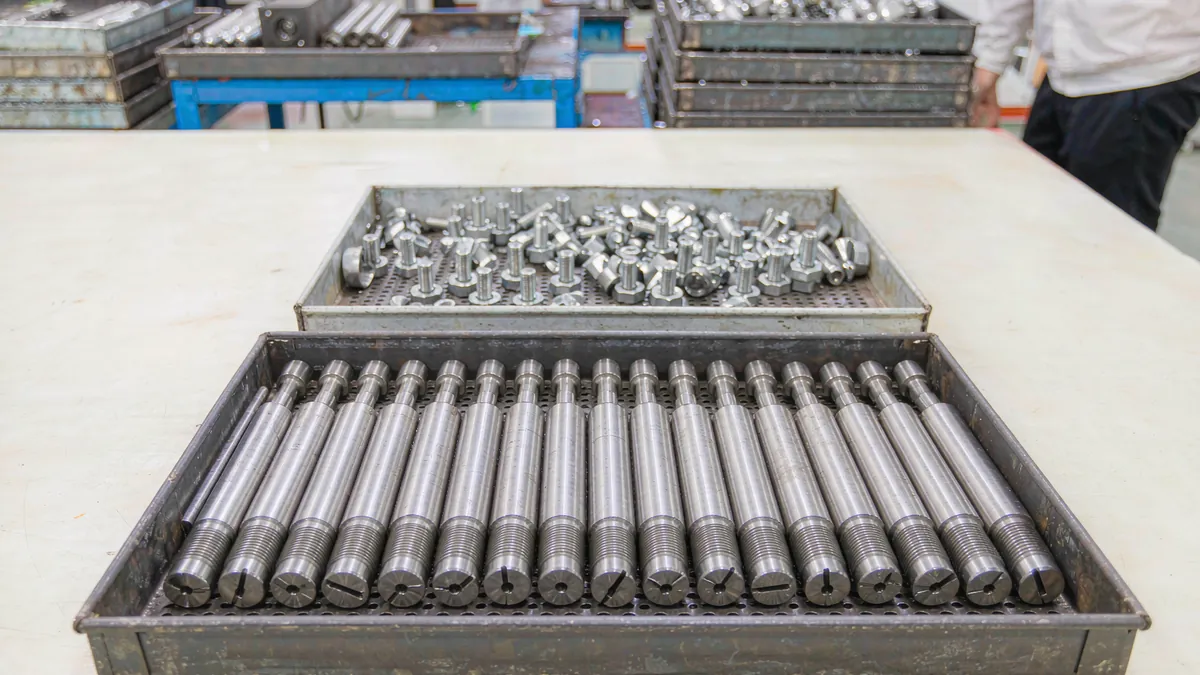
15-5 PH (UNS S15500, W.Nr 1.4545, X5CrNiCuNb15-5, ASTM A564 type XM-12, AMS 5659) is a martensitic precipitation-hardening stainless steel developed by Armco in the 1960s as a forging-grade companion to 17-4 PH. The chemistry looks almost identical at a glance — 14.0–15.5 % Cr, 3.5–5.5 % Ni, 2.5–4.5 % Cu, 0.15–0.45 % Nb+Ta — but the shift of about 1.5 points of chromium into nickel is deliberate, and it changes the solidification behaviour in a way that matters for anything thicker than a hand-held part.
Lower chromium and higher nickel narrow the ferrite field, so 15-5 solidifies with substantially less delta ferrite than 17-4 in the same section. Ferrite is soft and it is strung out in the rolling or forging direction; it is also where cracks start. The consequence is a grade with the same 1,310 MPa capability at H900 but 30–50 % better transverse reduction of area in heavy sections, better Charpy toughness, and far fewer forging cracks. That is why airframe forgings, large valve bodies, pump housings and downhole tool bodies are commonly specified in 15-5 rather than 17-4, even though 15-5 costs slightly more and is less widely stocked.
The trade-off is corrosion. With a maximum of 15.5 % chromium and no molybdenum, PREN works out at roughly 15–16, a point below 17-4. In practice both alloys are mild-environment materials — atmospheric, fresh water, mild acids, food and paper streams — and neither belongs in seawater immersion. If the duty is aggressive enough that one and a half points of chromium decide the outcome, neither grade is the right answer and you should be looking at a duplex or a nickel alloy.
Heat analysis per ASTM A564 / A693 type XM-12 (wt %):
| Element | Content (wt %) | What it does — and why it differs from 17-4 |
|---|---|---|
| Chromium (Cr) | 14.00–15.50 | Passive film. Deliberately lower than 17-4 (15.0–17.5) to shrink the ferrite field — a corrosion sacrifice made for toughness |
| Nickel (Ni) | 3.50–5.50 | Higher than 17-4 (3.0–5.0). Widens the austenite field, lowers the martensite start temperature, and suppresses delta ferrite on solidification |
| Copper (Cu) | 2.50–4.50 | The hardening element: copper-rich precipitates on ageing. A slightly narrower window than 17-4, which is why the same ageing temperature gives a more consistent result heat to heat |
| Niobium + Tantalum (Nb+Ta) | 0.15–0.45 | Carbide former: pins grain boundaries, protects chromium from carbide precipitation, refines the forge grain. Some mill and aerospace tables additionally require Nb+Ta ≥ 5 × C — worth writing on the order if you are buying forging stock |
| Molybdenum (Mo) | 0.50 max | Residual only, capped. Present in the specification to stop a mill from using molybdenum scrap credited as nickel |
| Carbon (C) | 0.07 max | Low carbon keeps the martensite tough. This is a forging alloy; toughness is the whole point |
| Manganese (Mn) | 1.00 max | Deoxidation |
| Silicon (Si) | 1.00 max | Deoxidation. Silicon raises the ferrite tendency, so mills keep it low in practice |
| Phosphorus (P) | 0.040 max | Residual; segregation hurts heavy-section toughness |
| Sulphur (S) | 0.030 max | Residual. Sulphur above this creates stringer inclusions that behave like delta ferrite in transverse testing |
| Iron (Fe) | Balance | Matrix |
Read the chemistry as a ratio, not a list. The Ni/Cr ratio of 15-5 is about 0.30 against 0.24 for 17-4, and that ratio is what determines how much ferrite survives solidification. A heat at Cr 15.5 / Ni 3.5 is still inside the A564 window but sits at the ferrite-prone corner of it; a heat at Cr 14.2 / Ni 5.2 sits at the tough corner. Mills that supply aerospace forging stock control to the middle of the window for exactly this reason, and the certificate will tell you which corner you got if you look.
For forging stock, ask for the chemistry plus the delta-ferrite or inclusion rating. Two heats that both meet A564 can behave completely differently under a 3,000-tonne press, and the difference is visible in the Cr and Ni lines before you ever cut a test bar.
Minimum values per ASTM A564 (bars, billets and forgings, longitudinal, section ≤ 75 mm unless noted), with typical mill-certificate ranges in brackets:
| Condition | Ageing treatment | 0.2 % yield | Tensile strength | Elongation | Reduction of area | Hardness |
|---|---|---|---|---|---|---|
| A — solution annealed | 1,040 °C, quench below 32 °C | not specified | not specified | not specified | not specified | ≤ 363 HB / ≤ 38 HRC |
| H900 | 482 °C / 1 h, air | ≥ 1,170 MPa [1,180–1,270] | ≥ 1,310 MPa [1,320–1,420] | ≥ 10 % [12–17] | ≥ 35 % [45–58] | ≥ 40 HRC (≈ 388 HB) |
| H925 | 496 °C / 4 h, air | ≥ 1,070 MPa [1,080–1,160] | ≥ 1,170 MPa [1,190–1,280] | ≥ 10 % [13–17] | ≥ 38 % [48–58] | 38–45 HRC |
| H1025 | 552 °C / 4 h, air | ≥ 1,000 MPa [1,010–1,090] | ≥ 1,070 MPa [1,080–1,160] | ≥ 12 % [14–18] | ≥ 45 % [52–60] | 34–42 HRC (≈ 331 HB) |
| H1075 | 579 °C / 4 h, air | ≥ 860 MPa [870–950] | ≥ 1,000 MPa [1,010–1,080] | ≥ 13 % [15–19] | ≥ 45 % [52–60] | 31–38 HRC (≈ 311 HB) |
| H1100 | 593 °C / 4 h, air | ≥ 795 MPa [805–890] | ≥ 965 MPa [980–1,050] | ≥ 14 % [16–20] | ≥ 45 % [52–60] | 30–37 HRC |
| H1150 | 621 °C / 4 h, air | ≥ 725 MPa [740–820] | ≥ 930 MPa [940–1,010] | ≥ 16 % [18–22] | ≥ 50 % [56–64] | 28–37 HRC (≈ 277 HB) |
| H1150M (double overage) | 760 °C / 2 h + 621 °C / 4 h | ≥ 520 MPa [540–620] | ≥ 795 MPa [810–880] | ≥ 18 % [20–25] | ≥ 55 % [62–70] | ≈ 255 HB / 24–33 HRC |
The numbers are the same as 17-4 on purpose — the difference is where they are measured. A564 requires the same minima from both grades, so a certificate comparison at 25 mm section will show almost nothing. Order a 150 mm forged bar of each and test transverse: the 15-5 will typically hold 40 % reduction of area where the 17-4 falls into the low 20s, and the Charpy values at −20 °C separate the two even further. That transverse result, not the longitudinal tensile, is what 15-5 is bought for.
Note also the high-temperature behaviour: above about 400 °C both grades over-age, but 15-5 retains a slightly more stable structure because of the higher nickel, which is one reason it is preferred for compressor and steam-path hardware in the 300–400 °C band. Neither grade should be designed above roughly 316 °C for continuous duty without specific creep data from the mill.
Unless your drawing says otherwise, H1025 is the correct default for a forged 15-5 part: 1,000 MPa yield with 45 % reduction of area and better SCC behaviour than H900, at a heat-treatment cost identical to any other condition. Reserve H900 for parts where 1,310 MPa is genuinely required and the stress state is compressive or benign.
| Property | Condition A | H900 | H1150 |
|---|---|---|---|
| Density | 7.75 g/cm³ | 7.81 g/cm³ | 7.86 g/cm³ |
| Melting range | 1,404–1,441 °C (2,560–2,625 °F) | ||
| Thermal conductivity | ≈ 16 W/m·K at 20 °C | 18.3 W/m·K at 100 °C | ≈ 18–19 W/m·K at 200 °C |
| Specific heat | 460 J/kg·K | 460 J/kg·K | 460 J/kg·K |
| Mean expansion, 20–100 °C | 10.9 ×10⁻⁶ /K | 10.9 ×10⁻⁶ /K | ≈ 11.5 ×10⁻⁶ /K |
| Mean expansion, 20–300 °C | 11.1 ×10⁻⁶ /K | 11.1 ×10⁻⁶ /K | ≈ 12.2 ×10⁻⁶ /K |
| Mean expansion, 20–427 °C | 11.3 ×10⁻⁶ /K | 11.3 ×10⁻⁶ /K | ≈ 12.8 ×10⁻⁶ /K |
| Young's modulus | 200 GPa at 20 °C | ≈ 196–200 GPa | ≈ 170 GPa at 400 °C |
| Poisson's ratio | 0.272 | ||
| Electrical resistivity | ≈ 0.98 µΩ·m | ≈ 0.77 µΩ·m | ≈ 0.86 µΩ·m |
| Magnetic behaviour | Ferromagnetic in every condition — the matrix is martensite | ||
Density rises with ageing because the copper precipitates are denser than the martensite they form from: 7.75 g/cm³ in Condition A, 7.81 after H900, 7.86 after H1150. For mass calculations 7.78 g/cm³ is a safe average; the spread only matters on a multi-tonne forging. Our own grade data sheet quotes 7.80 g/cm³ for the annealed condition, which is the H900-era figure rather than the Condition A value — a 0.6 % difference, irrelevant for quoting, worth knowing if you are checking a mill's weight calculation.
Thermal expansion at 10.9 ×10⁻⁶/K is close to carbon steel and about 10 % below 304. That is helpful when a 15-5 shaft runs in a steel bearing housing, and it is the reason 15-5 actuators matched to aluminium airframe structure need a thermal compensation check rather than a rule of thumb: aluminium expands at 23 ×10⁻⁶/K, more than twice as fast.
Ageing shrinks the part: 0.045 % from Condition A to H900, 0.053 % to H1025, 0.22 % to H1150. On a 400 mm forged valve body that is up to 0.9 mm at H1150 — which is why large parts are aged before finish machining, or machined with a documented allowance.
PREN for 15-5 works out at 15–16 (Cr 14.0–15.5, no Mo, no deliberate N) against 16–17 for 17-4 and 18 for 304L. The ranking is real but narrow: in atmospheric exposure, fresh water, mild organic acids, food and dairy streams and paper-mill white water, the two grades behave the same way within the scatter of any field trial. Where the difference appears is in borderline chloride service — a warm, slightly saline wash-down, a coastal atmosphere with salt deposition, a stagnant crevice — and there 17-4 will last longer.
15-5 PH is normally rated for continuous service up to about 316 °C (600 °F) and is not recommended for cryogenic application. In the 400–500 °C band the copper precipitates over-age and the martensite embrittles; tensile strength may still pass a room-temperature test while impact toughness has already gone. Above 500 °C the precipitates coarsen and strength falls away quickly. This is not a high-temperature alloy in any sense — for 500–700 °C duty the answer is A286 or 13-8 Mo, and above 700 °C a nickel-base grade.
If your medium is aggressive enough that you are comparing 14 % Cr with 17 % Cr, you are asking the wrong question: step to 2205 (PREN 35), 2507 (PREN 42) or Alloy 625 (PREN 50) and stop worrying about one point of chromium. 15-5 is bought for strength and toughness in a mild environment, not for corrosion margin.
15-5 was designed to be forged, and the process route is where most of its advantage is either realised or thrown away.
1,040 ± 15 °C, hold about 30 minutes per 25 mm of section, then oil quench or forced-air cool to below 32 °C within one hour. The one-hour rule is not a formality: if the core is still warm, austenite is retained and the subsequent ageing produces lower strength that no re-age can recover. Only a fresh solution treatment fixes it.
| Condition | Temperature / time | Typical use |
|---|---|---|
| H900 | 482 °C / 1 h (or 4 h for improved toughness) | Wear parts, high-strength fasteners, compressive-load components |
| H925 | 496 °C / 4 h | Strength with a little more toughness than H900 |
| H1025 | 552 °C / 4 h | General engineering default for forgings and valve bodies |
| H1075 | 579 °C / 4 h | Fatigue and alternating-load duty |
| H1100 | 593 °C / 4 h | Higher toughness, lower strength |
| H1150 | 621 °C / 4 h | Sour service, marine hardware, maximum SCC resistance |
| H1150M | 760 °C / 2 h + 621 °C / 4 h | Maximum toughness and dimensional stability; heavy-section forgings |
Ageing is a precipitation reaction, so the cooling rate afterwards does not matter and distortion stays small — typically under 0.1 % for the low-temperature conditions. That is what allows a finished-machined part to be aged as the last operation. What you must not do is "stress relieve" between rough and finish machining at 600–700 °C: that is inside the over-ageing range and permanently costs strength.
| Industry | Typical 15-5 PH components | Why 15-5 rather than 17-4 |
|---|---|---|
| Aerospace | Airframe forgings, landing-gear components, actuator bodies, flap-track fittings, engine mounts, high-strength fasteners | Transverse toughness and forging soundness in thick sections; AMS 5659 with VAR melting is the normal call-out |
| Oil & gas | Forged valve bodies, wellhead components, downhole tool bodies, drill collars, pump housings, subsea clamps | Large forged sections without the 17-4 ferrite problem; H1150 for sour or wet CO₂ duty |
| Power generation | Steam-turbine blades, valve trim, feedwater pump parts, generator retaining components | Strength to about 316 °C with better section uniformity than 17-4 |
| Pulp, paper and process | Paper-mill equipment, refiner components, high-pressure pump shafts, digester hardware | Cost-effective where 316L is not strong enough and a duplex is over-specified |
| Marine and naval | Propeller shafting on workboats, submarine hardware, deck machinery, helicopter landing platforms | Toughness under shock load; immersion duty still needs a corrosion review and usually a coating |
| General machinery | Gears, spindles, wear rings, die and mould inserts, hydraulic cylinder rods | Hardened part with predictable distortion — machine in Condition A, age, finish grind |
| Medical and food | Surgical instrument components, dental tools, food-processing shafts and homogeniser parts | Hard, polishable and corrosion resistant in mild cleaning chemistry |
| Product form | Standard | Notes |
|---|---|---|
| Bars, billets, forging stock | ASTM A564 / ASME SA564 type XM-12 | The primary specification; properties by condition, with the ≤ 75 mm and > 75 mm sections treated separately |
| Plate, sheet, strip | ASTM A693 / ASME SA693 type XM-12 | Available but less common than in 17-4 — 15-5 is a forging alloy first |
| Forgings, rolled rings, flanges | ASTM A705 / ASME SA705 | Supplied to drawing with UT and dimensional report; our core product for this grade |
| Aerospace bar, forgings, rings | AMS 5659 | Normally VAR or VIM-VAR melted with tighter cleanliness; some mills additionally list AMS 5862 — confirm the revision on the certificate |
| Weld wire and electrodes | ER630 (AWS A5.9), E630 (AWS A5.4) | Matching filler for both 15-5 and 17-4; see welding notes |
| European designation | EN 1.4545, X5CrNiCuNb15-5 | Chemistry essentially identical to XM-12 |
| Other designations | UNS S15500, XM-12, GB 05Cr15Ni5Cu4Nb | The Chinese designation appears on domestic mill certificates; check Cu and Nb lines either way |
Forms in regular supply: round bar 10–400 mm, open-die forged blocks and rings, closed-die forgings to drawing, and finish-machined parts. Because 15-5 is a forging grade, our natural supply is forged rather than rolled — rolled ring and open-die forging are the two routes we use most, both followed by a certified solution treatment and ageing to the condition on the order.
Machine in Condition A at 28–35 HRC. The alloy is tough and gummy: expect stringy chips, a strong work-hardening tendency under a dull edge and a real risk of built-up edge on finishing passes. Sharp positive-rake carbide, heavy enough feed to stay under the worked skin, high-pressure coolant, and no rubbing. At H900 (40+ HRC) turning is possible but slow; the standard route for a precision part is rough machine in A, age, then finish turn or grind. Cut all threads and deep holes before ageing — after H900 they become a grinding job.
15-5 welds better than 17-4 because it has less delta ferrite in the weld metal and the heat-affected zone, which reduces hot-cracking and the toughness dip at the fusion line. The rules are otherwise the same as for 17-4:
Cold forming is limited by the high as-quenched strength; bends need generous radii and a stress relief afterwards. Hot forming is done in the same 1,150–950 °C window as forging, followed by a full solution treatment. Do not attempt to straighten a hardened part by local heating — a torch on H900 15-5 creates a soft, over-aged patch that will be the first place to fail.
The two grades are chemically close enough that a handheld XRF gun cannot tell them apart reliably, and the price difference is small enough that substitutions happen in both directions. The certificate is your primary evidence; the checks below are how you confirm it.
| Check | What to look for | What it catches |
|---|---|---|
| Certificate chemistry | Cr ≤ 15.50 and Ni ≥ 3.50 points to 15-5; Cr ≥ 15.50 points to 17-4. In the 15.0–15.5 overlap you need the full analysis, not a single element | Substitution in either direction; the single most common mix-up in PH stainless |
| UNS number on the certificate | S15500 / XM-12, not S17400 / 630 | Paperwork substitution — the cheapest fraud and the easiest to catch |
| Cu and Nb+Ta | Cu 2.5–4.5 and Nb+Ta 0.15–0.45 (some specs require Nb+Ta ≥ 5 × C) | 410/420/431 substitution, which has neither element |
| Condition and hardness | Condition A ≤ 363 HB / ≤ 38 HRC; H1025 ≈ 331 HB; H1150 ≈ 277 HB | Wrong ageing temperature, or ageing without a proper solution treatment |
| Transverse tensile / RA | For heavy sections, test transverse: RA should hold up where 17-4 drops | The whole point of buying 15-5 — if transverse toughness is poor you may as well have bought 17-4 |
| UT and macro-etch on forgings | No internal indications; uniform worked structure, no unworked core | Forging bursts, coarse grain and the air-cooled-from-the-press defect |
| Delta ferrite / inclusion rating | Within the limit on the drawing, if one is specified | Heats at the ferrite-prone corner of the chemistry window |
Put five things on the purchase order: UNS S15500, the exact condition (H900 / H1025 / H1150 …), the property table you are buying to, the section size those properties apply to, and EN 10204 3.1 certification. For forged parts add the UT acceptance level and the drawing revision. Everything else is a conversation you do not want to have after the part is machined.
Forged rings are our core business, which makes 15-5 PH a natural fit: we supply open-die forged blocks and rings, closed-die forgings and machined parts in Condition A or any aged condition from H900 to H1150M, with EN 10204 3.1 certificates, PMI on every lot and hardness verification before packing. Where the application calls for it we can supply VAR-melted stock to AMS 5659 and arrange third-party UT and mechanical testing to your drawing.
Typical lead times: 10–20 days for stock bar, 30–45 days for forged rings and machined-to-drawing parts. If you are deciding between 15-5 PH, 17-4 PH and 13-8 Mo, send us the duty — section size, stress state, medium and temperature — and we will tell you which grade we would forge and which condition we would age it to.
Chemistry and, as a result, toughness. 15-5 has lower chromium (14.0–15.5 vs 15.0–17.5%), higher nickel (3.5–5.5 vs 3.0–5.0%) and slightly lower copper. That suppresses delta ferrite, so heavy sections and forgings keep their transverse ductility. The strength ladder and ageing conditions are identical; 17-4 has slightly better corrosion resistance and is cheaper and far more available.
Yes, strongly — the matrix is martensite in every condition. A non-magnetic 15-5 bar is not 15-5.
About 316 °C (600 °F) for continuous duty, and it is not recommended for cryogenic service. Avoid the 400–500 °C band entirely: the alloy over-ages and embrittles there while tensile strength can still look acceptable. For 500 °C and above, use A286, 13-8 Mo or a nickel-base grade.
H1025 for general service — 1,000 MPa yield with 45 % reduction of area and better SCC resistance than H900. Use H1150 or H1150M if the duty is sour, wet CO₂ or chloride-bearing with a sustained tensile stress. H900 only where 1,310 MPa is genuinely needed and the stress state is benign.
Yes, and it welds slightly better than 17-4 because it carries less delta ferrite. Use ER630 filler, weld in Condition A, then age the assembly — that gives about 80–90 % of base-metal strength. For critical welds, solution treat and re-age after welding. Never stress relieve in the 400–650 °C band.
Not for immersion or continuous wet chloride service. PREN is only about 15–16, lower than 17-4, so pitting and crevice attack start early and SCC is a risk at H900 under sustained stress. Use 2205 or 2507 duplex, a super-austenitic such as 254SMO, or a nickel alloy such as 625 or Monel K-500.
Send us your drawing or specification for a quotation — we reply within one business day.
Buy this grade as: Plate · Round bar · Fasteners · Welding wire · Forged rings

Browsing for a grade? The full library of per-grade technical guides is on one list.
Open the list
Which family fits which corrosion or temperature problem — and the selection rules that keep you out of trouble.
Read article
Traceability, honest heats, the documents to demand — and the red flags to walk away from.
Read article