
All grade guides — one page, every alloy we cover
Browsing for a grade? The full library of per-grade technical guides is on one list.
Open the listCustom 450 (XM-25, UNS S45000) is the martensitic precipitation-hardening stainless that answers a question we hear weekly: "I need 17-4-class strength, but the corrosion or welding side keeps biting me." By trading a little copper for a specified 0.5–1.0 % molybdenum and a niobium stabilisation, it delivers about 1,240–1,350 MPa tensile in H900 with better general corrosion than 17-4, no-preheat weldability and a calmer ageing response. This guide gathers the numbers and the selection rules we use when quoting Custom 450 bar, plate, forgings and rings.
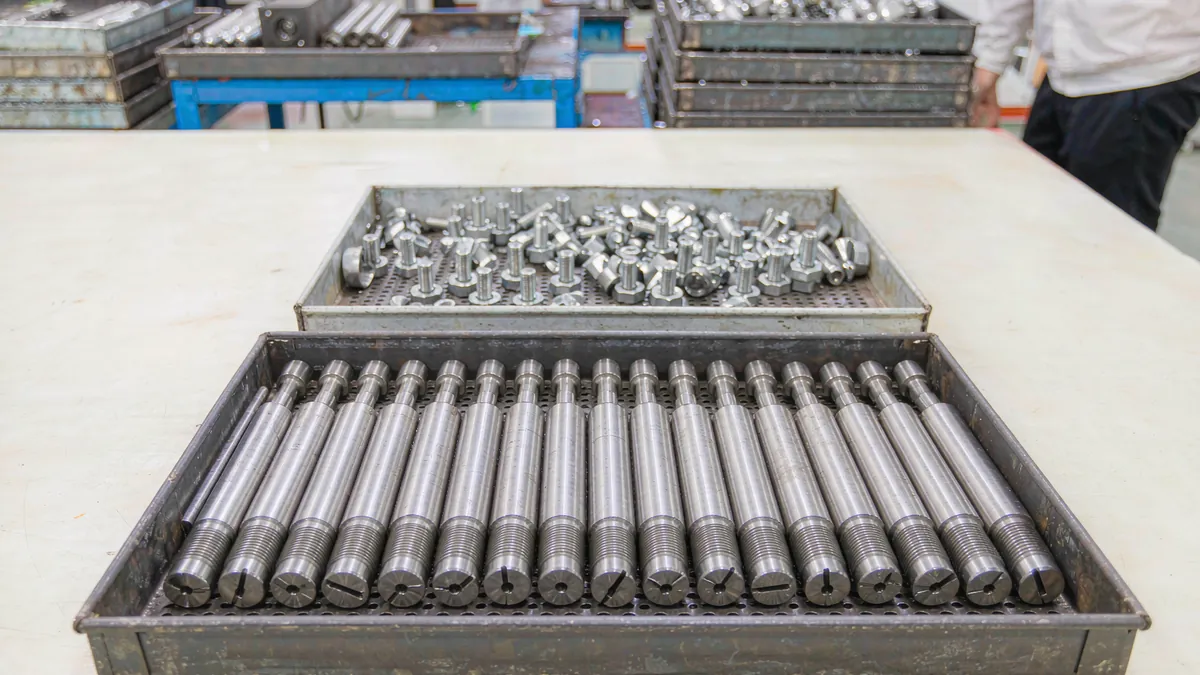
Custom 450 (UNS S45000, ASTM Type XM-25, EN 1.4594 / X5CrNiMoCuNb14-5, GE trade name GTD-450) is a martensitic precipitation-hardening stainless steel in the same family as 17-4 PH, with 14–16 % chromium, 5–7 % nickel, 1.25–1.75 % copper, 0.5–1.0 % molybdenum and niobium for stabilisation. The niobium pins carbon as carbides, keeping the HAZ clean; the molybdenum lifts pitting resistance above 17-4; the copper plus a single low-temperature ageing step (480–620 °C) precipitates the hardening phase. Compared with 17-4 it offers better ductility, a lower work-hardening rate and no-preheat weldability, at the cost of slightly lower peak strength. In every condition it is ferromagnetic and fully martensitic.
| Element | Content (wt %) | Why it matters |
|---|---|---|
| Chromium (Cr) | 14.0–16.0 | Corrosion and oxidation resistance; martensite formation with 5–7 % Ni |
| Nickel (Ni) | 5.0–7.0 | Restrains the austenite so the structure transforms to low-carbon martensite |
| Copper (Cu) | 1.25–1.75 | The main ageing-strengthening element (lower than 17-4's 3–5 % — hence softer peak strength and better toughness) |
| Molybdenum (Mo) | 0.5–1.0 | Lifts pitting resistance above 17-4 PH (which has none specified) |
| Niobium (Nb) | 8×C to 0.5 | Stabilisation: ties up carbon, prevents sensitisation and cleans up the weld HAZ |
| Carbon (C) | 0.05 max | Low-carbon martensite for weldability and toughness |
| Manganese / Silicon | 1.0 max each | Deoxidation and processing control |
| Iron (Fe) | Balance | — |
Design note: this is the "middle" Cu content strategy. 17-4 pushes copper to 3–5 % for peak strength; Custom 455 drops Cr to 11–12.5 % for ultra-high strength. Custom 450 sits between them, deliberately spending alloy budget on molybdenum and niobium instead.
Condition A (solution treated) minimums are fixed by ASTM A564; for the aged conditions the specification minimum varies with section size, so the table gives typical mill ranges (Tech Steel / Carpenter-class data cross-checked with our own certificates):
| Condition | Yield strength (0.2 %) | Tensile strength | Elongation | Hardness |
|---|---|---|---|---|
| Condition A (solution treated) | ≥ 655 MPa [typ. 815] | ≥ 860 MPa [typ. 980] | ≥ 10 % [typ. 13] | ≤ 32 HRC |
| H900 (482 °C / 1 h) | ≈ 1,170–1,300 MPa | ≈ 1,240–1,350 MPa | ≈ 14–16 % | ≈ 41–43 HRC |
| H1000 (538 °C / 4 h) | ≈ 1,150–1,270 MPa | ≈ 1,200–1,290 MPa | ≈ 16 % | ≈ 41–42 HRC |
| H1050 (566 °C / 4 h) | ≈ 1,000–1,165 MPa | ≈ 1,080–1,190 MPa | ≈ 17 % | ≈ 39 HRC |
| H1075 | ≈ 1,000 MPa | ≈ 1,080 MPa | ≈ 16 % | — |
| H1150 (621 °C / 4 h) | ≈ 1,000–1,050 MPa | ≈ 1,080–1,100 MPa | ≈ 20 % | ≈ 37 HRC |
Notes for designers: H900 is the peak-strength condition and the most common supply state; H1000 and above progressively trade strength for toughness and stress-corrosion resistance — space-industry practice (ECSS-Q-ST-70-36C) qualifies Custom 450 for high SCC resistance only at H1000 and above. Ageing shrinks the part by roughly 0.1 % (0.001 in/in) linearly — on a Ø200 mm bore that is 0.2 mm, enough to matter on an H7 fit. Many shops finish-machine in Condition A and age last.
| Property | Value |
|---|---|
| Density | 7.75 g/cm³ (some sources 7.80) |
| Melting range | ≈ 1,400–1,454 °C |
| Thermal conductivity | ≈ 15.0 W/m·K at 21 °C; 18.2 at 200 °C; 24.4 at 500 °C (one mill quotes ≈ 11.3 at 20 °C — verify on the datasheet of the actual mill) |
| Specific heat | ≈ 477 J/kg·K (23–102 °C) |
| Mean thermal expansion (24–93 °C) | ≈ 10.6 ×10⁻⁶ /K, rising to ≈ 11.0–11.1 ×10⁻⁶ /K by 600 °C |
| Elastic modulus | ≈ 193–200 GPa (tension, room temperature) |
| Electrical resistivity (20 °C) | ≈ 0.99 µΩ·m |
| Ac1 / Ac3 | ≈ 632 °C / ≈ 707 °C; Ms ≈ 118 °C, Mf ≈ 38 °C |
| Magnetic behaviour | Ferromagnetic in every condition — martensitic; cannot be made non-magnetic |
General corrosion resistance is comparable to Type 304, clearly better than the 410/416/420 martensitic family, and slightly better than 17-4 PH — because molybdenum is a specified element here and is not in 17-4. The pitting resistance equivalent PREN = %Cr + 3.3 × %Mo works out at roughly 17–19 across the ASTM window — well below the ~32–35 territory of the duplex grades.
Selection rule of thumb: if you need 17-4-class strength but keep hitting chloride SCC, weld repair problems or corrosion slightly worse than 304, Custom 450 is the upgrade — one Mo point instead of one Cu point. But it is still a 304-class, PREN ≈ 17–19 alloy: never let "Custom" branding pull it into seawater immersion duty.
Fabrication traps: ageing shrinks parts ~0.1 % (finish-machine in Condition A, age last), and H1150 at 621 °C sits only ~11 °C below Ac1 (≈ 632 °C) — furnace uniformity must be verified or partial re-austenitising creates fresh untempered martensite.
| Industry | Typical Custom 450 components |
|---|---|
| Oil & gas | Valve stems and trim, pump shafts, sucker-rod components, high-strength fasteners |
| Power generation | Gas-turbine compressor blades and buckets (as GE GTD-450), steam-turbine blading, wet-steam internals |
| Aerospace | Structural fasteners, landing-gear linkage parts, actuators (AMS 5763 / 5773 / 5859 / 5863) |
| Pumps & rotating equipment | Shafts, impellers, bushings where 17-4 has shown corrosion or SCC issues |
| Food, pharma, pulp & paper | High-strength sanitary components, liquor-handling pump parts |
| Forged rings & flanges | Rings and flanges for valve bodies and pressure equipment needing PH-level strength |
Welding: one of the practical selling points — no preheat is required and the niobium stabilisation keeps the HAZ clean. For weld-metal properties matching the base metal, the standard choice is the ER630 / E630 (17-4-type) filler; where joint strength matching is not required, austenitic 308L gives a more ductile joint. Confirm the filler and the post-weld treatment on the WPS: a weldment is normally given the same ageing (or re-solution + re-ageing) cycle as the parent part. Aged material that has not been in service above ~500 °C can be re-solution treated and re-aged without penalty — but always re-solution before re-ageing to a lower H-number.
Machining: Condition A machines at roughly 304-level speeds; after ageing the H900/H1000 condition behaves like a 42 HRC alloy steel — budget carbide tooling if machining must follow ageing.
Buying: write the condition (A / H900 / H1000…) and the product standard (A564, A693, AMS number) into the PO — minimums move with section size. PMI is genuinely useful on this grade: the Cu (1.25–1.75 %) plus Mo (0.5–1.0 %) signature distinguishes Custom 450 from 17-4 (Cu 3–5 %, no Mo) and from 15-5 (no Mo) on a handheld XRF — unlike 17-4 vs 15-5, which XRF cannot separate. Ask for the mill certificate to confirm the Nb requirement (8×C min).
Switch when 17-4 is failing on the corrosion or welding side: Custom 450 has a specified 0.5–1.0 % Mo (17-4 has none), giving slightly better general and pitting resistance, plus no-preheat weldability and better ductility. If you need maximum peak hardness instead, stay with 17-4; if you need even higher strength, look at Custom 455 or Custom 465.
Yes — it is martensitic in every condition (Condition A included) and ferromagnetic. Unlike austenitic A286 or 17-7 PH Condition A, a magnet sticking firmly is normal, not a defect.
About 0.1 % (0.001 in/in) linearly in H900 — e.g. 0.2 mm on a Ø200 mm bore. Common practice is to finish-machine in Condition A and perform the ageing heat treatment last; alternatively pre-compensate in CAD.
No. With PREN ≈ 17–19 it is a 304-class corrosion alloy. Salt spray and splash-zone atmospheres are fine (with H1000+ ageing for SCC), but continuous immersion requires duplex 2205 or super duplex — and sour service needs qualification.
It is GE's trade designation for Custom 450 (UNS S45000) when supplied to their gas-turbine compressor-blade specification — the same alloy chemistry, ordered against the OEM spec rather than the generic ASTM/AMS standards.
Send us your drawing or specification for a quotation — we reply within one business day.
Buy this grade as: Plate · Round bar · Seamless tube · Flanges · Fasteners · Welding wire · Forged rings

Browsing for a grade? The full library of per-grade technical guides is on one list.
Open the list
Which family fits which corrosion or temperature problem — and the selection rules that keep you out of trouble.
Read article
Traceability, honest heats, the documents to demand — and the red flags to walk away from.
Read article