
All grade guides — one page, every alloy we cover
Browsing for a grade? The full library of per-grade technical guides is on one list.
Open the listTi-6Al-4V — ASTM Grade 5 — is the alloy behind roughly 90 % of all titanium ever used: an alpha-beta alloy strengthened by 6 % aluminium and 4 % vanadium that delivers three times the strength of CP titanium at the same 4.43 g/cm³ density, keeps useful strength to about 400 °C and remains weldable and forgeable. This guide gives the numbers, the condition-dependent strength table and the selection rules we apply when quoting Gr.5 bar, plate, forgings and machined parts.
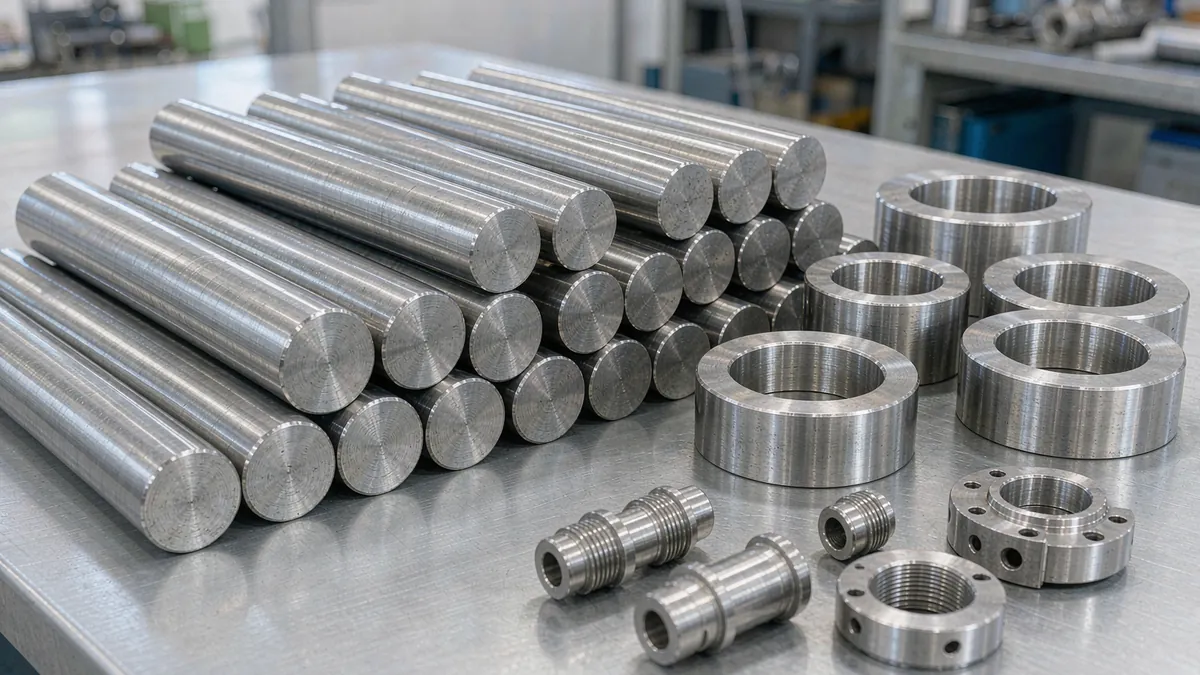
Titanium Grade 5 (UNS R56400, W.Nr 3.7165), universally called Ti-6Al-4V or simply "6-4", is the flagship alpha-beta titanium alloy. Aluminium stabilises and strengthens the alpha phase, vanadium stabilises the beta phase, and the two-phase structure is what allows strength between 895 and 1,100 MPa depending on heat treatment — three times CP Grade 2 — while density stays at 4.43 g/cm³. It accounts for about half of total titanium production and roughly 90 % of aerospace titanium. It retains useful strength in service up to about 400 °C, performs at cryogenic temperatures (the ELI variant down to −253 °C), and inherits titanium's full-seawater corrosion behaviour. The trade-offs versus Grade 2: reduced cold formability, weld-zone ductility that depends on filler choice, and a machinability bill that is real but manageable.
| Element | Content (wt %) | Why it matters |
|---|---|---|
| Titanium (Ti) | Balance | Matrix metal; TiO₂ passive film gives seawater immunity |
| Aluminium (Al) | 5.5–6.75 | Alpha stabiliser; raises strength and oxidation resistance, cuts density |
| Vanadium (V) | 3.5–4.5 | Beta stabiliser; enables the two-phase structure and heat-treatment response |
| Iron (Fe) | 0.40 max | Residual; kept low for property consistency |
| Oxygen (O) | 0.20 max | Interstitial strengthener; also the key difference to ELI (extra-low interstitial) variants |
| Carbon (C) | 0.08 max | Brittle-carbide control |
| Nitrogen (N) | 0.05 max | Strong embrittler above limit |
| Hydrogen (H) | 0.015 max | Hydride embrittlement control — strictest interstitial limit |
Variant to know: Grade 23 / Ti-6Al-4V ELI (UNS R56401, ASTM F136) lowers O, Fe and N to maximise fracture toughness — it is the medical-implant and cryogenic-vessel version. Ordinary Grade 5 is not interchangeable with ELI in fracture-toughness-critical specs.
Minimum values per ASTM, with typical mill-certificate ranges in brackets:
| Condition / product | Yield strength (0.2 %) | Tensile strength | Elongation |
|---|---|---|---|
| Bar / billet — annealed, ASTM B348 minimum | ≥ 828 MPa | ≥ 895 MPa | ≥ 10 % |
| Sheet / plate — annealed, ASTM B265 minimum | ≥ 880 MPa | ≥ 950 MPa | ≥ 14 % |
| Typical mill values, annealed | [830–900] | [900–980] | [10–15] (RA ≈ 25–33 %) |
| Solution treated + aged (STA, typical) | [950–1,070] | [1,000–1,100] | [8–12] |
| ELI bar (Grade 23), annealed — minimum | ≥ 795 MPa | ≥ 860 MPa | ≥ 10 % |
Strength retention at temperature (annealed, indicative literature values — B348 specifies no elevated-temperature minimums): ≈ 800/700 MPa UTS/YS at 200 °C, ≈ 680/580 at 300 °C, ≈ 520/440 at 400 °C. Modulus ≈ 110–114 GPa, fatigue limit (smooth, 10⁷ cycles) ≈ 500–620 MPa, fracture toughness ≈ 55–75 MPa√m annealed (lower in STA). Design notes: the gap between the B348 bar minimum (828/895) and the B265 plate minimum (880/950) is real — write the product standard into the PO, not just "Grade 5". STA gives the top strength but costs elongation and toughness; for threaded fasteners and shafts the annealed condition is usually the better engineering choice unless stiffness under yield-limited loads demands more.
| Property | Value |
|---|---|
| Density | 4.43 g/cm³ |
| Melting range | 1,604–1,660 °C (solidus–liquidus) |
| Beta transus | ≈ 980 °C (some mills quote 995 °C — furnace calibration matters for forging) |
| Thermal conductivity (room temp) | ≈ 6.7 W/m·K — about 60 % LOWER than CP titanium; heat extraction during machining is poor |
| Specific heat | ≈ 526 J/kg·K (a few datasheets quote 540–565 — source spread, confirm on mill sheet) |
| Thermal expansion (20–100 °C) | ≈ 8.6 ×10⁻⁶ /K (≈ 9.2 at 20–315 °C, 9.7 at 20–650 °C) |
| Modulus of elasticity | ≈ 110–114 GPa (shear modulus ≈ 44 GPa, Poisson ≈ 0.33) |
| Electrical resistivity | ≈ 1.78 µΩ·m |
| Magnetic behaviour | Non-magnetic (permeability ≈ 1.00005) |
Selection rule of thumb: corrosion-driven duty → Grade 2 (cheaper, more formable). Strength/weight-driven duty under 400 °C → Grade 5. Corrosion AND strength together (high-pressure seawater valves, subsea hardware) → Grade 5 with ELI or extra-toughness heats. Reducing hot acids → neither; that is Gr.7 / zirconium territory.
| Industry | Typical Ti-6Al-4V components |
|---|---|
| Aerospace | Airframe forgings and fittings, engine discs and blades, landing-gear parts, fasteners, hydraulic tubing |
| Medical | Implants and prostheses (F136 ELI), surgical instruments, bone plates |
| Oil & gas | High-pressure valve trim, subsea components, downhole tools, composite-to-metal transition fittings |
| Industrial & marine | Springs, high-strength shafts, pump impellers, seawater valve bodies, propeller shafting |
| Automotive & motorsport | Valves, connecting rods, wheel hardware, exhaust valves in racing engines |
| Chemical (selective) | Agitator shafts and high-strength internals in seawater/oxidising duties where Gr.2 strength is insufficient |
Welding: TIG or plasma with full argon shielding (trailing shield plus root purge) as for all titanium. Matching ERTi-5 filler is standard; ERTi-5ELI filler raises weld-metal ductility and toughness at modest cost — the right call for thick joints and low-temperature or fatigue-critical service. No preheat; keep interpass below ~150 °C; post-weld stress relief around 650–700 °C (shielded) where residual stress matters. Forging: hot-work in the 900–955 °C alpha-beta range, always below the beta transus to keep the fine two-phase structure. Machining: rigid setups, sharp positive-rake carbide, heavy coolant and controlled chip evacuation — the low thermal conductivity (6.7 W/m·K) pushes heat into the tool, so tool life is the cost driver, not material removal itself. On purchase orders, three things separate a good Gr.5 inquiry from an expensive mistake: (1) state the condition — annealed or STA — because STA certificates at 1,050 MPa look tempting but cost ductility; (2) state the product standard (B348 vs B265 vs B381) since minimums differ by 50–70 MPa; (3) if fatigue or fracture governs, specify fracture toughness testing or ELI chemistry explicitly.
Buyer trap we see weekly: "Grade 5" on a drawing with no condition and no product standard. Annealed B348 bar (895 min), annealed B265 plate (950 min) and STA bar (1,000+ typical) are three different mechanical products — quote them separately and never let a supplier substitute.
We supply Titanium Grade 5 bar, plate, forgings (including forged rings), seamless tube and machined-to-drawing parts, with in-house saw cutting and turning. Every shipment carries EN 10204 3.1 mill certificates; condition (annealed/STA), product standard and interstitial chemistry are stated on the certificate, and third-party inspection can be arranged. Typical lead time: 10–20 days for stock sizes, 30–45 days for forged or machined parts.
No — permeability is essentially 1.00005. Like all titanium alloys it is non-magnetic, which is why it is used around MRI equipment and sensitive sensors.
Roughly double the per-kg price for three times the strength. For corrosion-only duty that premium is wasted — buy Grade 2. You pay for Grade 5 when the design is strength- or stiffness-limited: thinner walls, lighter parts, high-pressure hardware.
Yes with conditions: full argon shielding (including root purge), matching ERTi-5 or ELI filler, and a stress relief where needed. Weld-metal ductility is lower than parent metal, so fatigue-critical and cryogenic joints should use ELI filler and be qualified by test.
Not because it is hard (33–36 HRC), but because its thermal conductivity is only 6.7 W/m·K — cutting heat stays at the tool tip instead of leaving with the chip. Sharp tools, rigid setups, flood coolant and low-to-moderate speeds solve it; the real risk is tool wear degrading surface finish into a fatigue initiator.
Send us your drawing or specification for a quotation — we reply within one business day.
Buy this grade as: Plate · Round bar · Seamless tube · Flanges

Browsing for a grade? The full library of per-grade technical guides is on one list.
Open the list
Which family fits which corrosion or temperature problem — and the selection rules that keep you out of trouble.
Read article
Traceability, honest heats, the documents to demand — and the red flags to walk away from.
Read article