
All grade guides — one page, every alloy we cover
Browsing for a grade? The full library of per-grade technical guides is on one list.
Open the listTitanium Grade 2 is the workhorse of commercially pure titanium: 99.2 % minimum titanium with tightly controlled oxygen, iron and nitrogen as the only deliberate 'alloying', yet it outperforms most stainless steels in seawater, wet chlorine and oxidising acids at roughly half the density. This guide collects the numbers and selection rules we use when quoting Gr.2 plate, tube, bar and forgings for chemical plant, desalination and energy customers.
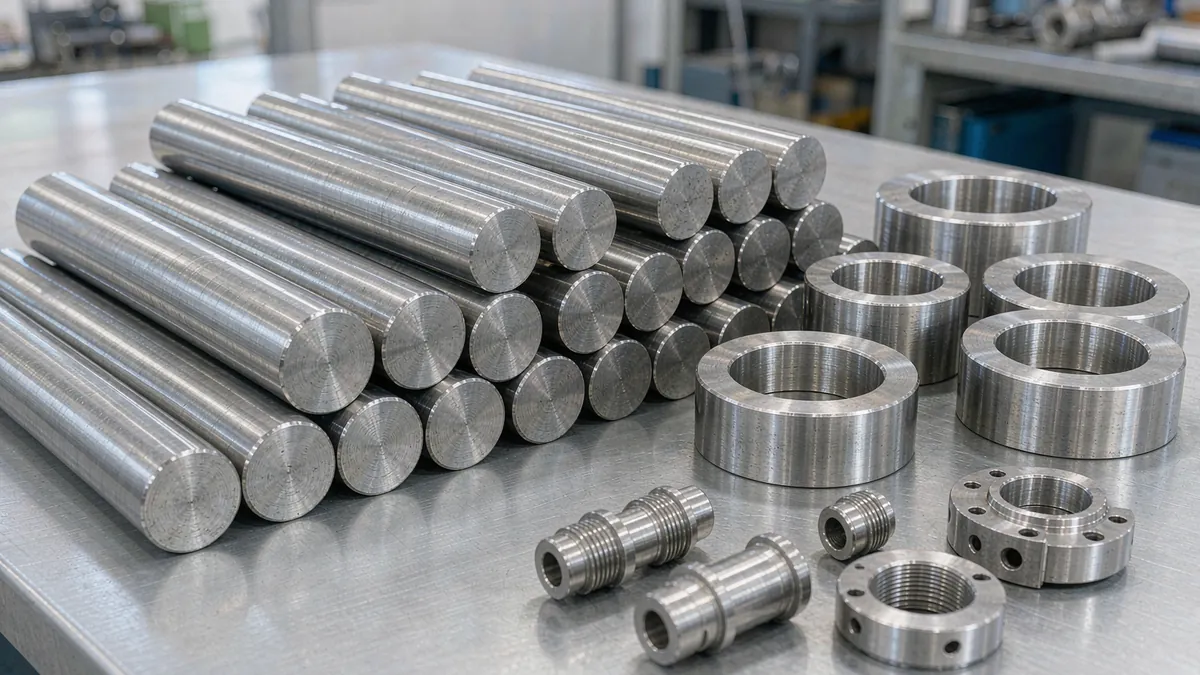
Titanium Grade 2 (UNS R50400, W.Nr 3.7035) is an unalloyed (commercially pure) titanium, nominally 99.2 % Ti minimum, whose strength comes almost entirely from interstitial elements — oxygen at 0.25 % max being the key one. Among the four CP grades (1, 2, 3, 4), Grade 2 sits in the middle: noticeably stronger than Grade 1 while keeping good ductility and cold formability, which is why it accounts for the majority of CP titanium tonnage. It is not hardenable by heat treatment; strength increases only through controlled oxygen content or cold work. Its protective TiO₂ passive film gives it outstanding behaviour in seawater, brine, wet chlorine and oxidising media — and at a density of 4.51 g/cm³, a Grade 2 heat-exchanger wall weighs roughly half of the equivalent 316L design.
| Element | Content (wt %) | Why it matters |
|---|---|---|
| Titanium (Ti) | 99.2 min (balance) | Matrix metal; forms the self-healing TiO₂ passive film |
| Oxygen (O) | 0.25 max | Interstitial strengthener — the real differentiator between CP Grades 1–4; too much lowers ductility |
| Iron (Fe) | 0.30 max | Residual from sponge/melting; excess Fe can reduce corrosion resistance in reducing media |
| Carbon (C) | 0.08 max | Kept low to avoid brittle carbides |
| Nitrogen (N) | 0.03 max | Strong interstitial strengthener but embrittling above the limit |
| Hydrogen (H) | 0.015 max | Critical: hydride formation embrittles titanium — the strictest H limit of any common engineering metal |
Buyer note: the composition limits above match ASTM B265 / B348 / B338. EN 3.7035 (Ti99.2-B) is the German equivalent and is dimensionally identical in practice; multi-certification to DIN 17850/17860 plus ASTM is common from European mills.
Minimum values per ASTM B265 (sheet/plate) and B348 (bar), annealed condition, with typical mill-certificate ranges in brackets:
| Condition / product | Yield strength (0.2 %) | Tensile strength | Elongation |
|---|---|---|---|
| Grade 2, annealed — ASTM minimum (B265 / B348) | ≥ 275 MPa | ≥ 345 MPa | ≥ 20 % |
| Typical mill values, annealed | [275–410] | [345–500] | [20–35] (RA ≈ 35 %) |
| Cold-worked (e.g. coiled strip, swaged bar) | [380–550] | [480–650] | [8–15] |
Design notes: Grade 2 has no hardening heat treatment — if a certificate shows yield well above ~410 MPa, the material was cold worked or an O-rich melt was used, and forming behaviour will differ accordingly. Modulus is about 103–105 GPa, roughly half of steel: springback in forming is large and stiffness-governed designs (long spans, vibration) need extra section. Fatigue strength (unnotched, 10⁷ cycles) is typically ≈ 300 MPa; notches sharply reduce it, so machined fillets matter.
| Property | Value |
|---|---|
| Density | 4.51 g/cm³ (≈ 56 % of steel) |
| Melting point | ≈ 1,668 °C liquidus (≈ 1,665 °C per MatWeb-class datasheets) |
| Beta transus | ≈ 913 °C (metallurgical, not a service limit) |
| Thermal conductivity (room temp) | ≈ 16.4 W/m·K (about 1/13 of copper, better than 316L) |
| Specific heat | ≈ 523 J/kg·K |
| Thermal expansion (20–100 °C) | ≈ 8.6 ×10⁻⁶ /K (≈ 9.2 at 20–315 °C, 9.7 at 20–540 °C) — about half of austenitic stainless |
| Modulus of elasticity | ≈ 105 GPa |
| Electrical resistivity | ≈ 0.47–0.52 µΩ·m |
| Magnetic behaviour | Non-magnetic (paramagnetic) |
Selection rule of thumb: ambient-temperature seawater, wet chlorine, oxidising acids → Grade 2 is usually the cheapest metal that survives. Hot (> 80 °C) reducing acid, dilute HF, or dry chlorine → do not use CP titanium; step to Gr.7 (Pd), zirconium R60702, or Hastelloy C-276 and run the iso-corrosion curves before quoting.
| Industry | Typical Grade 2 components |
|---|---|
| Chemical processing | Heat-exchanger tubing and plates, reactor vessels, agitators, chlorine and PTA plant internals |
| Desalination & seawater | Condenser tubing, RO high-pressure piping, multistage-flash brine heaters, pump impellers |
| Power generation | Turbine condenser tube bundles (the classic thin-wall Gr.2 tube application) |
| Oil & gas | Seawater-cooled exchangers, produced-water handling, NACE MR0175-qualified components for sour service |
| Medical & lab | Instrument components (ASTM F67), implants hardware, laboratory ware |
| Architecture & consumer | Cladding, bicycle frames, spectacle frames — wherever weight and corrosion both matter |
Grade 2 welds readily but titanium forgives nothing about shielding: above roughly 300 °C the metal absorbs oxygen, nitrogen and hydrogen and the contaminated zone is brittle. TIG or plasma welding with pure argon, a trailing shield, and argon backup purging inside the weld root is mandatory; discoloration beyond light straw is a reject signal. Matched ERTi-2 filler restores full strength. For forming, expect pronounced springback (E ≈ 105 GPa) and use generous bend radii; hot forming above ~200 °C must again be shielded or pickled afterwards. Machining is straightforward with sharp carbide tooling, low cutting speeds and heavy flood coolant — never let fine dry titanium chips accumulate (fire risk). On purchase orders, the two things worth specifying beyond the standard are: (1) oxygen range if forming or toughness matters (low-O heats form better), and (2) hydrogen analysis on thick sections that will see hot alkaline service.
Commonest real-world failure: not corrosion but weld-zone contamination. A shiny weld under argon without backup purge on the root side can still be embrittled by oxygen diffusing from the inside — always verify hardness across the weld, not just visual colour.
We supply Titanium Grade 2 plate, sheet, bar, seamless tube, forgings and cut-to-drawing machined parts, with saw cutting, turning and drilling in-house. Every shipment carries EN 10204 3.1 mill certificates, and third-party inspection (SGS/TUV) can be arranged on request. Typical lead time: 7–15 days for stock sizes, 25–40 days for forged or machined-to-drawing parts.
No — commercially pure titanium is paramagnetic and shows no attraction to magnets at any condition. That is one reason it is used around MRI and sensitive instrumentation.
If the driver is corrosion (seawater, wet chlorine, oxidising acids) and moderate strength is enough, Grade 2 is cheaper, easier to form and weld. If you need 3× the strength-to-weight for structural parts — brackets, shafts, fasteners, high-pressure valves — Grade 5 (Ti-6Al-4V) is the choice. For hot reducing acids, neither: look at Grade 7 or zirconium.
No. CP titanium is not hardenable by heat treatment; strength is set by oxygen content and cold work. If a supplier offers 'heat treated' Grade 2 at high yield, it is either cold-worked material or the wrong grade — check the certificate.
Titanium sponge and melting are energy-intensive, wall thicknesses are thin (which helps), but yield per melt is low and processing windows are narrow. In heat-exchanger duty the comparison usually ends in Grade 2's favour once 20-year maintenance-free service and half the weight are counted.
Send us your drawing or specification for a quotation — we reply within one business day.
Buy this grade as: Plate · Round bar · Seamless tube · Flanges

Browsing for a grade? The full library of per-grade technical guides is on one list.
Open the list
Which family fits which corrosion or temperature problem — and the selection rules that keep you out of trouble.
Read article
Traceability, honest heats, the documents to demand — and the red flags to walk away from.
Read article