
All grade guides — one page, every alloy we cover
Browsing for a grade? The full library of per-grade technical guides is on one list.
Open the listA286 (UNS S66286, AISI 660, W.Nr 1.4980) is the iron-base superalloy that quietly holds together most hot flanges and jet engines: an austenitic Fe-Ni-Cr alloy aged with titanium to about 895 MPa minimum tensile, non-magnetic, usable from cryogenic temperature up to roughly 650–700 °C, and machineable like a stainless rather than like a nickel superalloy. Its 16.5 ×10⁻⁶ /K expansion matches 304/316 almost exactly — which is why it is the anchor grade of ASTM A453 Grade 660 bolting. This guide collects the numbers we quote daily on A286 bar, fasteners, wire and forged rings.
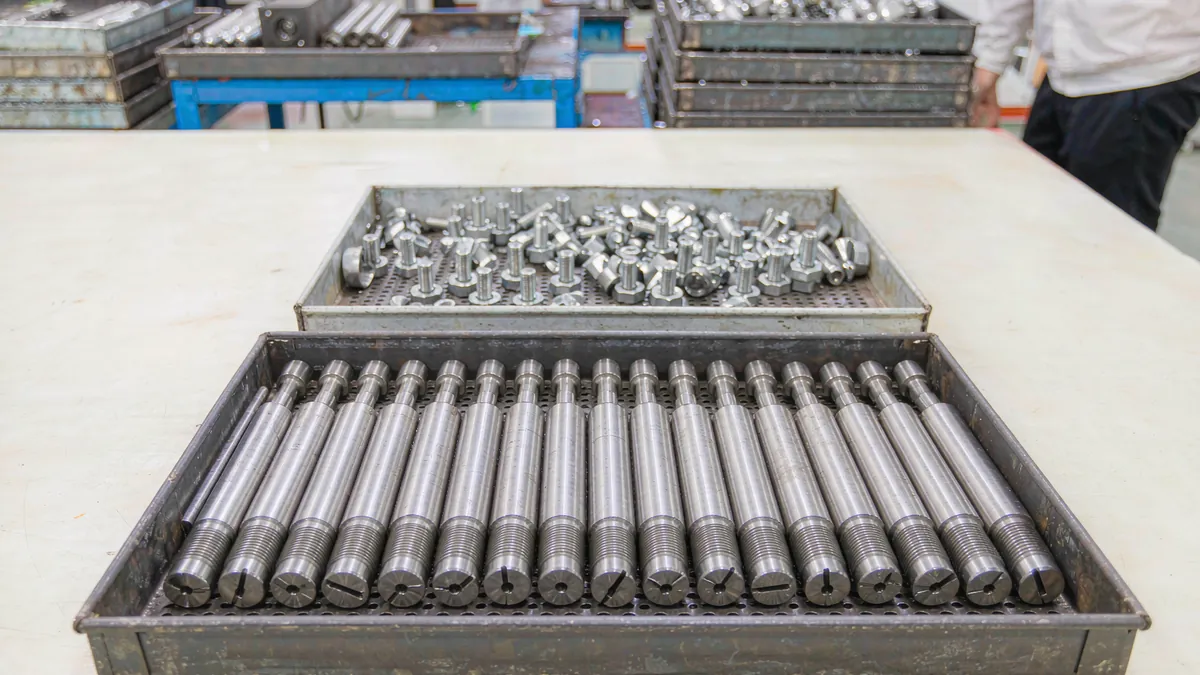
A286 (UNS S66286, AISI 660, W.Nr 1.4980 / X5NiCrTiMoVB25-15-2) is an iron-base superalloy: 24–27 % nickel, 13.5–16 % chromium, 1–1.5 % molybdenum, 1.9–2.35 % titanium with a little vanadium, aluminium and boron on an iron balance. Despite the "stainless steel" AISI 660 label, its strength comes from a controlled ageing treatment (typically 16 h at 704–760 °C, air cool) that precipitates Ni₃(Ti,Al) particles in an austenitic matrix. The result is a genuinely hybrid material: superalloy-class strength and creep behaviour to 650–700 °C, excellent cryogenic toughness, non-magnetic austenitic structure, and machining behaviour closer to the 300-series than to Waspaloy or 718. That combination has made it the default choice for high-temperature fasteners across aerospace, power and petrochemical industries for six decades.
| Element | Content (wt %) | Why it matters |
|---|---|---|
| Nickel (Ni) | 24.0–27.0 | Stabilises the austenitic structure and forms the Ni₃(Ti,Al) strengthening phase with Ti |
| Chromium (Cr) | 13.5–16.0 | Corrosion and oxidation resistance to ~700 °C |
| Titanium (Ti) | 1.90–2.35 | The key ageing element — Ti level on the certificate is the best predictor of aged strength |
| Molybdenum (Mo) | 1.0–1.5 | Solid-solution strengthening and creep resistance |
| Vanadium (V) | 0.10–0.50 | Refines the strengthening precipitates |
| Aluminium (Al) | 0.35 max | Joins Ti in the γ′ Ni₃(Al,Ti) precipitate |
| Boron (B) | 0.001–0.010 | Strengthens grain boundaries for creep rupture life |
| Carbon (C) | 0.08 max | — |
| Manganese / Silicon | 2.0 / 1.0 max | Deoxidation and processing control |
| Iron (Fe) | Balance | What makes A286 far cheaper per kg than Ni-base superalloys |
Minimum values for the standard solution-treated + aged condition (solution 900–980 °C, oil/water quench; age 704–760 °C, most commonly 16 h, air cool) are set by ASTM B637 and the AMS series; product form matters, so minimums and typicals are given separately:
| Condition | Yield strength (0.2 %) | Tensile strength | Elongation |
|---|---|---|---|
| Solution treated (soft, for forming/machining) | ≈ 275 MPa | ≈ 620 MPa | ≈ 40 % |
| Solution treated + aged (spec minimum, ASTM B637 / AMS 5737 class) | ≥ 590 MPa | ≥ 895 MPa | ≥ 15 % (up to 20–25 % depending on form) |
| Aged — typical mill values | 620–760 MPa | 930–1,050 MPa | 20–28 % |
| Bar aged (typical, NASA handbook data: 899 °C solution + age) | ≈ 700 MPa | ≈ 1,025 MPa | ≈ 25 % |
Notes for designers: strength retention is the whole point of A286 — it keeps useful strength to 650 °C and is service-rated to roughly 700 °C, while retaining excellent toughness at cryogenic temperature (widely used in liquid-oxygen and liquid-hydrogen hardware). Cold-worked + aged material reaches higher strengths (used for high-strength bolting), at the cost of ductility. If your spec quotes a single yield number, check which standard it references: minimums differ between B637 bar, A453 Gr 660 bolting and the AMS sheet specs.
| Property | Value |
|---|---|
| Density | 7.93–7.94 g/cm³ |
| Melting range | ≈ 1,370–1,430 °C (one source quotes 1,364–1,424 °C) |
| Thermal conductivity | ≈ 13 W/m·K at room temperature; 15.1 at 100–150 °C; 17.8 at 300 °C; ≈ 23.8 at 600 °C |
| Specific heat | ≈ 420–460 J/kg·K (sources differ; use the mill datasheet for heat-balance calculations) |
| Mean thermal expansion (20–100 °C) | ≈ 16.5 ×10⁻⁶ /K — essentially identical to 304/316; 17.0 (21–316 °C); 18.6 (21–760 °C) |
| Elastic modulus | ≈ 198–201 GPa |
| Electrical resistivity (25 °C) | ≈ 0.91 µΩ·m |
| Magnetic permeability | 1.010 solution treated / 1.007 aged — essentially non-magnetic (austenitic) |
| Precipitation behaviour | Ni₃Ti-type ageing precipitates form between ~650 and 815 °C — the ageing window and the service ceiling are neighbours, so avoid unplanned re-ageing in service |
A286 is not bought as a corrosion specialty: its corrosion resistance is that of a good austenitic stainless (roughly 304-class), adequate for atmospheric, marine-atmosphere and most process environments, with the bonus of strong oxidation resistance up to ~700 °C and outstanding resistance to chloride stress-corrosion cracking for an austenitic alloy. Its three headline properties are thermal, not chemical:
Selection rule of thumb: A286's expansion coefficient (≈ 16.5 ×10⁻⁶ /K at 20–100 °C) is nearly identical to 304/316. Bolting an austenitic flange pair with A453 Gr 660 (A286) studs means flange and bolt grow together when hot — the joint keeps its preload. Use low-expansion bolting on austenitic flanges and you lose clamp load every heat-up cycle.
| Industry | Typical A286 components |
|---|---|
| Aerospace | Jet-engine bolts, fasteners and casings, turbine discs and compressor parts, hardware rated to 650–700 °C |
| Petrochemical / power | ASTM A453 Grade 660 studs and bolts on austenitic flange joints, superheater and reformer internals |
| Space & cryogenics | Liquid-oxygen/liquid-hydrogen compatible fasteners and structures, rocket-engine components (LOX/GOX qualified) |
| Automotive / motorsport | Turbocharger and exhaust fasteners, supercharger rotors and shafts where hot strength beats a normal stainless bolt |
| Industrial | Hot gas-path springs, bellows, valve stems and fasteners between 300 and 650 °C |
| Forged rings | Rings and flange blanks for gas-path casings and hot flange assemblies |
Welding: A286 is weldable by fusion and resistance processes but is more difficult than ordinary austenitic stainless steels — the titanium-bearing chemistry makes the weld metal susceptible to hot cracking at high heat input. Practical rules: weld in the solution-treated condition wherever possible, keep heat input low, and apply the full ageing treatment after welding to restore strength. For high-integrity aerospace joints, resistance or electron-beam processes are common precisely to limit HAZ exposure.
Machining: in the solution-treated condition A286 machines close to the 300-series — this is its big economic advantage over Ni-base superalloys. Once aged (~250–320 HB), it behaves like a hard alloy steel; schedule heavy material removal before ageing.
Buying: the two certificate checks that matter are (1) titanium content — 1.9 % vs 2.3 % on the same heat can swing aged strength by tens of MPa, and (2) the exact heat-treatment condition actually performed (solution only, or solution + aged, and at what temperature). If you buy "aged" material without stating the spec (B637 vs A453 vs AMS 5737), you can receive three different strength levels. PMI note: XRF reads the Ni/Cr/Ti signature fine, but boron is invisible to XRF — boron is certificate-only.
No — it is fully austenitic, with permeability of about 1.010 in solution-treated and 1.007 in the aged condition. A magnet response after heavy cold work is normal and does not indicate a wrong grade.
Below ~650 °C, A286 is usually the economic choice — it machines like stainless and costs far less per kg. Above ~650–700 °C, or when yield above ~1,000 MPa is required at temperature, step up to 718 (or Nimonic grades). Also remember A286 wins specifically on austenitic flanges because its expansion matches 304/316, while 718's is lower.
AISI 660 lists it among stainless steels because iron is the balance element and it is austenitic; the industry calls it an iron-base superalloy because its strengthening relies on a superalloy-style precipitation hardening and it serves to 700 °C. Both labels describe the same UNS S66286 alloy.
Specification minimums are around 895 MPa tensile / 590 MPa yield; typical mill certificates run 930–1,050 MPa tensile / 620–760 MPa yield with 20–28 % elongation, depending on product form and the ageing cycle used. Always tie the PO to the specific standard (B637, A453 Gr 660, or the AMS number) — each sets different minimums.
Yes, but with care: it is more crack-sensitive than ordinary austenitic stainless. Weld in the solution-treated condition, use low heat input, and re-age after welding to recover strength. For critical joints, resistance or EB welding limits the HAZ.
Send us your drawing or specification for a quotation — we reply within one business day.
Buy this grade as: Plate · Round bar · Fasteners · Welding wire · Forged rings

Browsing for a grade? The full library of per-grade technical guides is on one list.
Open the list
Which family fits which corrosion or temperature problem — and the selection rules that keep you out of trouble.
Read article
Traceability, honest heats, the documents to demand — and the red flags to walk away from.
Read article