
All grade guides — one page, every alloy we cover
Browsing for a grade? The full library of per-grade technical guides is on one list.
Open the list2507 (UNS S32750) is the reference super duplex: 25 % chromium, 4 % molybdenum and 0.27 % nitrogen push the PREN past 40, which buys roughly 20–25 °C more critical pitting temperature than 2205, while the 550 MPa minimum yield lets you halve wall thickness against 316L. This guide collects the numbers we quote from — composition, mechanical minima with typical mill values, physical data versus temperature, corrosion limits, and the welding rules that decide whether a 2507 fabrication survives its first year.
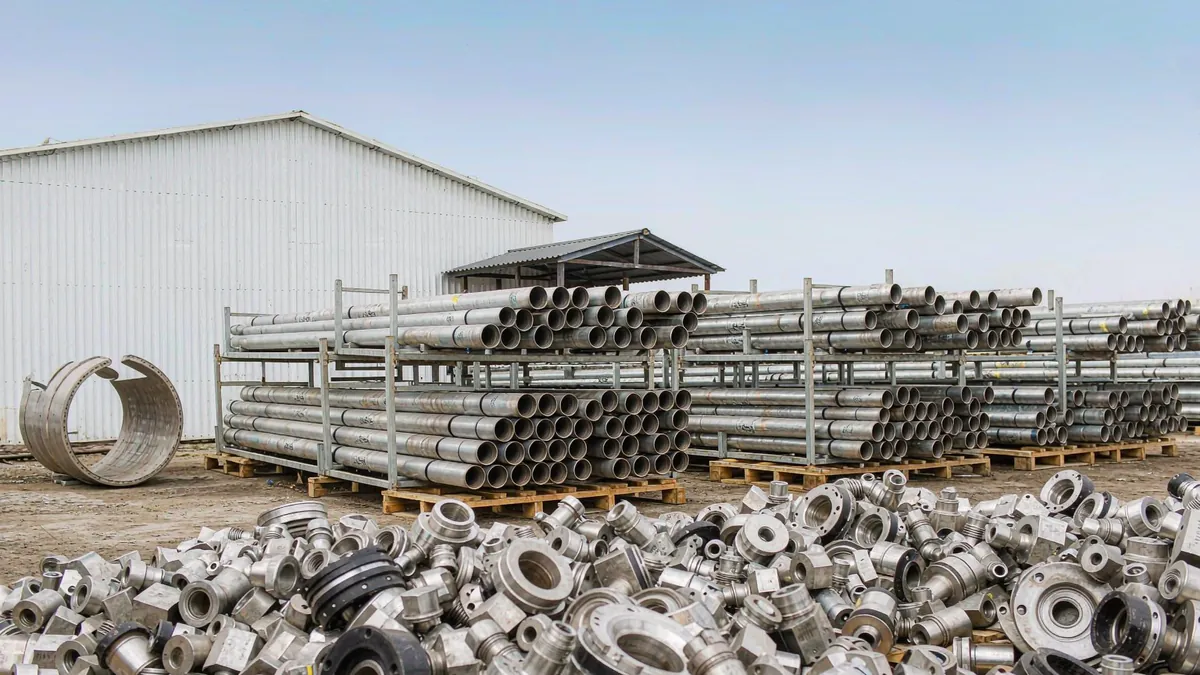
2507 — UNS S32750, W.Nr 1.4410, EN X2CrNiMoN25-7-4, forging grade F53 — is a 25 % Cr super duplex stainless steel with a ferritic-austenitic microstructure of roughly 50/50. Compared with standard duplex 2205 it carries about 1 % more chromium, 1 % more molybdenum and 0.05 % more nitrogen, and that last percent of alloying is what moves the pitting resistance equivalent number (PREN) from the 34–36 band into the 40–43 band. The payoff is a critical pitting temperature some 20–25 °C higher, plus a minimum yield strength of 550 MPa — about twice that of 316L — which is why 2507 is specified for seawater systems, offshore flowlines, desalination high-pressure trains and chemical tanker cargo tanks where both corrosion and weight matter.
What 2507 is not: it is not a high-temperature alloy (stay at or below about 300 °C), it is not a substitute for nickel alloys in hot concentrated hydrochloric acid, and it is not forgiving in fabrication — the same alloying that gives the corrosion resistance makes it sensitive to intermetallic phase precipitation if you weld it with too much heat input or try to stress-relieve it in the wrong temperature window.
ASTM A240 / A276 limits for UNS S32750, with the role each element plays:
| Element | Content (wt %) | Why it matters |
|---|---|---|
| Chromium (Cr) | 24.0–26.0 | Passive film former; the base of both pitting resistance and general corrosion resistance |
| Nickel (Ni) | 6.0–8.0 | Balances the austenite/ferrite ratio near 50/50 — too little and the weld turns ferritic and brittle |
| Molybdenum (Mo) | 3.0–5.0 | Pitting and crevice resistance, especially in chlorides; also resistance to reducing acids |
| Nitrogen (N) | 0.24–0.32 | Strong austenite former, raises yield strength, and is the cheapest PREN contributor (16 × N) |
| Carbon (C) | 0.030 max | Kept ultra-low to avoid chromium carbide precipitation in the weld HAZ |
| Manganese (Mn) | 1.20 max | Deoxidation; also holds nitrogen in solution during melting |
| Silicon (Si) | 0.80 max | Deoxidation; excess promotes intermetallic phases |
| Copper (Cu) | 0.50 max | Residual in 2507 — the W + Cu combination is what distinguishes Zeron 100 (S32760) |
| Phosphorus / Sulphur | 0.035 / 0.020 max | Tramp elements; sulphur is capped tighter in EN 10088-2 (0.015 max) — relevant when dual-certifying |
| Iron (Fe) | Balance | — |
PREN = Cr + 3.3 Mo + 16 N. At the specification minimums this gives 24.0 + 3.3 × 3.0 + 16 × 0.24 = 37.7; at a typical heat (25.0 Cr, 4.0 Mo, 0.27 N) it gives 42.5. That gap is the single most important purchasing detail on this grade: a certificate that only meets the element minimums can legally be called S32750 and still miss the PREN ≥ 40 that the application was designed around. State PREN ≥ 40 on the purchase order, or specify the actual Cr/Mo/N targets.
Code minima with typical mill-certificate ranges in brackets. 2507 is supplied in the solution-annealed condition and is not strengthened by heat treatment:
| Product form / standard | Yield strength 0.2 % | Tensile strength | Elongation | Hardness |
|---|---|---|---|---|
| Plate & sheet — ASTM A240 (A480 tolerances) | ≥ 550 MPa [600–700] | ≥ 795 MPa [820–920] | ≥ 15 % [25–35] | ≤ 310 HBW [250–290] |
| Bar & rod — ASTM A276 / A479 | ≥ 550 MPa [620–750] | ≥ 800 MPa [840–950] | ≥ 25 % [25–32] | ≤ 310 HBW [255–295] |
| Seamless tube — ASTM A790 / A789 | ≥ 550 MPa [600–720] | ≥ 800 MPa [820–900] | ≥ 25 % [25–35] | ≤ 310 HBW |
| Forged flanges & fittings — A182 F53 / A815 | ≥ 550 MPa [580–700] | ≥ 760 MPa [800–900] | ≥ 25 % [25–32] | ≤ 310 HBW |
| Cold-drawn bar / wire (no code minimum) | 700–950 MPa | 800–1,050 MPa | 8–20 % | — |
Notes for designers:
| Property | Value |
|---|---|
| Density | 7.80 g/cm³ (7.79–7.81 measured) |
| Melting range | ≈ 1,350–1,400 °C |
| Modulus of elasticity (20 °C) | 200 GPa |
| Thermal conductivity (20 °C) | ≈ 14 W/m·K |
| Specific heat (20 °C) | ≈ 480 J/kg·K |
| Electrical resistivity (20 °C) | ≈ 0.80 µΩ·m |
| Mean expansion 20–100 °C | ≈ 13.0 ×10⁻⁶ /K |
| Ferrite content (annealed) | 35–55 % (target ≈ 50 %) |
| Magnetic behaviour | Strongly ferromagnetic — a magnet cannot distinguish it from carbon steel |
| Temperature | Thermal conductivity | Mean expansion (from 20 °C) | Modulus of elasticity |
|---|---|---|---|
| 20 °C | 14 W/m·K | — | 200 GPa |
| 100 °C | 15 W/m·K | 13.0 ×10⁻⁶ /K | 190 GPa |
| 200 °C | 17 W/m·K | 13.5 ×10⁻⁶ /K | 180 GPa |
| 300 °C | 18 W/m·K | 14.0 ×10⁻⁶ /K | 170 GPa |
| 400 °C | 20 W/m·K | 14.5 ×10⁻⁶ /K | 160 GPa |
Two practical consequences. First, the thermal expansion is about 30 % lower than 304/316 (13.0 versus 16–17 ×10⁻⁶ /K), which is the main reason duplex heat exchangers and piping see less thermal stress than austenitic equivalents — but it also means dissimilar welds to austenitic steel carry real restraint. Second, the conductivity is roughly double that of austenitic stainless, which helps in seawater coolers and makes welding heat spread away from the pool faster than an austenitic welder expects.
2507 sits above 2205 and below the 6 % Mo super-austenitics in the pitting hierarchy. The numbers that matter in a specification are the critical pitting temperature (CPT, ASTM G48 method C) and the critical crevice temperature (CCT, method D):
| Index | 2205 (S32205) | 2507 (S32750) | Zeron 100 (S32760) |
|---|---|---|---|
| PREN | 34–36 | 40–43 (typ. 42.5) | ≥ 40 (typ. 42–43, W included) |
| CPT, ASTM G48 C | ≈ 50–60 °C | ≈ 80–90 °C | ≈ 80–90 °C |
| CCT, ASTM G48 D | ≈ 25–35 °C | ≈ 55–70 °C | ≈ 55–70 °C |
Published CPT/CCT values move by 5–10 °C between heats and test labs, so treat the ranges above as selection guidance and a mill certificate value as the contract number. What the jump from 2205 to 2507 actually buys is roughly 20–25 °C of pitting margin — enough to move from "acceptable in ambient seawater" to "acceptable in warm seawater and in creviced joints", not immunity.
| Environment | 2507 behaviour | Comment |
|---|---|---|
| Ambient and warm seawater, chlorinated seawater | Good to ≈ 40–50 °C | Keep chlorination residual low and avoid stagnant crevices; above ~50 °C go to 6Mo / 625 |
| Chloride stress-corrosion cracking | Excellent | The ferrite phase blocks transgranular SCC; this is the main reason duplex replaces 304/316 in chloride service |
| Dilute sulphuric acid | Good at low concentration and moderate temperature | Not for concentrated H₂SO₄ — use Alloy 20 or 904L |
| Hydrochloric acid | Not recommended | Even dilute HCl attacks the passive film; specify C-276 or 625 |
| Organic acids (formic, acetic) | Very good | Better than 316L by a wide margin |
| Caustic soda | Good to moderate concentration/temperature | Watch SCC risk at high concentration and temperature |
| Hypochlorite / chlorine dioxide bleaching | Conditional | Oxidising chloride conditions are the weak point; validate with corrosion testing before committing |
| Sour service (H₂S) | Conditional | Listed in NACE MR0175 within a pH₂S / temperature / hardness envelope — the envelope, not the grade name, governs |
Selection rule: use 2205 up to about 40 °C seawater and for general chloride duty; step to 2507 when the seawater is warm, when crevices are unavoidable (flange faces, tube-to-tubesheet joints, threaded connections), or when you need the extra 100 MPa of yield for weight. Do not step to 2507 expecting it to handle hydrochloric acid or hot concentrated sulphuric acid — that is nickel-alloy territory.
| Temperature band | What happens | What to do |
|---|---|---|
| −50 to +50 °C | Full toughness and corrosion performance | Standard supply condition; impact tested if specified |
| 50–250 °C | Design range for pressure equipment | Use code allowable stresses; strength falls with temperature |
| 250–315 °C | Practical ceiling for long-term service; 475 °C embrittlement begins | ASME VIII Div. 1 lists duplex grades only to 315 °C (600 °F) — above that, use austenitic or nickel alloy |
| 600–900 °C | Sigma and chi phase precipitate rapidly (nose ≈ 800–850 °C) | Never stress-relieve or slow-cool in this window; it destroys toughness and corrosion resistance |
| > 900 °C | Oxidation and grain growth | Not a service condition for 2507 |
If a fabrication needs post-weld heat treatment, it must be a full solution anneal at 1,025–1,125 °C followed by water quenching or forced rapid cooling — never a 600–700 °C stress relief. In practice, correctly welded 2507 needs no PWHT at all, and a customer who asks for stress relief on a duplex vessel is usually about to destroy it. Flag this at the quotation stage, not after welding.
| Industry | Typical 2507 components |
|---|---|
| Oil & gas / subsea | Flowlines and risers, subsea manifolds and hubs, X-tree bodies, HIP joints, umbilical tubing, topside process piping |
| Desalination | RO high-pressure pipework, brine pumps and valves, energy-recovery device housings, evaporator tube bundles |
| Chemical & petrochemical | Heat exchangers, reactor internals, cargo tanks and pipework on chemical tankers, phosphoric and nitric acid handling |
| Power & environmental | FGD scrubber internals, absorber recirculation piping, flue-gas reheaters, wastewater and effluent systems |
| Pulp & paper | Digesters and blow lines, brownstock washers, bleach-plant piping, white-liquor handling |
| Marine | Seawater cooling systems, firewater pumps and piping, propeller shafting, rudder stocks, mooring hardware |
| Hydropower | Penstocks, turbine runners and draft tubes in aggressive river water, sand-erosion-resistant liners |
| Food & salt processing | Brine handling, evaporator bodies, centrifuges, salt-dust-exposed structural parts |
Two patterns are worth noting. Subsea projects consume 2507 mostly as forged and machined parts (hubs, blocks, stems) rather than plate, because the wall thicknesses are driven by pressure and fatigue rather than corrosion. Desalination consumes it as tube and heavy-wall pipe. Both are forms where the mill's solution-annealing practice and the forge shop's thermal control matter more than the chemistry on the certificate.
| Grade | PREN | Min. yield | Seawater / chloride sweet spot | Relative price |
|---|---|---|---|---|
| 316L (S31603) | ≈ 24 | 170 MPa | Fresh water, mild chlorides; not seawater | 1.0 (baseline) |
| 2205 (S32205) | 34–36 | 450 MPa | Ambient seawater, general chloride duty | 1.5–2.0× |
| 2507 (S32750) | 40–43 | 550 MPa | Warm seawater, creviced joints, high-pressure piping | 2.2–3.0× |
| 254SMO / AL-6XN (6 % Mo) | 43–47 | 300 MPa | Seawater where welding of thick duplex is impractical | 3.5–4.5× |
| Inconel 625 (N06625) | ≈ 50 | 414 MPa | Hot seawater, HCl-bearing, sour, high temperature | 8–12× |
Price multiples are indicative and move with the nickel and molybdenum markets — use them to frame the conversation, not as a quotation. The decision usually turns on three questions: how hot is the chloride environment, how many crevices will the design contain, and can the fabricator weld duplex to procedure. If the answer to the last one is no, the 6 % Mo austenitics are the safer engineering choice even at a higher price per kilogram.
| Parameter | Recommendation | Why |
|---|---|---|
| Filler metal | ER2594 / E2594 (25 9 4 N L) | Over-matches the base metal PREN; do not use ER2209 — the weld would be the weak link |
| Preheat | None | Duplex is not hardenable; preheat only hurts phase balance |
| Heat input | 0.5–1.5 kJ/mm typical, hard cap 2.0 | Too much heat → coarse grains and sigma; too little → excessive ferrite |
| Interpass temperature | ≤ 150 °C | Prevents intermetallic precipitation in multipass welds |
| Root purge | Argon, or Ar + 2–5 % N₂ | Nitrogen backing restores austenite in the root and protects pitting resistance |
| Post-weld heat treatment | None required | If PWHT is unavoidable: full solution anneal 1,025–1,125 °C + water quench |
| Post-weld cleaning | Pickle and passivate; brush only with stainless-dedicated tools | Heat tint is a pitting initiation site in seawater |
| Ferrite in weld | 35–55 % (check on the procedure qualification) | Outside that band, toughness or corrosion resistance is compromised |
Machining: 2507 work-hardens quickly and generates high cutting forces. Use rigid set-ups, low surface speeds (typically 30–50 m/min with carbide), high feed per tooth, generous coolant, and never let the tool rub. Drilling deep holes in duplex is the classic productivity trap — peck, clear the chip, and keep the edge sharp.
Forming: cold bending is practical up to modest strain; beyond roughly 10–15 % deformation, a solution anneal is required before the part goes into chloride service. Hot forming must finish above 950 °C and be followed by a full anneal and water quench — never air-cool a hot-formed duplex part.
The most common 2507 failure we see in incoming inspection is not wrong chemistry — it is correct chemistry with the wrong thermal history: plate supplied annealed but slow-cooled, or a forging that was reheated into the sigma range during straightening. The MTC looks perfect. Ask for the quench record on anything thicker than 40 mm.
We supply super duplex 2507 as plate, bar, seamless tube, and — our core strength — as rolled and forged rings, flanges and machined-to-drawing components. Forged rings are produced with controlled forging ratios and followed by solution annealing with recorded quench, which is exactly the step that decides whether a 2507 ring performs in seawater. Every shipment leaves with EN 10204 3.1 certificates and PMI verification; G48 corrosion testing and Charpy impact testing can be witnessed by a third party at the buyer's cost. Typical lead time: 10–20 working days for stock plate and bar, 30–45 days for forged rings and custom machined parts, with tolerances to your drawing (a common ring specification is −0/+2 mm on diameter).
Yes — strongly. The ferrite phase (about half the microstructure) is ferromagnetic, so a magnet sticks to 2507 just as it does to carbon steel. A magnet test tells you nothing about grade; ask for PMI.
Use 2205 for ambient seawater, general chloride duty and applications where 450 MPa yield is enough; it is significantly cheaper. Choose 2507 when the seawater is warm (roughly above 40 °C), when crevices are unavoidable, when you need 550 MPa yield to cut wall thickness, or when the design temperature reaches 250–300 °C. The PREN difference (42 versus 35) is what you are paying for.
Not for long-term pressure service. 475 °C embrittlement starts to matter from about 300 °C, and ASME Section VIII Div. 1 only lists duplex grades to 315 °C. Above that, move to a 6 % Mo austenitic or a nickel alloy such as 625.
ER2594 (25 9 4 N L) for TIG/MIG and E2594 for stick. ER2209 must not be used: the weld would have a lower PREN than the base metal and would become the preferential pitting site in seawater.
It is listed in NACE MR0175, but only inside a defined envelope of pH₂S, temperature and hardness (≤ 32 HRC). Whether your specific well conditions fall inside it must be checked against MR0175 tables — the grade name alone is not an approval.
Roughly 1 % more chromium, 1 % more molybdenum and 0.05 % more nitrogen, plus tighter thermal control in rolling and annealing. Molybdenum is the expensive one; it is also the element doing the work in chloride service, which is why the price gap is worth paying rather than stepping back to 2205 and accepting a shorter service life.
Send us your drawing or specification for a quotation — we reply within one business day.
Buy this grade as: Plate · Round bar · Seamless tube · Flanges

Browsing for a grade? The full library of per-grade technical guides is on one list.
Open the list
Which family fits which corrosion or temperature problem — and the selection rules that keep you out of trouble.
Read article
Traceability, honest heats, the documents to demand — and the red flags to walk away from.
Read article