
All grade guides — one page, every alloy we cover
Browsing for a grade? The full library of per-grade technical guides is on one list.
Open the listDuplex 2304 (UNS S32304, EN 1.4362) is the 'lean duplex': virtually no molybdenum and only 3.5–5.5 % nickel, yet roughly twice the yield strength of 304L/316L, a PREN of about 24–26 comparable to 316L, and the chloride stress-corrosion-cracking immunity that duplex structure brings. For strength-driven designs in mildly corrosive media it replaces 304L or 316L at a lower and far more price-stable alloy cost. This guide sets out the numbers, the selection rules and the fabrication notes we use when quoting 2304 plate, tube, bar and structural sections.
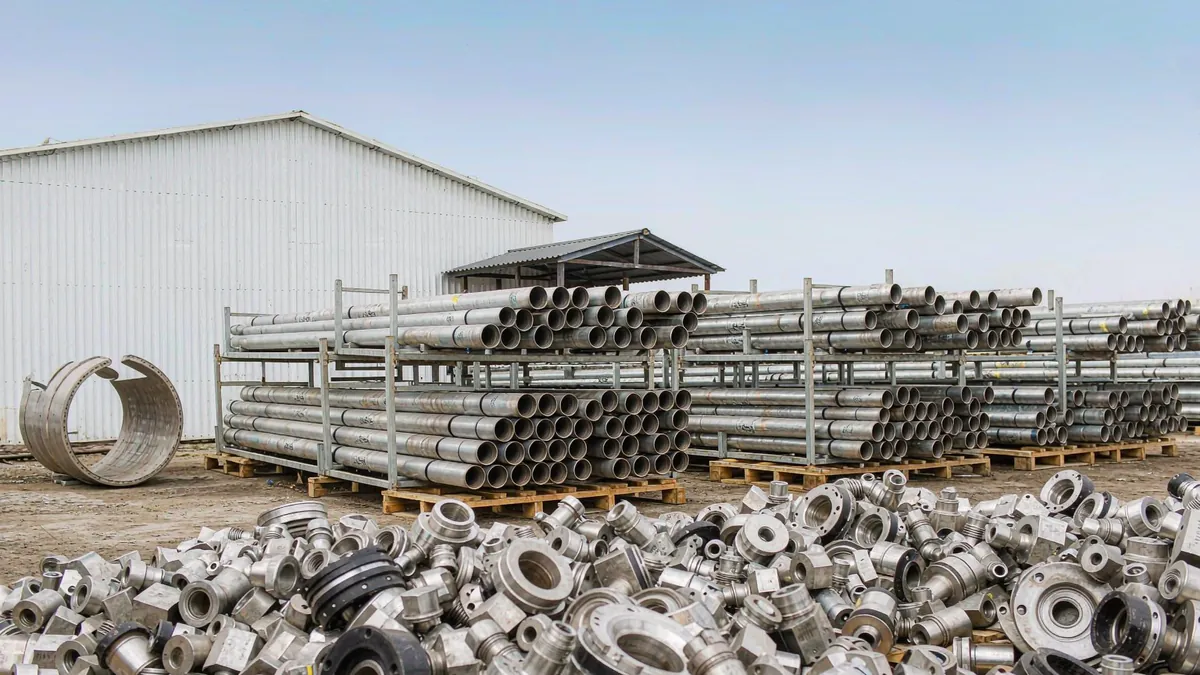
Duplex 2304 (UNS S32304, EN 1.4362, X2CrNiN23-4) is the lowest-alloyed member of the duplex family — the 'lean duplex'. It keeps the roughly 50/50 ferrite-austenite structure and nitrogen stabilisation of the family, but drops molybdenum almost entirely (0.05–0.60 %) and keeps nickel to 3.5–5.5 %. The result: yield strength around twice 304L/316L (≥ 400 MPa min), pitting resistance in the same band as 316L (PREN ≈ 24–26), and duplex-grade resistance to chloride stress-corrosion cracking — at an alloy cost dominated by chromium rather than nickel and molybdenum, which makes pricing far more stable. It is the go-to grade where a design is strength-driven or SCC-driven rather than pitting-driven.
| Element | Content (wt %) | Why it matters |
|---|---|---|
| Chromium (Cr) | 21.5–24.5 | Base corrosion resistance (EN narrows this to 22.0–24.0) |
| Nickel (Ni) | 3.5–5.5 | Sets the austenite fraction; much lower than 304L (8–12) — this is where the cost saving comes from |
| Molybdenum (Mo) | 0.05–0.60 | Deliberately minimal — 2304 is not a pitting-resistance upgrade play |
| Nitrogen (N) | 0.05–0.20 | Stabilises phase balance after welding; adds strength and pitting resistance |
| Copper (Cu) | 0.05–0.60 | Small addition that helps in mildly acidic (e.g. dilute sulfuric) environments |
| Carbon (C) | 0.030 max | Controls sensitisation |
| Manganese / Silicon | 2.00 / 1.00 max | Deoxidation and processing control |
| Iron (Fe) | Balance | Matrix |
Note the ASTM/EN spread: ASTM lists Ni 3.5–5.5 / Cu 0.05–0.60 for S32304, while EN 10088 (1.4362, X2CrNiN23-4) quotes Ni 3.5–5.5 / Cu 0.10–0.60 / Cr 22.0–24.0 / Mo 0.10–0.60. Certificates should name the standard that governs your order.
Minimum values for annealed product per ASTM A240 with typical values in brackets:
| Condition | Yield strength (0.2 %) | Tensile strength | Elongation | Hardness |
|---|---|---|---|---|
| Annealed (specification minimum) | ≥ 400 MPa | ≥ 600 MPa | ≥ 25 % | ≤ 290 HB (EN datasheets often quote ≤ 260 HB) |
| Annealed (typical mill values) | 450–550 MPa | 600–830 MPa (EN range) | 25–35 % | ≈ 230–260 HB |
Practical consequences: the 400 MPa yield floor is roughly double 304L/316L, so tanks, structures and pressure components can be thinner and lighter at the same load — often the entire business case for 2304. Elongation is lower than austenitic grades, so cold forming needs larger bend radii and revisited forming limits. Impact toughness is usable to about −50 °C; specify Charpy testing at the design minimum temperature for anything colder.
| Property | Value |
|---|---|
| Density | 7.70 g/cm³ per our base data; many European datasheets (METALCOR and others) quote 7.8 g/cm³ — use the mill datasheet for weight take-off |
| Melting range | ≈ 1,400–1,460 °C per our base data; published ranges vary roughly 1,385–1,460 °C |
| Thermal conductivity (20 °C) | ≈ 15 W/m·K (higher than 304L/316L's ≈ 15 at 100 °C) |
| Specific heat | ≈ 500 J/kg·K |
| Thermal expansion (20–100 °C) | ≈ 13.0 ×10⁻⁶ /K (about 25 % lower than 304L — close to carbon steel) |
| Elastic modulus | ≈ 200 GPa |
| Electrical resistivity | ≈ 0.80 µΩ·m |
| Magnetic behaviour | Ferromagnetic — a magnet sticks to 2304. Normal for duplex, not a sign of a wrong grade. |
Selection rule of thumb: use 2304 where 304L/316L is the current choice but the design is driven by strength, SCC or weight — tanks, structures, rebar, architectural sections. If the medium is hot seawater, brine above ~40 °C or aggressive crevice conditions, step up to 2205 (PREN ≈ 34–36) or 2507; if the design needs deep drawing or cryogenic toughness, go back to austenitic 304L/316L.
| Industry | Typical 2304 components |
|---|---|
| Construction / architecture | Structural sections, coastal façades and bridges, stainless rebar |
| Water & wastewater | Water and effluent tanks, treatment plant equipment, piping |
| Storage & logistics | Storage vessels and silos where weight savings from higher yield compound |
| Chemical processing | Vessels and lines in mildly corrosive media where 304L/316L is marginal on SCC |
| Pulp & paper | Process equipment in moderate chloride duty |
| Food & infrastructure | Load-bearing frames, supports and structures needing stainless appearance + strength |
Hangbo supplies 2304 plate, tube and pipe, bar, sections and forgings with EN 10204 3.1 certificates and heat-number traceability; PMI verification is standard before packing.
Welding: the standard filler is ER2209 (AWS A5.9, EN 1600 22 9 3 N L) — the same overmatching consumable used for 2205 — which restores nitrogen and phase balance in the joint. No preheat; keep interpass below 150 °C and moderate the heat input (too low gives excess ferrite, too high promotes intermetallics). Do not stress-relieve: if a repair needs heat treatment it must be a full solution anneal (≈ 950–1,050 °C per EN datasheets) with rapid quench. Some non-critical procedures use 309L — confirm against your WPS before substituting.
Fabrication: expect stronger springback than 304L (higher yield) and lower elongation — widen bend radii, avoid deep drawing. Hot-formed parts need solution annealing. Machining forces are higher than austenitic grades; use rigid setups.
Procurement pitfalls: (1) 2304 and 304L both test near PREN 24–26 — a certificate that does not name UNS S32304 / EN 1.4362 explicitly is a red flag; (2) ASTM vs EN composition windows differ on Cr/Mo/Cu limits, so name the governing standard on the PO; (3) for corrosion-critical duty, request ASTM A923 or equivalent testing in addition to chemistry.
Yes — like all duplex grades, the ferrite phase makes 2304 ferromagnetic. A magnet sticking to it is normal and a quick check that you did not receive an austenitic grade.
They have comparable pitting resistance (PREN ≈ 24–26), but 2304 offers roughly double the yield strength and far better chloride-SCC resistance at a lower, more price-stable alloy cost (no molybdenum, half the nickel). Stay with 316L if you need deep drawing, urea/mid-acid service, or the widest fabrication familiarity.
2304 (PREN ≈ 24–26) covers strength- and SCC-driven duty in mild media; 2205 (PREN ≈ 34–36) is the choice once seawater, hot chlorides or aggressive crevice conditions appear. If a drawing already says 2205, do not downgrade to save cost without a corrosion review.
Usable toughness down to about −50 °C and, like all duplexes, a practical pressure-service ceiling around 250–300 °C because 475 °C embrittlement starts near 300 °C. Confirm the exact limit in your design code.
Most datasheets quote 7.8 g/cm³, some 7.7 — the small spread reflects the variable ferrite/austenite balance and measurement basis. For weight and freight calculations use the value on the mill certificate or the mill's own datasheet.
Send us your drawing or specification for a quotation — we reply within one business day.
Buy this grade as: Plate · Round bar · Seamless tube · Flanges

Browsing for a grade? The full library of per-grade technical guides is on one list.
Open the list
Which family fits which corrosion or temperature problem — and the selection rules that keep you out of trouble.
Read article
Traceability, honest heats, the documents to demand — and the red flags to walk away from.
Read article