
All grade guides — one page, every alloy we cover
Browsing for a grade? The full library of per-grade technical guides is on one list.
Open the listDuplex 2205 is the default duplex stainless steel worldwide: a balanced austenite-ferrite structure that gives roughly twice the yield strength of 316L, a PREN of about 34–36, and outstanding resistance to chloride stress-corrosion cracking — all at a nickel level half that of an austenitic grade. This guide collects the composition, mechanical and physical numbers, the selection rules and the fabrication discipline we apply when quoting 2205 plate, pipe, bar and forgings.
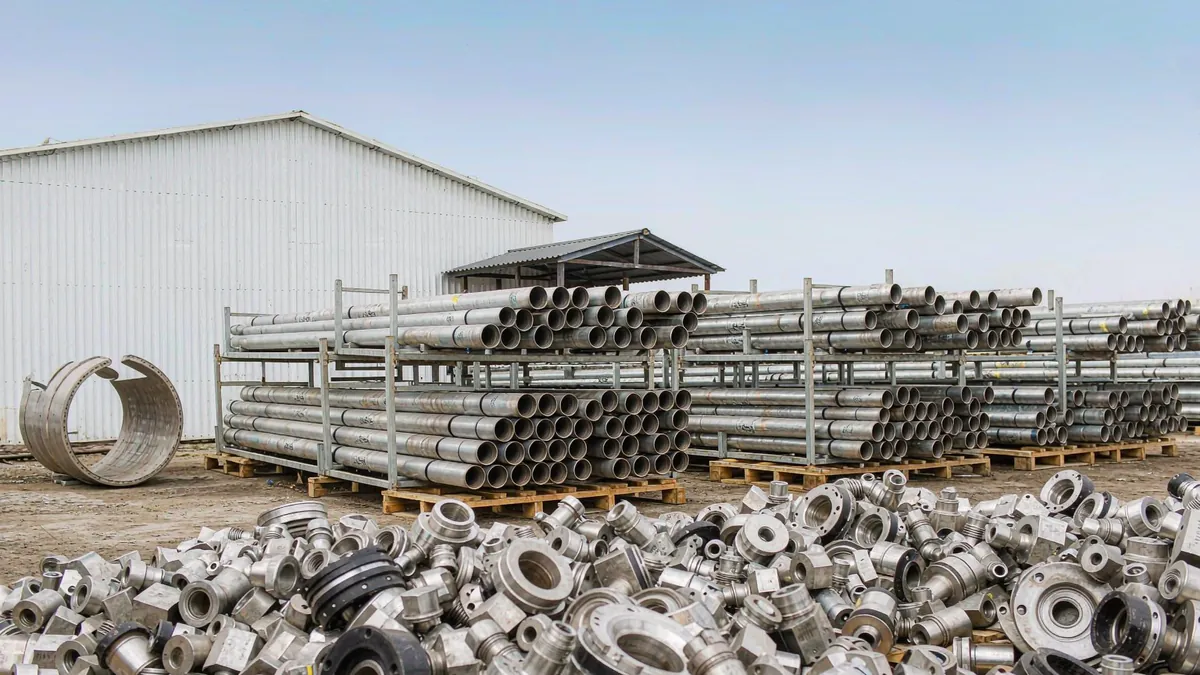
Duplex 2205 (UNS S32205, EN 1.4462, X2CrNiMoN22-5-3) is a two-phase stainless steel with roughly 50 % ferrite and 50 % austenite in the annealed condition. Nitrogen (0.14–0.20 %) keeps the phase balance stable through welding and heat treatment, while the combined Cr + Mo + N give it a PREN of about 34–36 — comfortably above 316L (≈ 26). The payoff is threefold: about twice the yield strength of 316L, so pressure vessels and pipework can use thinner walls; far higher chloride stress-corrosion cracking (SCC) threshold than any austenitic grade; and a lower, more stable alloy cost because nickel is only 4.5–6.5 %. The modern UNS S32205 designation (Mo min 3.0 %, N min 0.14 %) superseded the older S31803; most mills now certify to S32205, and this guide covers both.
| Element | Content (wt %) | Why it matters |
|---|---|---|
| Chromium (Cr) | 22.0–23.0 | Base corrosion resistance and pitting resistance |
| Nickel (Ni) | 4.5–6.5 | Controls the austenite fraction and phase balance |
| Molybdenum (Mo) | 3.0–3.5 | Pitting/crevice resistance (raises PREN by 3.3 points per %) |
| Nitrogen (N) | 0.14–0.20 | Austenite former that stabilises phase balance after welding; adds strength and pitting resistance |
| Carbon (C) | 0.030 max | Keeps sensitisation and carbide precipitation under control |
| Manganese (Mn) | 2.00 max | Deoxidation, processing aid |
| Silicon (Si) | 1.00 max | Deoxidation |
| Phosphorus / Sulfur | 0.030 / 0.020 max | Residual control |
| Iron (Fe) | Balance | Matrix |
S32205 vs S31803: the older S31803 allowed Mo 2.50 min and N 0.08 min, which puts its PREN nearer 33. S32205 tightens both minima (Mo 3.0 min, N 0.14 min). For new specifications, ask for S32205 — the price difference is usually negligible.
Minimum values for annealed product per ASTM A240 (plate), A276 / A479 (bar), A790 (pipe) — all essentially the same floors — with typical mill-certificate ranges in brackets:
| Condition | Yield strength (0.2 %) | Tensile strength | Elongation | Hardness |
|---|---|---|---|---|
| Annealed (specification minimum) | ≥ 450 MPa | ≥ 655 MPa | ≥ 25 % | ≤ 293 HB |
| Annealed (typical mill values) | 500–600 MPa | 700–900 MPa | 25–35 % | ≈ 240–280 HB |
Notes for designers:
| Property | Value |
|---|---|
| Density | 7.80 g/cm³ (lower than 316L's 8.00 — ferrite packs tighter) |
| Melting range | ≈ 1,385–1,460 °C (published datasheets vary roughly 1,350–1,460) |
| Thermal conductivity (20 °C) | ≈ 13.5–15 W/m·K (higher than 316L's ≈ 13.5 at high temperature; some datasheets quote up to 19 W/m·K at 100 °C) |
| Specific heat | ≈ 450–500 J/kg·K |
| Thermal expansion (20–100 °C) | ≈ 13.7 ×10⁻⁶ /K (about 25 % lower than 316L — close to carbon steel, which simplifies mixed-material piping layouts) |
| Elastic modulus | 190–200 GPa |
| Electrical resistivity | ≈ 0.85 µΩ·m |
| Magnetic behaviour | Ferromagnetic — a magnet sticks to 2205. This is normal for duplex and does not indicate a wrong grade. |
Selection rules: (1) For pressure service, most design codes cap duplex at roughly 250–300 °C — above this range the ferrite embrittles (475 °C embrittlement starts around 300 °C, and sigma phase forms at 600–950 °C). Never stress-relieve 2205 in the 600–950 °C band. (2) In seawater hotter than about 40–50 °C, 2205's pitting margin disappears — step up to super duplex 2507 (PREN ≥ 40). (3) If the design is driven by strength and mild chlorides, lean duplex 2304 may do the job cheaper.
For critical chloride service, ask for ASTM A923 corrosion testing (ferrite count plus pitting test) in addition to the standard mill certificate — it is the industry-accepted way to catch an improper anneal.
| Industry | Typical 2205 components |
|---|---|
| Oil & gas | Flowlines, separators, production tubing, sour-service vessels (NACE MR0175), offshore piping |
| Chemical / petrochemical | Pressure vessels, heat-exchanger shells and tubing, reactors, transfer lines |
| Chemical tankers | Cargo tanks and pump/manifold systems carrying aggressive cargoes |
| Desalination / water | RO high-pressure piping, seawater intakes, pumps and valves (ambient-temperature seawater) |
| Pulp & paper | Digesters, bleach plant washers, liquor handling |
| Power / environment | FGD scrubbers, dampers, quench systems |
| Architecture | Load-bearing structures, bridges and façades in coastal/marine atmospheres |
Hangbo supplies 2205 plate, bar, seamless/welded pipe, forgings and machined-to-drawing parts with EN 10204 3.1 certificates, heat-number traceability and optional PMI and A923 testing.
Welding: 2205 welds well with a disciplined procedure. Use ER2209 (AWS A5.9, EN 1600 22 9 3 N L) filler, which overmatches the base metal in nitrogen. No preheat is required; keep interpass temperature below 150 °C and heat input in the roughly 0.5–2.5 kJ/mm band — too little heat gives excess ferrite in the weld, too much drives sigma formation. Do not post-weld heat treat: if a joint must be re-annealed, it needs a full solution anneal (typically 1,040–1,100 °C followed by rapid quench), not a stress relief. Root shielding gas should avoid nitrogen losses (use Ar + 1–3 % N or correct purge practice).
Forming and machining: expect higher springback and larger bend radii than 316L (higher yield, lower elongation); hot forming must be followed by solution annealing. Machining is slower than austenitic grades — rigid setups, positive-rake tooling and generous coolant, roughly comparable to 316 in cutting forces but less gummy.
Procurement pitfalls: (1) confirm the certificate says S32205, not S31803, if your spec calls for the tighter Mo/N minima — XRF PMI can separate them by Mo reading, so ask for PMI on heat lots; (2) check ferrite balance (≈ 40–60 %) on welded or heavily formed product; (3) for seawater service, specify A923 testing rather than relying on chemistry alone.
Yes — the ~50 % ferrite phase makes 2205 ferromagnetic, and a magnet will stick to it. This is normal and is actually a quick sanity check that you received duplex rather than an austenitic grade.
Choose 2205 when chlorides, SCC risk or wall-thickness savings dominate: roughly twice the yield (450 vs 240 MPa min), PREN ≈ 34–36 vs 26, and near-immunity to chloride SCC. Stay with 316L for mild media, deep-drawn parts, or where cryogenic toughness is required.
PREN ≈ 34–36 for 2205 versus ≥ 40 for 2507. In practice: ambient-temperature seawater and brackish water suit 2205; hot seawater (> 40–50 °C), high-chloride acid brines and severe crevice geometries call for 2507.
Most pressure-vessel and piping codes limit duplex steels to about 250–300 °C because 475 °C embrittlement begins around 300 °C and sigma phase forms at 600–950 °C. Always check the exact limit in the design code you are working to.
S32205 is the modern, tighter version of S31803 (Mo minimum raised from 2.5 % to 3.0 %, nitrogen from 0.08 % to 0.14 %). They are frequently dual-certified; for new builds specify S32205 or write 'S31803 with Mo ≥ 3.0 % and N ≥ 0.14 %'.
Send us your drawing or specification for a quotation — we reply within one business day.
Buy this grade as: Plate · Round bar · Seamless tube · Flanges

Browsing for a grade? The full library of per-grade technical guides is on one list.
Open the list
Which family fits which corrosion or temperature problem — and the selection rules that keep you out of trouble.
Read article
Traceability, honest heats, the documents to demand — and the red flags to walk away from.
Read article