
All grade guides — one page, every alloy we cover
Browsing for a grade? The full library of per-grade technical guides is on one list.
Open the list17-7 PH is the semi-austenitic member of the precipitation-hardening family: it leaves the solution-annealing furnace soft, austenitic and formable, then reaches spring-grade strength (1,200–1,700 MPa class) through a conditioning-plus-ageing sequence instead of brute-force cold work. That combination — form first, harden last, with very low distortion — is why diaphragms, bellows, retainers and precision springs across aerospace and instrumentation keep specifying UNS S17700.
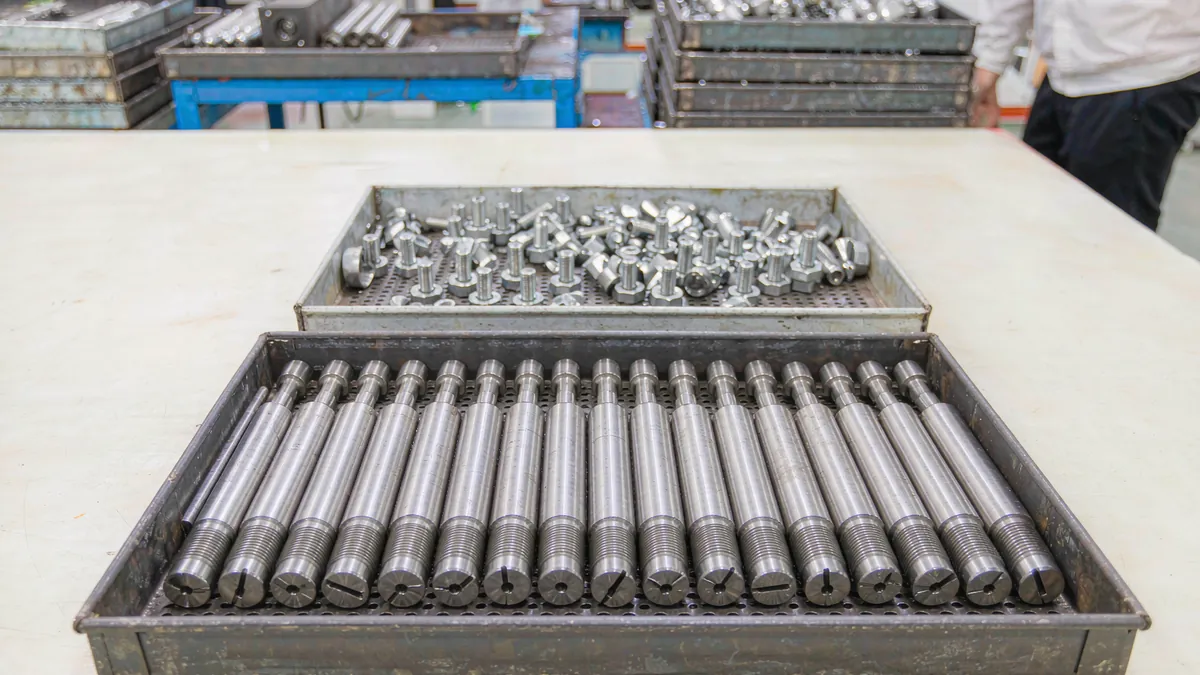
17-7 PH (UNS S17700, EN 1.4568, AISI 631, JIS SUS631) is a chromium-nickel-aluminium precipitation-hardening stainless steel named for its two defining elements: roughly 17 % chromium and 7 % nickel. Unlike 17-4 PH, which hardens directly from a martensitic structure, 17-7 is austenitic in Condition A — soft, only 200–230 HB, and readily stamped, deep-drawn or rolled. Strength is built in a second stage: the austenite is first converted to martensite (by intermediate conditioning at 760 °C in the TH route, by −73 °C refrigeration in the RH route, or by cold work in the CH route), then aged at 480–565 °C so that nickel-aluminium precipitates harden the structure. Final tensile strength spans roughly 1,140–1,690 MPa depending on the route chosen, with spring-quality strip reaching the top of that range.
| Element | Content (wt %) | Why it matters |
|---|---|---|
| Chromium (Cr) | 16.0–18.0 | Corrosion barrier — puts atmospheric resistance at 304-class level |
| Nickel (Ni) | 6.5–7.75 | Twice the nickel of 17-4: keeps the annealed structure austenitic and formable |
| Aluminium (Al) | 0.75–1.50 | The hardening element — Ni₃Al-type precipitates deliver the strength on ageing |
| Carbon (C) | 0.09 max | Kept low to avoid chromium carbides during the conditioning hold |
| Manganese (Mn) | 1.00 max | Deoxidation and hot-workability control |
| Silicon (Si) | 1.00 max | Deoxidation; kept moderate for oxide-free strip surfaces |
| Phosphorus / Sulfur | 0.040 / 0.030 max | Standard residual limits |
| Iron (Fe) | Balance | — |
Note what is absent: no copper, no molybdenum, no niobium. 17-7 gains nothing in pitting resistance from alloying — its corrosion performance is essentially a 16–18 % chromium austenitic steel, while all of its strength comes from the aluminium ageing reaction. That division of labour defines where the grade should and should not be used.
The condition is the specification. Published minimums also differ noticeably between ASTM A564 (bar), ASTM A693 (sheet/strip) and GB/T 1220 — the ranges below reflect that spread, so always order "condition + product standard" together:
| Condition | Tensile strength | Yield strength (0.2 %) | Elongation |
|---|---|---|---|
| Condition A — solution annealed (forming state) | ≤ ~1,030 MPa | ≈ 380–415 MPa | ≥ 20–35 % |
| TH1050 — condition at 760 °C, age 565 °C × 90 min | ≥ 1,140–1,170 MPa | ≥ 960–1,035 MPa | ≥ 5–7 % |
| RH950 — condition at 955 °C, −73 °C sub-zero, age 510 °C × 1 h | ≥ 1,230–1,520 MPa | ≥ 1,030–1,240 MPa | ≥ 4–6 % |
| CH900 — cold worked + aged 482 °C (strip and wire) | ≥ 1,650–1,690 MPa | ≥ 1,450–1,590 MPa | ≥ 1–2 % |
Hardness after ageing runs about 43 HRC in TH1050 and up to 44–49 HRC in RH950/CH900. Two practical readings of the table:
The spread between published RH950 minimums reaches roughly 25 % (1,230 vs 1,520 MPa) because the figures come from different product standards and test directions. On the purchase order, write the UNS number, the condition and the product standard (e.g. S17700, RH950 per ASTM A693) — a bare "17-7 PH RH950" lets the mill pick the weakest applicable book value.
| Property | Value |
|---|---|
| Density | 7.65 g/cm³ (a few datasheets list up to 7.8–7.9 depending on condition) |
| Melting range | ≈ 1,400–1,455 °C (some sources 1,390–1,450) |
| Thermal conductivity (≈100 °C) | ≈ 16 W/m·K (published 15.9–16.4) |
| Specific heat (0–100 °C) | ≈ 500 J/kg·K |
| Thermal expansion (20–100 °C) | ≈ 11 ×10⁻⁶ /K (some Chinese handbooks quote 15.3 over wider ranges — verify against the supplier datasheet) |
| Elastic modulus (room temp) | ≈ 200–204 GPa |
| Electrical resistivity | ≈ 0.80 µΩ·m |
| Magnetic behaviour | Non-magnetic in Condition A; magnetic after transformation + ageing |
With 16–18 % chromium and no molybdenum, copper or nitrogen, the pitting resistance equivalent works out around PREN ≈ 17 — 304-class. In practice this means:
Selection rule: if the medium is seawater, brine or acid, stop here — 17-7 buys you 304-class corrosion at three times the strength, nothing more. For high strength in wet chloride, the next steps are 15-5 PH (H1025/H1150), 13-8 Mo (H1000), or a duplex grade.
| Industry | Typical 17-7 PH components |
|---|---|
| Aerospace | Springs and spring washers, diaphragms and bellows, retaining rings, honeycomb sandwich panels, fasteners, hydraulic-line fittings |
| Precision instrumentation | Sensor diaphragms, Bourdon tubes, elastic elements in transducers, instrument springs |
| Oil & gas | Downhole tool springs, valve components, seal retainers in non-sour service |
| Chemical / food processing | Equipment structural parts and spring elements where 304-class media contact combines with high loads |
| Nuclear / power | Instrumentation and control-mechanism springs, retaining hardware |
| Medical (non-implant) | Surgical instrument springs, dental tool elements |
Supply conditions: Condition A (solution annealed) for customers who will form and harden themselves, or fully heat-treated TH1050 / RH950 / CH900 to order. Tell us the final condition when you enquire — aged properties are only guaranteed against the condition actually ordered.
Form first, harden last. All forming, machining and welding should happen in Condition A. The ageing step afterwards is a low-temperature treatment (480–565 °C) with very little distortion, so parts can be machined to near-final tolerance before hardening — a major cost advantage for thin, spring-like geometry that cannot be ground after ageing.
Procurement trap to avoid: ordering "17-7 PH" without a condition. Condition A material at 230 HB and TH1050 material at 43 HRC both answer to that name — the price differs, and so does the liability when a spring relaxes in service.
They encode the route to martensite plus the ageing temperature in °F: T = thermal conditioning, R = refrigeration (−73 °C), C = cold work; the number is the ageing temperature (950 °F ≈ 510 °C, 1050 °F ≈ 565 °C, 900 °F ≈ 482 °C). Higher ageing temperature means lower strength, better toughness; CH900 is strongest but ductility drops to 1–2 %.
Non-magnetic in Condition A (austenitic), magnetic once transformed and aged. A magnet check on delivered material is actually a quick verification that the heat treatment was done.
17-4 hardens from martensite directly, machines easily, and is the default for valve and pump parts up to H1150. 17-7 wins when you need to stamp, draw or roll a complex thin section first and harden it afterwards with minimal distortion — springs, diaphragms, bellows, retainers. Corrosion-wise both are 304-class; neither belongs in seawater.
Approximately 315–425 °C depending on condition — above that band the ageing phases over-age and strength decays. For long-term spring or diaphragm duty, stay below about 350 °C.
Because the minimum comes from different product standards and test directions: ASTM A693 sheet, ASTM A564 bar and GB/T 1220 publish different tables for the same condition. Insist on the product standard plus the condition on the PO, and check the mill certificate against both.
Send us your drawing or specification for a quotation — we reply within one business day.
Buy this grade as: Plate · Round bar · Seamless tube · Flanges

Browsing for a grade? The full library of per-grade technical guides is on one list.
Open the list
Which family fits which corrosion or temperature problem — and the selection rules that keep you out of trouble.
Read article
Traceability, honest heats, the documents to demand — and the red flags to walk away from.
Read article